
Who Controls the Strait of Hormuz?
No Iranian crude has been tracked loading for export since late August under the U.S. blockade. Iran has made passage dangerous and costly for everyone else. Neither can guarantee that an ordinary ship crosses safely.
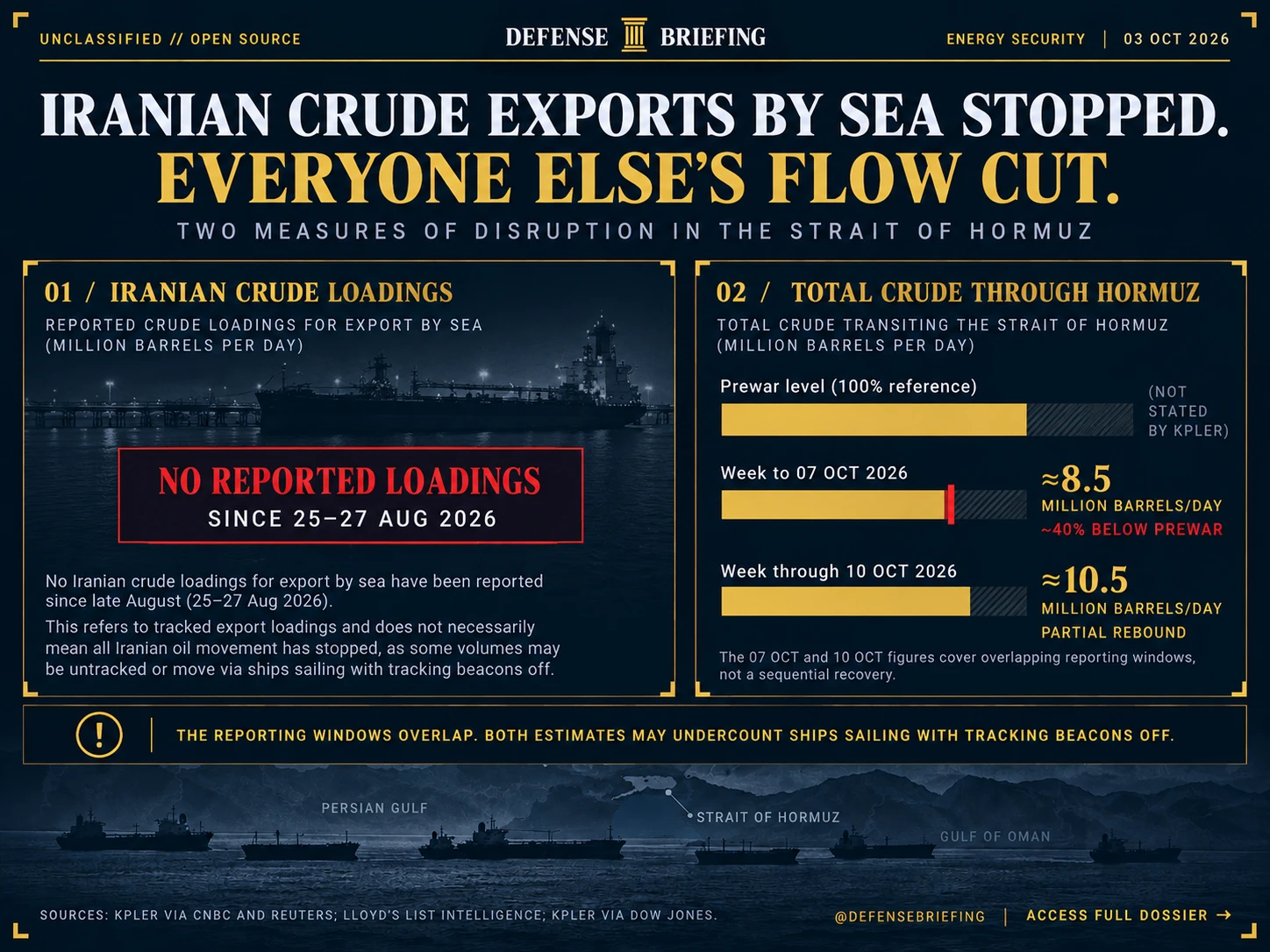
Two measures of disruption: Iran's own crude loadings and total crude through the strait. The two weekly flow figures cover overlapping windows. Graphic: Defense Briefing; data from Kpler and Lloyd's List Intelligence.
Bottom line
Two militaries say they control the Strait of Hormuz. The ship counts say each controls a different thing, and neither controls the whole waterway.
The United States has shown it can restrict Iran's seaborne oil exports. U.S. Central Command (CENTCOM), the military headquarters for the Middle East, says that since 14-JUL-2026 its blockade has turned back 135 ships, disabled four and destroyed 10 tankers linked to Iran's Islamic Revolutionary Guard Corps (IRGC).1 The ship-tracking firms Kpler and Lloyd's List report no tracked Iranian crude loaded for export since late August.2, 18
Iran is setting the cost of everyone else's passage. The IRGC publicly claims the attacks on non-Iranian shipping. Independent records confirm the strikes but not who carried out each one. Those attacks pushed visible transits to their lowest level in more than two months in early October, and crude oil flows through the strait fell to about 8.5 million barrels a day for the week to 07-OCT-2026, roughly 40% below prewar levels.2, 3 Kpler's later weekly estimate, about 10.5 million barrels a day for the week through 10-OCT-2026, is higher, but it covers an overlapping window and predates the 2.9 million barrels Kpler counted on 11-OCT-2026. It does not show a sustained recovery.47, 59, 68
The pace rose sharply over the weekend. Warnings from the U.K. Maritime Trade Operations center (UKMTO) show six ships struck on 11-OCT-2026 alone, and UKMTO issued four more attack warnings on 13-OCT-2026. Seatrade Maritime counts 24 UKMTO attack warnings and three advisories for the strait and nearby waters since 01-OCT-2026.44, 45, 64 Over the same weekend, Yemen's Iran-aligned Houthi movement struck Saudi airports and claimed hits on Saudi oil facilities.54, 57
Neither side's public claim matches that record. CENTCOM said on 07-OCT-2026, and again on 13-OCT-2026, that the United States and regional partners clearly control the strait.4, 68 Secretary of State Marco Rubio said the strait is open and that almost as much oil is leaving as before the war.43 U.S. Energy Secretary Chris Wright was reported as saying up to 14 million barrels a day pass through the strait, 80% to 90% of prewar levels.69, 76 An IRGC adviser said Iran has full control and the strait is closed.2, 43 Ships are still moving, ships are still being hit and oil flows remain well below prewar levels. The evidence supports none of these statements in full.
What control means
Control of a waterway is not one thing. Three separate abilities matter here, and they do not come as a package.
Three kinds of control
- • Economic denial: stopping an opponent's own trade. The evidence points to the United States here: since late August, trackers have recorded no Iranian crude loaded for export while the U.S. blockade has been in force.2, 18
- • Maritime disruption: making passage dangerous and costly for everyone else. Iran has shown this, through attacks it publicly claims, war-zone insurance prices and a two-month low in visible traffic.3, 43
- • Maritime security: guaranteeing safe passage for ordinary commercial ships. Neither side has shown this. Ships were struck on most days of the past week, and traffic has not returned to normal.
The first two are forms of military power. The third is what shipowners, insurers and oil buyers actually need. A navy can win any fight at sea and still be unable to promise that a tanker arrives undamaged. A weaker force can threaten shipping without being able to stop a determined navy. That gap is why both militaries can claim control, and why neither claim settles the question.
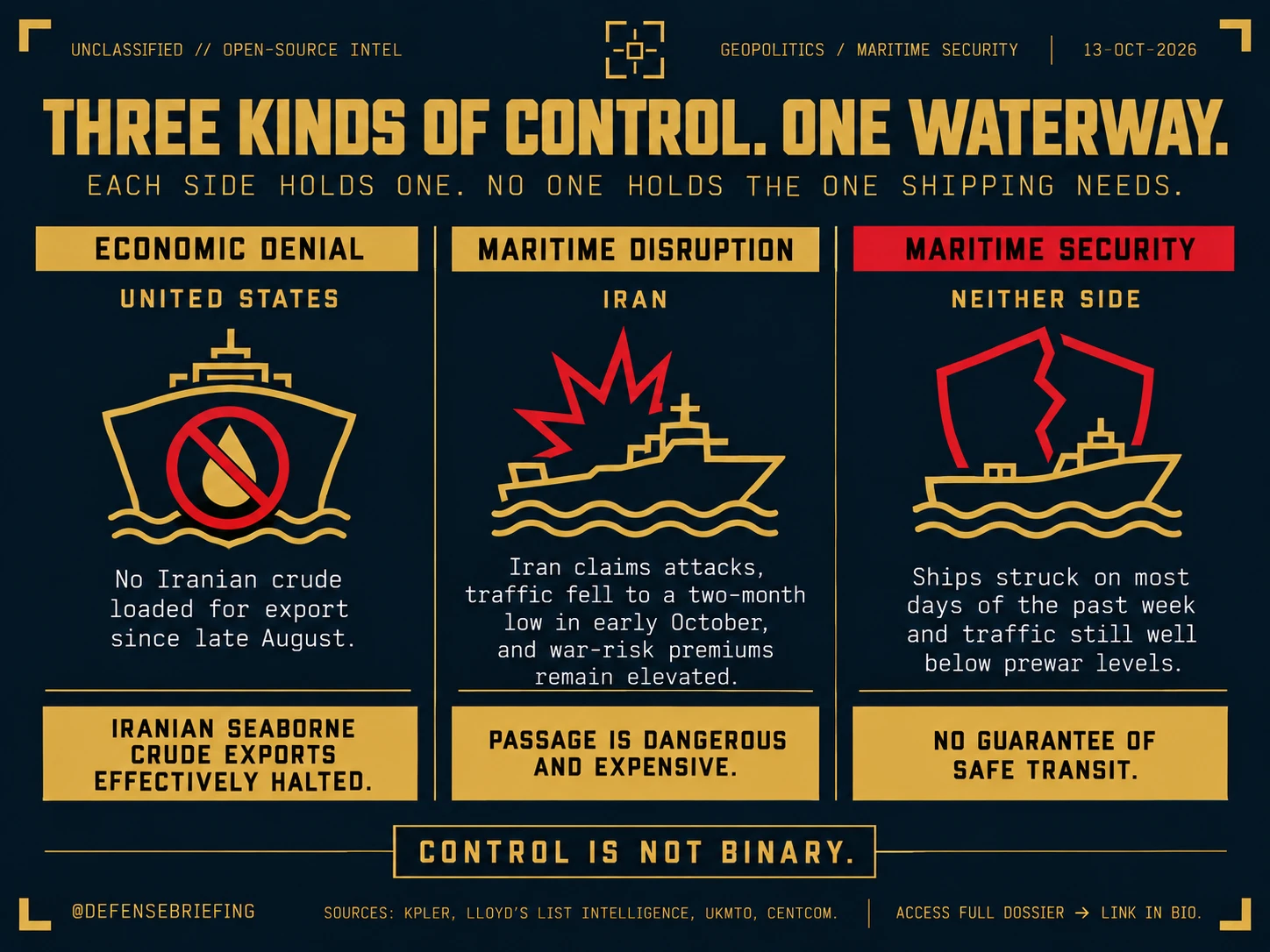
Each side holds one form of control. No one holds the one shipping needs. Graphic: Defense Briefing; data from Kpler, Lloyd's List Intelligence, UKMTO and CENTCOM.
Primary-source briefings on the chokepoints that move markets, every Wednesday.
Get Orbital Intel FreeThe evidence: ships and oil
On Tuesday, 06-OCT-2026, the tracker Kpler counted 7 commodity ships through the strait, the lowest since 23-JUL-2026.3 Data from the London Stock Exchange Group (LSEG) counted 8. U.S. Navy data on U.S.-facilitated transits, cited by the Joint Maritime Information Center (JMIC), averaged about 30 a day.3, 16 All three can be right, because they count different things in different ways. For scale, JMIC puts the 2025 average at about 138 ships a day.16
| Source | What it counts | Period | Figure |
|---|---|---|---|
| Kpler, via Reuters | Commodity ships visible on public tracking | 06-OCT-2026 | 7 ships3 |
| LSEG, via Reuters | Ships visible on public tracking | 06-OCT-2026 | 8 ships3 |
| U.S. Naval Cooperation and Guidance for Shipping, via JMIC | U.S.-facilitated transits only | 04 to 07-OCT-2026 | 120 transits, about 30 a day16 |
| Lloyd's List Intelligence | Transits by ships not linked to Iran | 28-SEP to 07-OCT-2026 | 143 transits18 |
The biggest reason for the gap is the automatic identification system (AIS). It is a radio beacon that broadcasts a ship's name, position and course so other ships can avoid collisions. Many commercial counts rely mainly on those broadcasts, although trackers can add satellite imagery, port records and inferred voyages. In a war zone, many captains switch AIS off so they are harder to find and target. Navies can still see those ships through radar, aircraft and direct radio contact. Kpler has not published the method behind this count. Reuters reported that it excludes ships sailing with AIS switched off.3
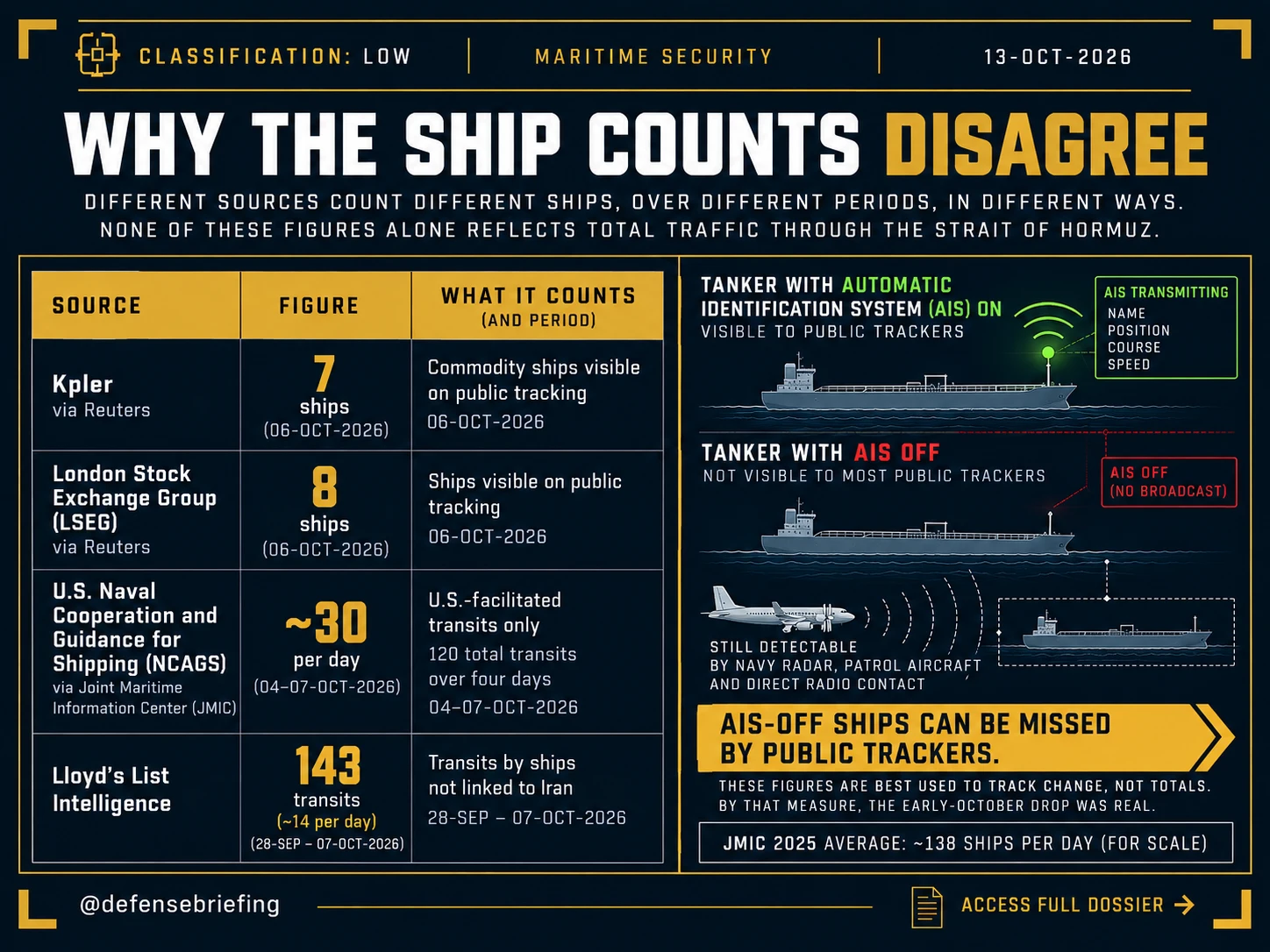
Different sources count different ships, over different periods, in different ways. Graphic: Defense Briefing; data from Kpler and LSEG via Reuters, JMIC and Lloyd's List Intelligence.
So figures that depend on AIS can undercount real transits, and false or duplicated signals can distort them in either direction. They are most useful for spotting change from one day to the next, measured the same way. By that measure the drop was real: Gulf oil exports topped prewar levels for about half of September, according to shipping data cited by Reuters, and early October fell to a two-and-a-half-month low.3, 62
Oil flow tells the same story. Kpler estimated crude flows of at least 10.1 million barrels a day in a note dated 06-OCT-2026, down 27% in a week. For the week to 07-OCT-2026 it estimated 8.5 million barrels a day, about 40% below prewar levels.2, 3 The two figures cover different windows and both may undercount for the same reason. A later Kpler estimate put crude flows at about 10.5 million barrels a day for the week through 10-OCT-2026. That window overlaps the earlier one, so the higher figure is not evidence of a sustained rebound.47, 59
Daily figures swing far more than weekly ones. Kpler data cited by Al Jazeera show about 20.8 million barrels passing on 08-OCT-2026 and only 2.9 million on 11-OCT-2026, the lowest daily figure of the month.68 Al Jazeera compares these with a prewar average of 17.1 million barrels of oil a day, a broader measure than the crude-only Kpler estimates above. A strait that carries more than 20 million barrels one day and under 3 million three days later is not under anyone's control in the sense shipping needs.
One tracked flow has stopped. Kpler and Lloyd's List both report no Iranian crude loaded for export since late August.2, 18 Tracking cannot rule out cargoes moved with AIS switched off, and the data do not by themselves show how much of the halt is due to the blockade. It is still the clearest available measure of what the blockade controls.
The week's escalation
UKMTO reported six ships struck on 11-OCT-2026 alone: five in or near the strait and one at the Sohar anchorage off Oman. One came in warning 164-26 that day. Five more came in warnings 165-26 to 169-26 on 12-OCT-2026, four of them late reports.7, 44, 45, 65 Separately, a U.S. aircraft disabled a cargo ship running the blockade on 10-OCT-2026.1 The table lists the main events documented in a UKMTO warning, an official statement or two independent sources. UKMTO does not name ships. Names supplied by private maritime security firms are marked as likely. Dates are when each attack happened, not when it was reported: four of the six strikes on 11-OCT-2026 were disclosed a day later. Times are in Coordinated Universal Time (UTC), the standard used in maritime security warnings.
| Date (UTC) | Event | Source |
|---|---|---|
| 13-OCT-2026 | Four ships hit by unknown projectiles: one tanker and three container ships. Vanguard Tech names them as the container ships GFS Pride, GFS Giselle and Al Saadiyat and the tanker Alfonso (likely). Unnamed maritime security sources told Reuters that the Singapore-flagged GFS Pride, managed from the UAE, has sunk; that report is unverified. The IRGC says an unnamed container ship carrying 2,500 containers sank after hitting a mine. | UKMTO via Seatrade Maritime; Reuters64, 66 |
| 11-OCT-2026 | Four more strikes disclosed in late UKMTO warnings on 12-OCT-2026: a crude oil tanker and a product tanker hit by unknown projectiles while leaving the strait, a third tanker hit while leaving with crew safe and a container ship hit while entering. Vanguard Tech names two of them as the Panama-flagged product tanker Kition M and the Bahamas-flagged Ever Vict (likely). | Seatrade Maritime; The National45, 43 |
| 11-OCT-2026 | At 1200, an outbound tanker in the strait was hit on its port (left) side by an unidentified projectile, with damage reported and crew safe. The security firm Vanguard Tech identifies it as the very large crude carrier Angola Prosperity, operated by Sinokor (likely). | UKMTO 164-267, 46 |
| 11-OCT-2026 | Tanker waiting at the Sohar anchorage off Oman hit by a drone. Local authorities evacuated the crew, and two Indian seafarers are reported missing. An Indian seafarers' union names it as the Nicaragua-flagged Petro Dolphin (likely). | UKMTO via Seatrade Maritime44 |
| 10-OCT-2026, 1920 | Outbound tanker in the strait hit on its port side by an unknown projectile. Fire reported, crew safe. Vanguard identifies it as the Marshall Islands-flagged tanker Valthera (likely). | UKMTO 162-266, 44 |
| 10-OCT-2026, 1850 | Several ship captains anchored off Ras Al Khaimah, United Arab Emirates (UAE), told by radio to leave their anchorages. UKMTO did not name the caller. The security firm Ambrey attributes it to the IRGC Navy. | UKMTO 161-2624, 25 |
| 10-OCT-2026 | A U.S. fighter jet struck the stern of the Panama-flagged bulk carrier Ocean Molica in the Gulf of Oman, disabling its propulsion. CENTCOM says the ship ignored repeated warnings after leaving an Iranian port. | CENTCOM; Al Jazeera1, 5 |
| 10-OCT-2026 | The UAE National Guard rescued 22 Asian crew members from a burning oil tanker in the Gulf. The UAE did not name the ship. | WAM via Khaleej Times13 |
| 07-OCT-2026, 1900 | Tanker hit 51 nautical miles north of Madinat ash Shamal, Qatar. UKMTO's first warning reported multiple projectiles and casualties; JMIC's later entry records three drones and one injured crew member. JMIC called it the first confirmed attack inside the Gulf since 09-SEP-2026. | UKMTO 158-26; JMIC15, 16 |
| 05-OCT-2026 | UAE-owned tanker On Peace hit by an unknown projectile while leaving the strait, logged by UKMTO as a late report (157-26). India's foreign ministry announced it on 06-OCT-2026. Twelve crew injured; Oman's Defense Ministry said it rescued 10.63 | International Maritime Organization (IMO); JMIC12, 16 |
Al Jazeera, citing UKMTO, counts 15 attacks from 06 to 14-OCT-2026, 11 of them in the last four days of that period.68 The bulk carrier Cape Dao, first hit on 23-SEP-2026, was also reported sinking near the strait, according to unnamed sources; that report is unverified.64, 66 Attacks continued into the week of publication: UKMTO reported another container ship struck by an unknown projectile in the strait on 14-OCT-2026.74
Iran's new tactics. Two unnamed senior Iranian officials told Reuters that Iran began using different offensive tactics against ships it considers in breach of its rules about 10 days ago. They said the aims include keeping oil prices high and influencing the outcome of the U.S. midterm elections, and gave no details. An unnamed U.S. military official told Reuters that the IRGC now uses unarmed spotters in small boats to identify targets, after U.S. strikes destroyed much of Iran's radar, and that U.S. forces destroyed one such dhow after ordering its crew to abandon ship.67 On 13-OCT-2026 Iran's navy said it had deployed new surveillance units east of the strait, across the Sea of Oman and into the Arabian Sea. It also warned ships not to switch off their AIS transponders.68 Both accounts come from unnamed officials and are unverified. The on-record element is the Iranian navy's statement on new surveillance units. If accurate, the accounts describe a force trying to keep a working hold on the strait without a navy that can contest the U.S. Navy at sea.
A second front: Saudi airports and oil sites. The weekend's deadliest attacks were not at sea. Yemen's Houthi movement, which is aligned with Iran but acts as a separate force, fired missiles and drones at Saudi airports through the week.58 On 10-OCT-2026 a missile struck Riyadh's King Khalid International Airport, killing at least 12 people and wounding more than 300, according to Saudi authorities. The toll later rose to 13.54, 56 More strikes followed, and a notice to airmen (NOTAM A3604/26) keeps the airport closed until at least 17-OCT-2026.55, 56, 60
On 11-OCT-2026 Houthi spokesman Yahya Saree claimed strikes on King Fahd International Airport in Dammam, which Saudi aviation authorities confirmed had been attacked, and on two facilities of the state oil company Saudi Aramco: the Shedgum gas plant and the Tanajib oil facility. Aramco has not commented.57
The Aramco claims matter for the strait. Saudi Arabia and the UAE have moved oil around Hormuz by pipeline, and the U.S. Energy Information Administration (EIA) reported attacks on Saudi Arabia's East-West pipeline in September.50 If oil sites in the Eastern Province, the center of Saudi production, become regular targets, the routes that avoid the strait come under pressure too. A strike hit Aramco's headquarters complex in Dhahran on the evening of 13-OCT-2026. The Saudi Energy Ministry reported a limited fire and no injuries.70, 73 Reuters, citing three unnamed sources, reported wider fire damage; that account is unverified.75 On 14-OCT-2026 the Houthis claimed the attack. They said they had fired ballistic missiles, cruise missiles and drones at Aramco facilities in Dhahran, Riyadh airport and an Aramco refinery in Riyadh, vowed further strikes and urged "international shipping companies," civilians and workers to evacuate Saudi airports and oil facilities. Saudi Arabia has not said who carried out the Dhahran strike, and the Houthi claim is unverified.72, 75 The Houthis describe their attacks as retaliation for Saudi strikes in Yemen. Late on 13-OCT-2026 the Saudi-led coalition struck energy sites in Houthi-held Yemen, including the Al Sabahah station in Sanaa and fuel-loading piers at Hodeidah, after warning civilians near the Sanaa site to leave. Coalition spokesman Maj. Gen. Turki Al-Malki said the Houthis use civilian facilities for their war effort.73, 75 The claimed hits on the Shedgum and Tanajib production sites remain unconfirmed.
UKMTO is the U.K. Maritime Trade Operations center, a Royal Navy office that collects reports from ship captains and security officers and issues warnings to shipping. Its warnings name the type of attack reported by the crew. They do not assign blame.
The disabled bulk carrier appears under three spellings: Ocean Molica in CENTCOM's release, Arika Sun in early reports and Akira Sun as its registered name. The ship-tracking database VesselFinder lists both Ocean Molica and Akira Sun under a single IMO hull number, 9139270: the ship broadcasts as Ocean Molica, and Akira Sun is its registered name.26 Arika Sun appears to be a misspelling. That number, not the name, is the reliable identifier.
India's shipping minister and its consulate in Dubai say the rescued crew came from the Panama-flagged tanker GEM No. 2, hit by a drone at Sharjah Anchorage on 09-OCT-2026 with 22 Indian sailors aboard.14 The crew count and nationality match the UAE statement. The UAE has not confirmed the name, and early reports place the ship in two different locations, so the identification remains likely rather than confirmed.
Every claim sourced. Every rating explained. Get the next ledger in your inbox.
Subscribe FreeThe claims ledger
Independent records now show more strikes than the IRGC claimed, but no public evidence yet supports its claim that mines caused them. UKMTO's warnings record crew reports of projectile or drone hits for every strike on 10, 11 and 13-OCT-2026.6, 7, 43, 64 A crew's report of an "unknown projectile" records what the crew saw or heard. It does not establish the weapon, since a crew may not be able to tell an underwater blast from an incoming strike, and it does not establish who fired it. The National reported that the shipping analyst Sal Mercogliano judged the IRGC's video did not appear to show a mine strike. His original comments have not been independently located.43
Each claim is rated by the evidence behind it. Multi-sourced means an official record plus at least one independent source, or two independent official records. A UKMTO warning repeated by several outlets counts as one source, a security firm's identification of a ship counts as identification, not corroboration, and unnamed sources never count as corroboration. Likely means one credible source with nothing contradicting it, or two opposing parties that agree. Possible means one party's claim only, including official tallies no one outside can check. Disputed means a party with direct knowledge, such as a ship's owner or crew, says otherwise, or independent data contradicts the claim.
A strike raises three separate questions: was a ship hit, who hit it and with what. The record answers them differently.
| Incident | Was a ship hit? | Who hit it? | With what? |
|---|---|---|---|
| 13-OCT-2026: four ships, including the container ship GFS Pride, reported sunk | for all four: UKMTO warnings record crew reports.64 The reported sinking of GFS Pride rests on unnamed maritime security sources and is unverified. Its manager could not be reached.64, 66 | Same basis as the 10 and 11-OCT-2026 strikes. The IRGC describes the sinking of an unnamed container ship on a route it calls unauthorized.8, 43, 64 | The IRGC says a mine. UKMTO records crew reports of unknown projectiles for all four ships. Neither account is forensically settled.64 |
| 12-OCT-2026: a third supertanker the IRGC says it set on fire, which analysts tentatively link to Al Maqam, a tanker of the Abu Dhabi National Oil Company (ADNOC) (unconfirmed) | Footage published by Tasnim, which is close to the IRGC, shows a tanker on fire. Analysts say its markings are consistent with ADNOC's Al Maqam, but the footage's date, location and link to the claim are unverified. ADNOC has not commented, and no UKMTO warning has been matched to it.45 | IRGC claim only | Not stated |
| 11-OCT-2026: six ships, five in the strait and one off Sohar, Oman | for five: UKMTO warnings only, repeated by other outlets.7, 43, 45 for the Sohar tanker: beyond UKMTO, local authorities evacuated the crew and an Indian seafarers' union named the ship.44 | The IRGC claims strikes on ships it says broke its rules, and the U.S. Navy-led JMIC attributes the pattern to Iran. No forensic attribution of any single strike has been published.8, 43 | The IRGC says mines. UKMTO records crew reports of projectiles for five and a drone for the sixth. The accounts conflict, and neither is forensically settled.7, 9, 43, 44 |
| 10-OCT-2026: outbound tanker, likely Valthera | UKMTO 162-26 only.6 | Same basis as above.8, 43 | The IRGC says a mine. UKMTO records a crew report of a projectile, and The National reports that one analyst saw no sign of a mine in the IRGC video. The evidence conflicts but is not forensically settled.6, 43 |
| 09-OCT-2026: liquefied petroleum gas carrier NV Sunshine | The owner, a unit of Vietnam's state oil company PetroVietnam, says the ship was not attacked.10, 11 | Not applicable | Not applicable |
The statements both sides made about the strait are rated the same way.
| Claim | Who made it | Rating | Why |
|---|---|---|---|
| A U.S. aircraft disabled the bulk carrier Ocean Molica in the Gulf of Oman on 10-OCT-2026 | CENTCOM | CENTCOM's release and video, plus a separate UKMTO notice of an incident involving military forces in the Gulf of Oman. That notice called the ship a tanker and gave no time. Wire reports relay CENTCOM and are not independent.1, 5, 46 | |
| The ship ignored repeated warnings after leaving an Iranian port, and no crew were harmed | CENTCOM | Official claim, independently unverified |
Reuters could not reach the operator.5 |
| Since 14-JUL-2026 the blockade has turned back 135 ships, disabled four and destroyed 10 IRGC-linked tankers | CENTCOM | Official claim, independently unverified |
The U.S. has not listed which ships it struck. The 05-OCT-2026 release counted 13 commercial vessels destroyed, a broader category that includes ships running the blockade.1, 17 |
| Traffic in the strait was carrying 20 million barrels of crude oil | CENTCOM, 07-OCT-2026 | Official claim, independently unverified |
The post said the oil was moving "right now," which reads as cargo aboard ships at one moment, not a daily rate. It cannot be compared with Kpler's daily flow estimates.4, 51 |
| The United States and regional partners clearly control the strait | CENTCOM, 07-OCT-2026 | Contrary evidence |
UKMTO reported six ships struck on 11-OCT-2026 alone, four days after this statement.7, 44, 45 |
| American forces and regional partners clearly control the Strait of Hormuz | CENTCOM, 13-OCT-2026 | Contrary evidence |
UKMTO issued four attack warnings the same day.64 |
| More than 19 million barrels of crude moved through the strait with U.S. help on 12-OCT-2026 | CENTCOM, 13-OCT-2026 | Official claim, independently unverified |
A one-day figure for U.S.-assisted shipping. Kpler counted 2.9 million barrels the day before. The two measure different things and cannot be compared directly.68 |
| The strait is open and almost as much oil is flowing as before the war | Secretary of State Marco Rubio | Contrary evidence |
Kpler estimates crude flows about 40% below prewar levels for the week to 07-OCT-2026.2, 43 |
| Up to 13 to 14 million barrels a day pass through the strait, 80% to 90% of prewar levels (as reported; no transcript found) | Energy Secretary Chris Wright, 12-OCT-2026 | Contrary evidence |
Reports differ on whether his 80% to 90% figure covered the strait alone or all Gulf crude, and The National suggests his broader estimate includes bypass pipelines. If so, that part is not directly comparable with strait-only data. Both reports, however, attribute to him a strait figure of about 13 to 14 million barrels a day, and Kpler data cited by The National put Hormuz oil exports slightly under 9 million barrels a day in September, about 44% of February's 20.6 million. The rating applies to that strait figure.69, 76 |
| The strait is closed and under Iran's full control | IRGC adviser Mohammadreza Naqdi, via Fars | Contrary evidence |
Commercial transits continued every day of the week.2, 3 |
| Ships sailing with tracking systems switched off will be treated as hostile, and IRGC action is no longer limited to the strait | IRGC, via PressTV | As Iran's stated position |
A policy statement, not an event, published by Iranian state media and repeated by Iran's navy on 13-OCT-2026. The drone strike off Sohar on 11-OCT-2026 fits the warning, but no one has formally attributed it.8, 10, 44, 68 |
| Iran and Oman agreed on coordinates for safe shipping routes | Iranian Foreign Ministry spokesman Esmaeil Baghaei, via the Islamic Republic News Agency (IRNA) | No Omani confirmation found. Iran announced the same agreement on 05-AUG-2026 and said a joint statement was nearly final. None has been published.33, 34, 35 | |
| The tanker whose 22 crew the UAE rescued was GEM No. 2 | India's shipping minister and Dubai consulate | Crew count and nationality match, and independent outlets report the drone strike. The UAE has not named the ship.14, 43 |
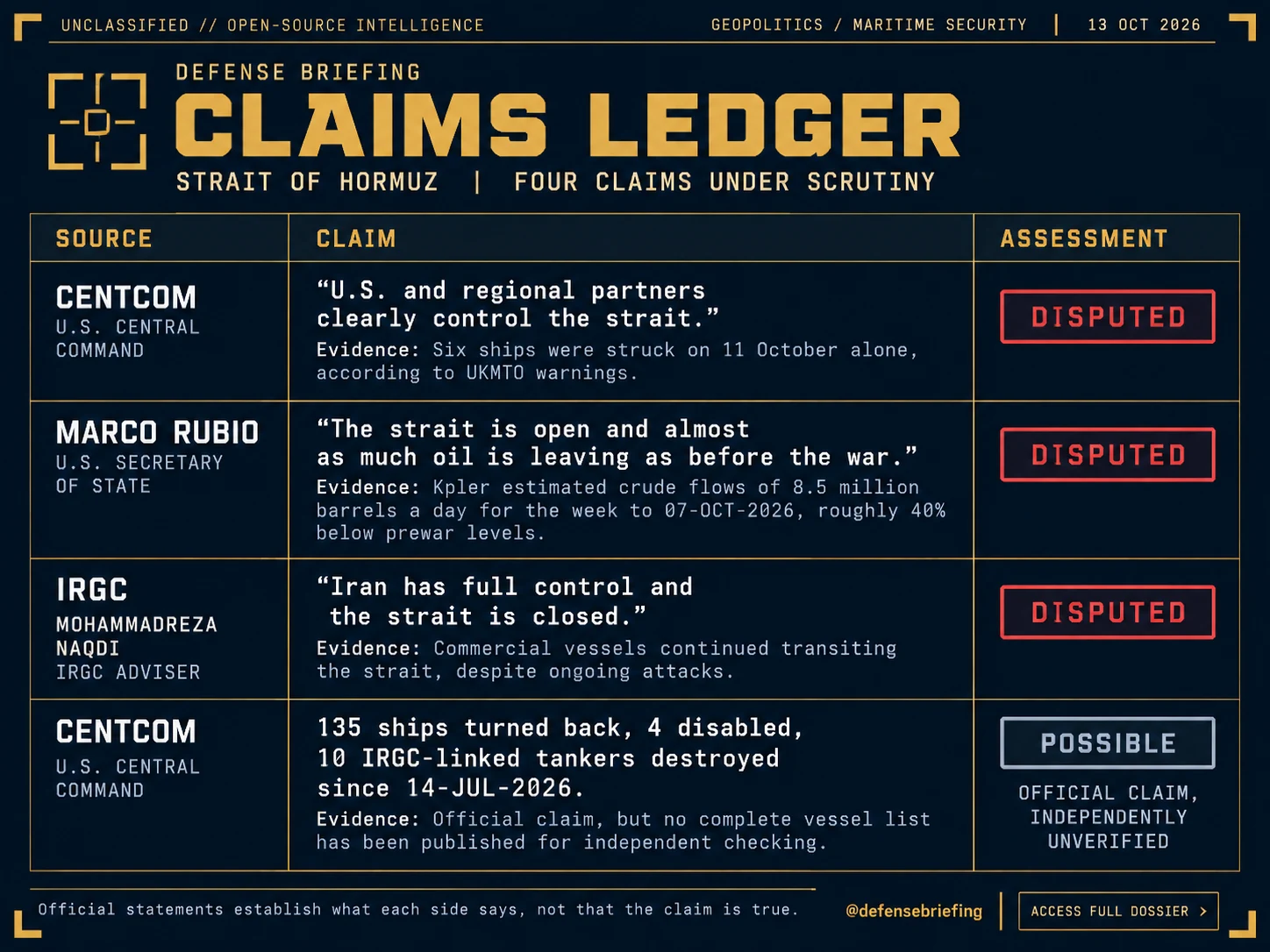
Official statements establish what each side says, not that the claim is true. Graphic: Defense Briefing; sources: CENTCOM, UKMTO, Kpler and IRGC statements as cited above.
The sources on Iran's side need labels. PressTV, Islamic Republic of Iran Broadcasting (IRIB) and IRNA are Iranian state media. Tasnim and Fars are close to the IRGC. Sepah News is the IRGC's official outlet, and Mehr is semi-official. Defense Briefing uses them as the record of what Iran's government says, not as confirmation that it happened.
Most IRGC strike claims name no ship, so no owner or crew can confirm or deny them. The NV Sunshine claim was the exception, which makes it the best available test of how far the IRGC's word can be trusted: the owner publicly denied any attack.11 That does not prove the later claims false. It does mean an IRGC claim alone is not evidence of a strike.
"A navy can win any fight at sea and still be unable to promise that a tanker arrives undamaged."
CENTCOM's numbers deserve the same scrutiny. Its releases have counted 130 ships redirected on 05-OCT-2026, 133 on 09-OCT-2026 and 135 on 10-OCT-2026, a steady and plausible climb.1, 17, 49 Its destroyed-vessel figures use different categories from one release to the next, and none names the ships. The U.S. figures are official, but they are not independently checkable.
Built for the people who price risk before the headlines catch up.
Get Orbital Intel FreeThe price of passage
Whoever is firing does not need to stop every ship to shape the market. Making each transit expensive and uncertain is enough, and insurance, freight and oil prices show that it has worked.
Insurance. Ships crossing a war zone buy extra coverage called war-risk insurance, priced as a share of the ship's value for each voyage. Unnamed insurance brokers quoted by the Financial Times on 07-OCT-2026 put that cost at 6% to 10% of a ship's value, or up to about $20 million for a very large crude carrier (VLCC) entering the Gulf. A VLCC carries about 2 million barrels.52 These are unnamed brokers' quoted ranges, unverified, not published rate sheets or premiums known to have been paid. Other estimates vary: a Morningstar DBRS analyst put current rates at 7.5% to 10%, and in July a broker quoted by The National put the range at 3% to 10%. Both put the prewar rate at about 0.25%.19, 53
Freight. The Baltic Exchange benchmark for a VLCC carrying crude from the Gulf to China reached a record equivalent to about $1.41 million a day.20 That figure measures what a shipowner would earn per day on the route. It is not a fee charged directly to refiners. Higher freight raises the delivered cost of oil, but how much reaches fuel buyers depends on contracts and markets.
Oil. Brent crude, the main international oil benchmark, settled at $104.72 a barrel on 09-OCT-2026.21 It dipped in early Asian trading on 12-OCT-2026 after President Trump announced a Russia-Ukraine "energy ceasefire" that neither government confirmed.22, 23 It then rose 1.8% to settle at $106.65, its highest close since 15-SEP-2026, in the first full session after the Houthi strikes on Saudi airports and the claimed hits on Aramco facilities, and Ukrainian President Volodymyr Zelenskyy also said Russia was still striking energy sites.48, 57, 61 Khaleej Times reported that oil prices rose after the attacks on Saudi Arabia.60 Brent eased slightly early on 13-OCT-2026, closed that day at $105.69 and traded near $106 early on 14-OCT-2026.61, 68 Oil prices respond to many developments at once, so no single move here can be tied to one cause. The EIA reported that Brent averaged $114 in September and forecast an average of $105 for the last three months of 2026.50
Higher energy prices are now visible in U.S. consumer prices. The Bureau of Labor Statistics reported on 14-OCT-2026 that the Consumer Price Index rose 0.6% in September and 3.7% over 12 months. Gasoline rose 9.1% in the month, which the bureau said accounted for over half of the monthly increase, and energy prices were up 20.4% from a year earlier.71 The release does not separate how much of that comes from the strait.
Why mines versus projectiles matters
Whether a ship was hit by a mine or a projectile changes the questions investigators ask, the defenses that work and how long the danger may last. The answer is not always simple, but it matters.
A naval mine is an explosive left in the water. Older contact mines go off when a hull touches them. Modern mines can use sensors that detect a ship's magnetic field, sound or water pressure, and some can be set to let small vessels pass and wait for larger ones. A mine stays dangerous after the ship that laid it leaves, and clearing one takes minehunting ships, sonar and divers. A mine does not automatically close a shipping lane, but even a suspected minefield can halt traffic until it is swept.
A projectile, such as a missile, drone or rocket, needs someone to fire it at that moment from within range. That does not make the shooter easy to identify. Launchers can move, drones can fly long distances and attribution of attacks in the Gulf has often been contested and slow. Projectile damage can also land near or below the waterline, depending on the weapon.
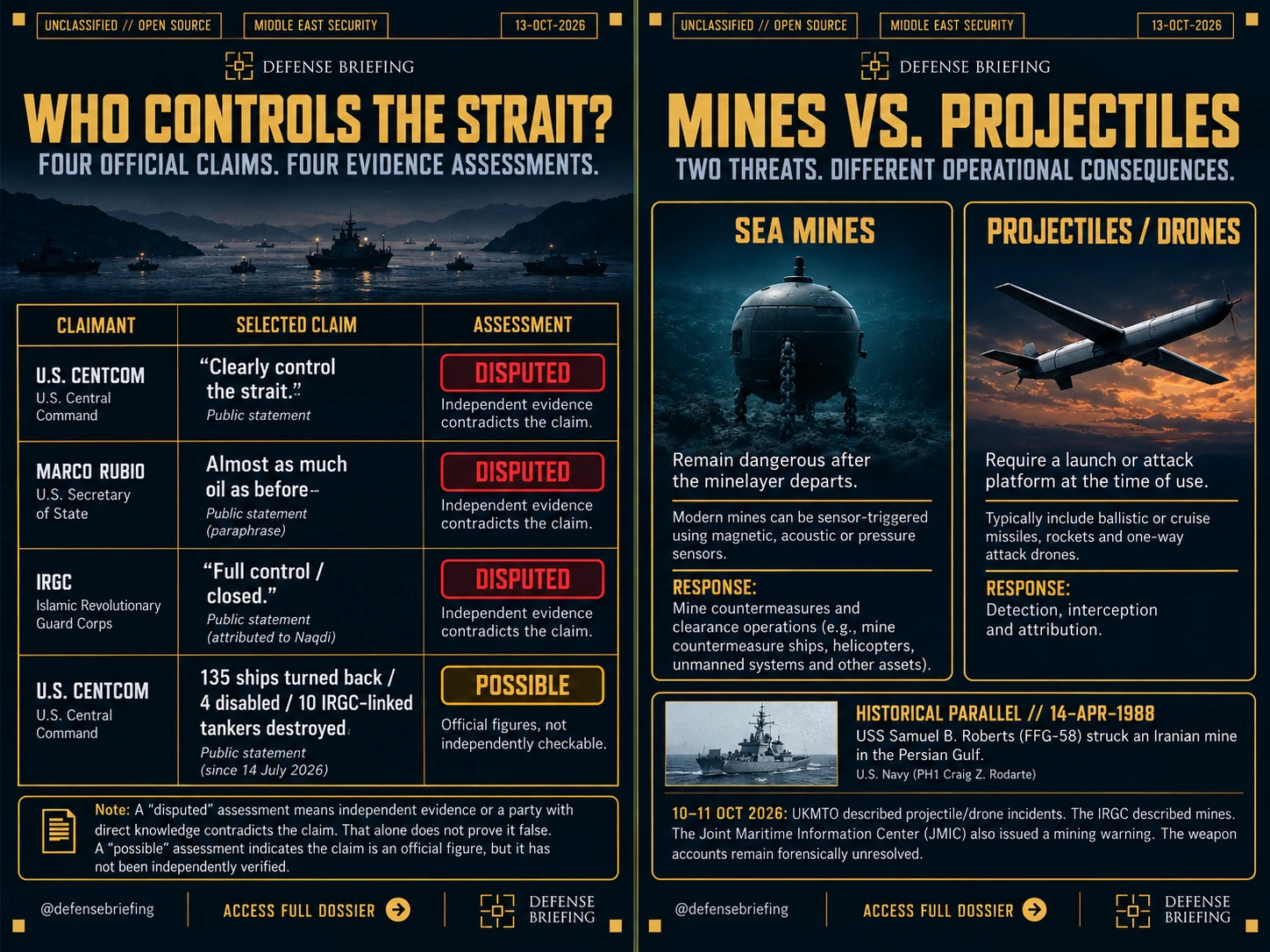
Two threats with different operational consequences. The weapon accounts for the 10 and 11-OCT-2026 strikes remain forensically unresolved. Graphic: Defense Briefing; sources: UKMTO, JMIC and Naval History and Heritage Command.
The region has been here before. On 14-APR-1988, during the Iran-Iraq War, the U.S. frigate Samuel B. Roberts struck an Iranian mine in the central Persian Gulf. The blast tore a 15-foot hole in the hull and broke its keel, and the crew kept it afloat.37, 38 Four days later the U.S. Navy struck Iranian warships and offshore bases in an operation called Praying Mantis.37, 39 The year before, the reflagged Kuwaiti supertanker Bridgeton hit a mine while under U.S. escort, exposing how few minehunting ships the Navy had in the Gulf.39
Why would the IRGC describe as mine strikes attacks that crews reported as projectile hits? The record does not say. One possible reason, which is inference and not established fact: a mine claim fits Iran's stated position that ships leaving its approved route are in danger, without admitting that a specific ship was deliberately targeted. The question is testable, but not by a single clue. Security firms have named the tankers hit on 10 and 11-OCT-2026 as Valthera and Angola Prosperity.44, 46 Settling what struck them would take forensic examination of the hull damage and any recovered fragments. None has been published. The National reports that one outside analyst saw no sign of a mine in the IRGC's video.43 Mining is still a live risk: the U.S. Navy-led JMIC advises mariners to stay vigilant for attempted mining in and near the shipping lanes.16
The law in brief
Two bodies of law bear on the strait, and they overlap rather than operate as alternatives. Peacetime law of the sea protects ships passing through. The law of naval warfare governs blockades during an armed conflict. Whether any particular action is lawful depends on facts the public record does not settle, including the legal status of the conflict, how the blockade is enforced and its effects on neutral shipping.
Peacetime rules. The strait is about 21 nautical miles wide at its narrowest, so every ship passes through Iranian or Omani territorial waters.28 The United Nations Convention on the Law of the Sea (UNCLOS) gives all ships a right of "transit passage" through international straits, and Article 44 says that right may not be suspended.28 Iran signed the convention in 1982 but never ratified it. When signing, Iran declared that transit passage is a right only for countries that have joined the treaty, and that it would apply older, narrower rules to everyone else.28, 29 The United States has not joined the convention either, but treats its navigation rules as binding custom and rejects Iran's position.30 Oman has ratified it.28 That right governs ordinary passage. Whether a particular wartime measure, such as the U.S. blockade or an attack on a ship, is lawful is a separate question decided under the law of naval warfare below.
Wartime rules. The law of naval warfare allows a country in an armed conflict to blockade an enemy's coast. The most cited guide is the San Remo Manual of 1994, written by legal and naval experts. It is an influential restatement of the law, not a treaty, and its individual rules do not all carry the same legal weight.42 It says a blockade must be declared, actually enforced, applied equally to ships of every country and must not cut off access to the ports of neutral countries. It also describes when force may be used against a neutral merchant ship believed to be breaking a blockade.40, 41, 42
That framework explains why the U.S. blockade targets ships going to or from Iran rather than closing the strait to everyone. The United States presents the Ocean Molica strike as blockade enforcement.1 Iran's envoy to the United Nations calls the blockade an act of aggression that violates the UN Charter's ban on the use of force.32
Iran presents its own actions as enforcement of approved routes through its waters, and the IRGC has rejected Oman's alternative corridor as unsafe.8, 27, 36 That position rests on Iran's reading of the convention, which the United States rejects. Iran has not publicly set out a legal basis for attacks on ships bound for neutral ports such as those of the UAE, Qatar and Oman. No court or international body has ruled on either side's conduct in this war, and the public record does not establish a settled legal entitlement for either side.
Plain language. Primary sources. No hype. Free every Wednesday.
Subscribe FreeWhat to watch next
The next week's evidence will test both sides' claims more than any new statement will.
- Forensic findings on Valthera and Angola Prosperity. Hull damage patterns and recovered fragments would test the IRGC's mine claims against UKMTO's projectile reports.6, 7, 44, 46
- The two missing seafarers and the Sohar strike. Any formal attribution of the drone attack off Oman would test whether IRGC action has moved beyond the strait, as it warned.10, 44
- The political calendar. President Trump said on 08-OCT-2026 that the United States would not attack Iran before the 03-NOV-2026 midterm elections and that the blockade remains in full force.25 The Treasury Department added 17 vessels to its sanctions list the same day.31
- The 12-OCT-2026 supertanker claim. Confirmation or denial from UKMTO or the operator will add one more data point on the IRGC's accuracy.43, 45
- A CENTCOM list of the ships it has destroyed. Naming them would make its totals checkable.1, 17
- Oman's position. An Omani statement confirming or denying the route agreement Iran has now announced twice would show whether a negotiated corridor exists.33, 34
- Transit counts measured the same way. A week of daily Kpler or Lloyd's List figures will show whether early October was a dip or a new floor.3, 18
- Insurance and freight. Falling war-risk premiums would be the clearest market signal that shipowners believe the danger is easing.20, 52
- Saudi airports and Aramco. Confirmation or denial of the claimed hits on the Shedgum and Tanajib facilities, and the reopening date for Riyadh's airport, will show whether the Houthi campaign is reaching the routes that bypass the strait.56, 57
The Angle
The evidence points to overlapping but incomplete control: Iran's tracked crude exports by sea have stopped under the U.S. blockade, Iran has made passage dangerous and costly for everyone else and neither can guarantee that ordinary ships cross safely.
The decisive test is not what either military declares. It is whether tankers and cargo ships can pass consistently, safely and at a cost the market can sustain. By that test, no one controls the strait today. The signals in the list above will show which way that changes first.
Forward this to the person on your team who prices Gulf shipping risk.
Sources: U.S. Central Command releases; UKMTO warnings and advisories; the Joint Maritime Information Center advisory; U.S. Treasury, Energy Information Administration and State Department documents; Naval History and Heritage Command records and UN treaty records, supplemented by Kpler and Lloyd's List Intelligence shipping data, legal commentary and reporting from Reuters, CNBC, Dow Jones, The Wall Street Journal, Al Jazeera, CNN, The National, Seatrade Maritime and others. Iranian state and IRGC-affiliated outlets are cited as the record of Iranian government statements, not as confirmation. The numbered list below is authoritative. No classified information was used and all material is publicly accessible.