
The Wolfpack Files for IPO
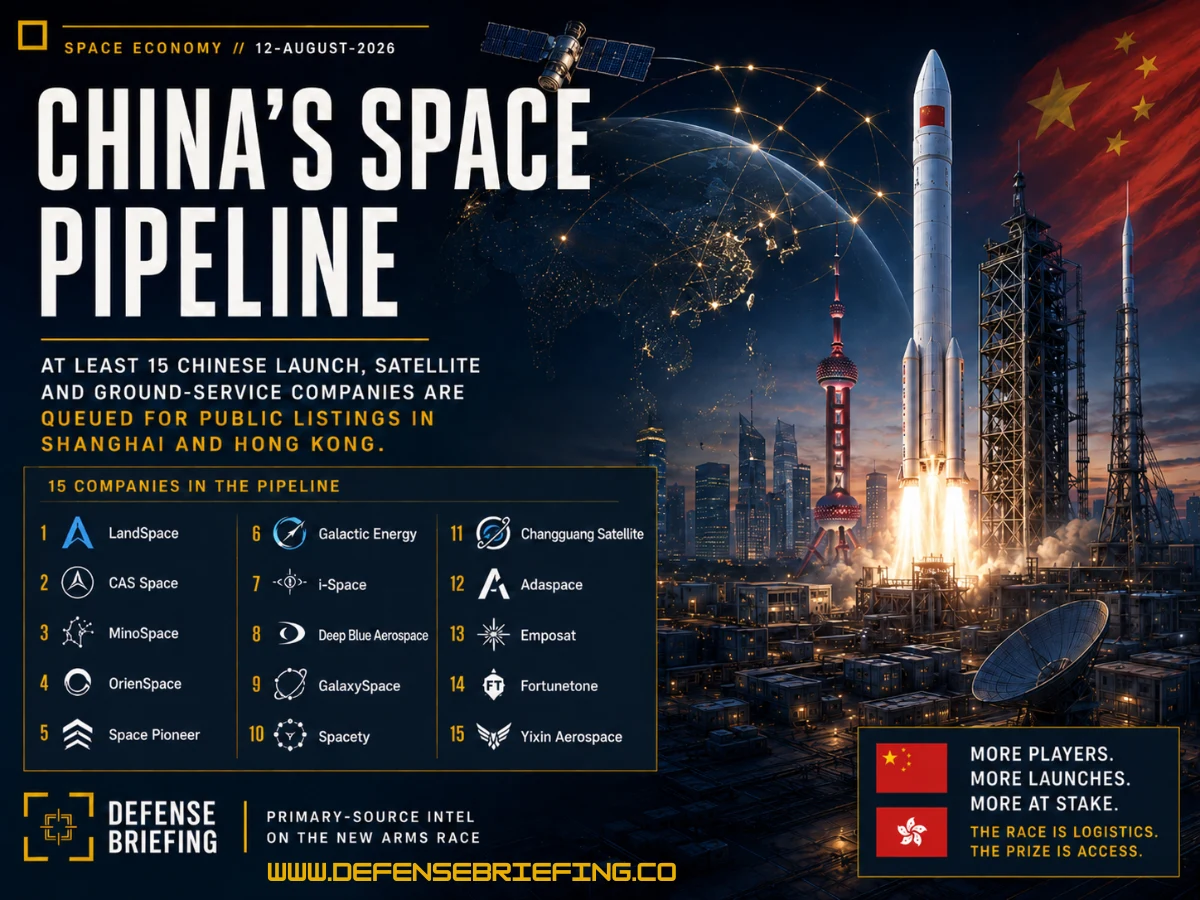
At least fifteen Chinese launch, satellite and ground-service companies are filing for public listings in Shanghai and Hong Kong. The pitch is that the funding will secure Chinese launch cadence. Beijing is not trying to build a single Chinese SpaceX. Beijing is purchasing industrial-scale redundancy and funding it with public equity.
Wolfpack vs. Megalodon: the capital and cadence gap between SpaceX and China's IPO cohort. Graphic: Defense Briefing. Data: company prospectuses, SSE, SEC filings.
China wants its own SpaceX. But that is not possible due to the huge lead Elon Musk's company has developed over every other company and country.
The Chinese language has a phrase for this kind of undertaking: 知其不可而为之 (zhi qi bu ke er wei zhi): the act of pursuing a goal despite knowing it may be impossible, motivated by strategic conviction rather than confidence in success. Closing the gap with a company that attempted 181 orbital launches last year,1 against China's national record of 92, is precisely that kind of project. The Shanghai Stock Exchange has just been handed the invoice.
At least fifteen commercial firms specializing in launches, satellites and ground services are now lined up for public listings in Shanghai and Hong Kong. LandSpace alone is seeking to raise 7.5 billion yuan ($1.1 billion) against 36.4 million yuan in revenue in the first half of 2025 and a net loss of 614 million yuan over the same period.2 This is a financing vehicle for optionality, and the option being purchased is national launch capacity.
Welcome to Orbital Intel, presented by Defense Briefing. Every Wednesday, you receive the week's defense, aerospace and space economy signal in plain language. Primary sources. No hype. Built for analysts, operators and the curious.
Today's headlines are rarely new. They're sequels. We deliver the prequels.
China's Space IPO Wave in 30 Seconds
- • China executed 92 orbital launch attempts in 2025 (national record); the U.S. executed 181, mostly via SpaceX.
- • China expanded the STAR Market's Fifth Listing Standard to commercial space in JUN-2025. Shanghai issued commercial-rocket eligibility rules on 26-DEC-2025; the new rules went live on 12-JAN-2026.
- • At least 15 companies across launch, satellites and ground services are now queued for listing, seeking a combined ~$3 billion.
- • Two megaconstellations, Guowang (~186 satellites) and Qianfan (200+), are driving launch demand that state vehicles alone cannot absorb.
- • Commercial launch capacity has military value even when it carries no military payload: shifting broadband missions away from the state fleet frees scarce national launch capacity for reconnaissance, warning and other government missions.
- • No Chinese company has yet demonstrated reusable reflight. LandSpace's filing gives itself three years to reach a milestone that took SpaceX five.
Forty-Eight Hours
Over the 48 hours preceding publication, China's space program absorbed two blows. On 10-AUG-2026 a Long March 7A carrying the ChinaSat-4B communications satellite suffered a flight anomaly roughly 85 seconds after liftoff from Wenchang and broke apart, destroying the payload. Chinese state media said an official investigation began immediately and that the cause remained under analysis.3 It was the country's fourth launch failure of the year in 56 attempts. LandSpace's Zhuque-3 Y2 orbital flight and first-stage recovery attempt, previously expected in early August, was postponed to late August 2026 for undisclosed reasons.
Chinese authorities have not identified a root cause. Early tracking data and long-wave infrared footage circulating among observers suggest the vehicle may have broken near its upper section around maximum aerodynamic pressure, or Max-Q, a pattern that raises structural failure or extreme high-altitude wind shear as possibilities rather than an immediate engine explosion. That assessment remains unconfirmed. The propulsion question still matters because the YF-100 liquid-oxygen/kerosene engine is used across the Long March 5, 6, 7 and 8 families. If investigators trace the anomaly to a shared YF-100 component or a broader quality-control flaw, the consequences could extend across several launch families, putting high-priority manifests such as Chang'e 7 and Guowang deployments at risk. If the failure is isolated to Long March 7A structural dynamics, the broader fleet is more likely to avoid a prolonged pause.3 For Defense Briefing's visual breakdown of the failure and the fleet-level implications, see the companion briefing on Instagram.
These events highlight short-term reliability and scheduling pressures on an ambitious program. They do not point to a fundamental crisis. Not yet.
The Fifth Standard
The enabling instrument is a listing rule. China expanded the STAR Market's Fifth Listing Standard to pre-profit hard-technology issuers, including commercial space, in JUN-2025. Shanghai then issued commercial-rocket eligibility rules on 26-DEC-2025. The new rules went live on 12-JAN-2026.4
A rocket company no longer needs to reach profitability before raising public equity. It need only demonstrate successful orbital insertion with a medium-to-large reusable vehicle; after that, it can turn to retail and institutional investors to finance the decade of development that follows. Bank lending generally will not accumulate enough funding for a launch program, nor will short-duration venture capital. Public markets can, and Beijing has decided to open that door.
This is a deliberate policy choice about who bears the risk. The state is not writing the check. It is opening a door and inviting domestic savers to walk through it. In June 2026 the CSRC expanded the Fifth Standard further to cover artificial intelligence, quantum technology and biomanufacturing, confirming that the listing track is a living policy instrument, not a one-off carve-out for space.5
Primary-source defense intelligence, delivered free every Wednesday.
Get Orbital Intel FreeWhat the Capital Buys
One thing. Launch cadence.
China executed 92 orbital launch attempts in 2025, a national record. It has set a target of roughly 140 orbital launches for 2026.6 Meanwhile the United States executed 181 orbital launch attempts in 2025, the large majority via SpaceX's Falcon 9.1 Two Chinese programs are absorbing most of the available capacity.
Guowang, operated by China SatNet, stood at approximately 186 satellites in orbit after the 04-AUG-2026 Long March 8A mission from Wenchang. China SatNet's 2026 target is 310 satellites. Closing the remaining gap requires roughly 124 additional spacecraft in under five months. The subsequent plan calls for 900 satellites in 2027 and 3,600 annually from 2028 onward, set against the International Telecommunication Union (ITU) requirement to field roughly 6,500 spacecraft by 2032 to retain spectrum rights.8 Guowang's filing covers 12,992 satellites; 50 percent is 6,496, which secondary sources round to "roughly 6,500."
Qianfan, the Shanghai-backed commercial rival, surpassed 200 satellites after its June 2026 launches and overtook Guowang in the process.9 That reversal is perhaps the more instructive data point. The commercially structured constellation is outpacing the national champion on deployment pace, an outcome that validates the case for funding multiple competitors rather than a single national program. If the wolfpack thesis has a proof of concept, it is Qianfan beating Guowang to 200 with a smaller budget and a shorter operational history. Qianfan had suspended deployments in late 2025 following thruster and attitude-control anomalies on orbit; it resumed in April 2026 and has maintained batch launches since.
Together the two programs accounted for an estimated 45 launches in 2025 and are projected to require more than 70 in 2026. Long March expendable vehicles cannot absorb that demand without displacing crewed, lunar and national-security missions. The IPO wave exists to generate the additional lift capacity the state manifest cannot spare.
The Fifteen
Four companies have advanced far enough that their filings are readable documents rather than statements of intent.
LandSpace is the closest structural analogue to the reusable-launch side of SpaceX, but it is far from an equivalent. Its STAR Market application was accepted on 31-DEC-2025 and moved to the inquiry stage on 22-JAN-2026; the prospectus was updated 29-JUN-2026. The planned raise is 7.5 billion yuan, directed at production scale-up and the methane-liquid-oxygen Zhuque-3. Between 2022 and mid-2025 the company spent more than 2.2 billion yuan on research and development. Profitability is projected for 2029. LandSpace has also secured formal launch contracts for both the Guowang and Qianfan constellations, positioning Zhuque-3 as a core vehicle for megaconstellation deployment.2
CAS Space is the most institutionally embedded of the group. Founded in 2018 and incubated by the Institute of Mechanics at the Chinese Academy of Sciences (CAS), it is seeking 4.18 billion yuan to fund reusable heavy-lift vehicles, spacecraft and liquid engines. The application reached the inquiry stage in April. Revenue rose from 5.95 million yuan in 2022 to 244 million in 2024; accumulated losses over the same window reached 2.5 billion yuan. The filing projects profitability in 2029 under optimistic and neutral assumptions and in 2030 under conservative ones.10
The prequels to tomorrow's headlines. Free, every Wednesday.
Subscribe FreeMinoSpace supplies the complementary half of the industrial equation. It does not build rockets; it builds the satellites that justify launch cadence, together with ground stations, tracking and data services. Its STAR Market application was accepted on 11-MAY-2026 and moved to the inquiry stage on 25-MAY-2026, with a planned raise of roughly 5 billion yuan. Revenue reached approximately 385 million yuan in 2025, with net losses narrowed to 181 million yuan. The revenue path from 2023 to 2025 (51.1 million yuan, then 40.0 million, then 385 million) reflects the timing of large contract recognition against a reported backlog that includes a major provincial remote-sensing constellation order. Five customers accounted for 92.33 percent of 2025 revenue. Founder Gao Enyu holds 4.42 percent of the equity directly and controls 67.50 percent of the voting rights through four partnership vehicles and concert-party agreements. Outside capital will finance the company; it will not control it.11
Orienspace closed a pre-C financing round on 05-AUG-2026 and has entered IPO coaching, with a shareholding restructuring still required before formal filing. Proceeds are directed at Gravity-2, a two-stage reusable kerosene-liquid-oxygen vehicle rated at 21,500 kilograms to low Earth orbit (LEO) when expended and approximately 17,000 to 17,400 kilograms with first-stage recovery. Vehicle height is 70 meters. Orienspace is aiming to have Gravity-2 ready for launch in Q4 2026.12
Behind them, the field.
| # | Company | Role | Listing Stage |
|---|---|---|---|
| 1 | LandSpace 蓝箭航天 | Launch. Zhuque-2, ZQ-3 reusable | Accepted 31-DEC-2025; inquiry 22-JAN-2026; prospectus 29-JUN-2026. ¥7.5B |
| 2 | CAS Space 中科宇航 | Launch. Kinetica, liquid engines | Accepted MAR-2026; inquiry APR-2026. ¥4.18B |
| 3 | MinoSpace 微纳星空 | Satellites, ground, data services | Accepted 11-MAY-2026; inquiry 25-MAY-2026. ¥5B |
| 4 | Orienspace 东方空间 | Launch. Gravity-1, G-2 reusable | IPO coaching. Pre-C round 05-AUG-2026 |
| 5 | Space Pioneer 天兵科技 | Launch. Tianlong series | Listing counselling |
| 6 | Galactic Energy 星河动力 | Launch. Ceres, Pallas | IPO guidance stage |
| 7 | i-Space 星际荣耀 | Launch. Hyperbola series | Listing counselling |
| 8 | Deep Blue Aerospace 深蓝航天 | Launch. Nebula-1 reusable | Pre-IPO financing |
| 9 | GalaxySpace 银河航天 | Satellites. Constellation prime | A-share tutoring, Huatai United, MAR-2026 |
| 10 | Spacety 天仪研究院 | Satellites. SAR, remote sensing | IPO process opened FEB-2026 |
| 11 | Chang Guang 长光卫星 | Satellites. Jilin-1 constellation | Withdrew DEC-2024; restarted 2026 |
| 12 | Adaspace 国星宇航 | Satellites. AI, orbital compute | In process |
| 13 | Emposat 航天驭星 | Ground segment. TT&C networks | In process |
| 14 | Fortunetone 九州云箭 | Propulsion components | In process |
| 15 | Yixin Aerospace 屹信航天 | Aerospace components, propulsion | IPO counseling completed AUG-2025 |
The shape of the cohort matters more than any single name. Seven launch companies compete to drive down the cost of access. Five satellite manufacturers build the payloads and, in turn, become anchor customers for the launchers. Ground-service firms operate what reaches orbit. No single failure kills the program. That is the design logic: Beijing is buying redundancy at the industrial level and financing it through public equity.
Two of the three conditions those filings attach to profitability deserve scrutiny, because they are not commercial conditions. LandSpace and CAS Space both peg breakeven to 2029 and make it contingent on routine first-stage recovery and reflight, on serial manufacturing at industrial unit costs and on securing high-volume launch allocations from state constellation operators. The first condition is engineering. The second is industrial. The third is procurement policy. A company whose path to profit runs through a government purchasing decision is not a commercial company competing on price. It is a supplier waiting on a plan.
"The capacity those IPOs are financing does not serve a single manifest."
TJS-27 and What the Capacity Carries
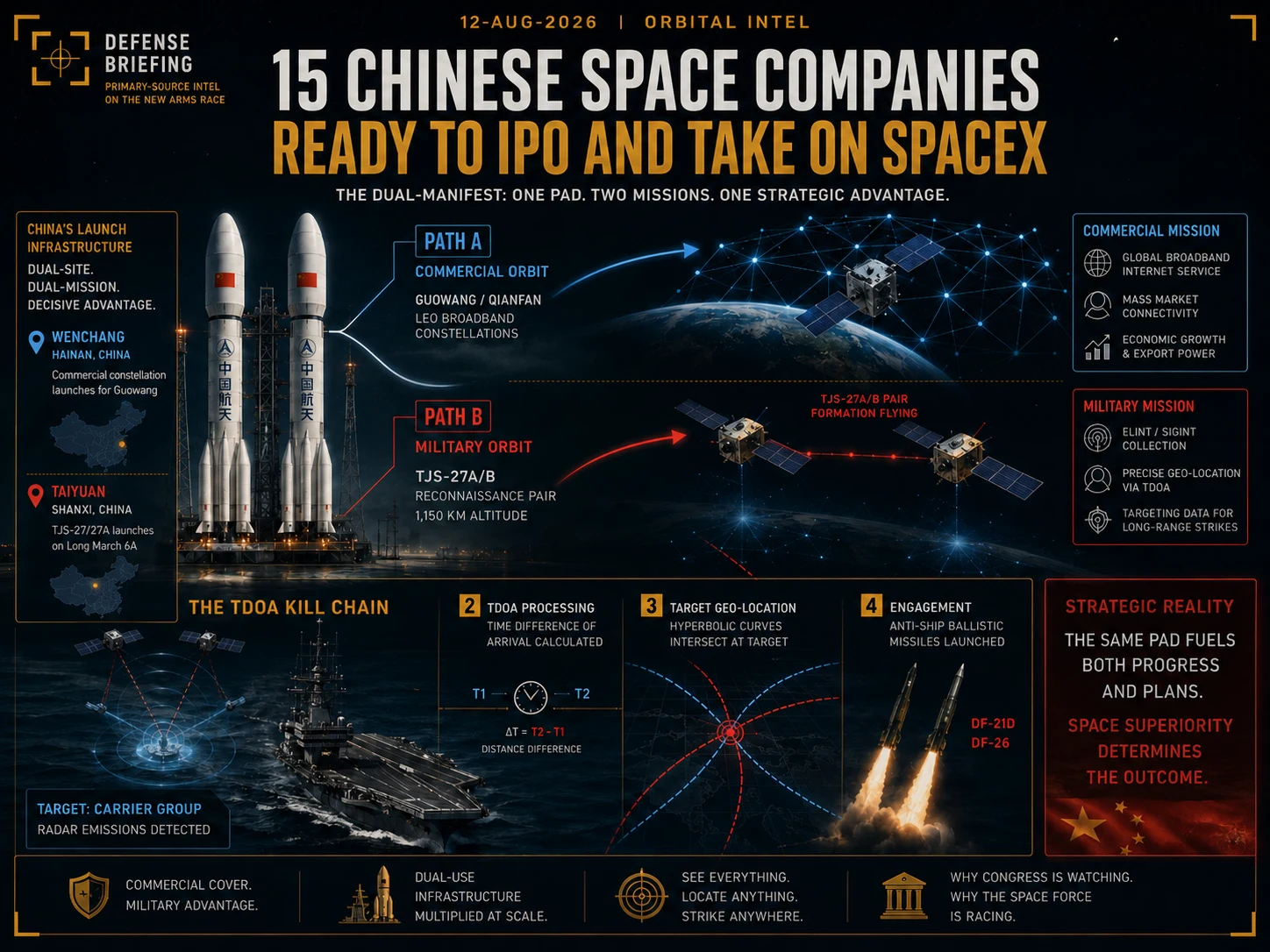
A Long March 6A lifted off from Taiyuan Satellite Launch Center at 0100 UTC on 30-JUL-2026 carrying TJS-27A and TJS-27B. The China Aerospace Science and Technology Corporation (CASC) described the pair as communication technology test satellites. U.S. Space Force tracking placed them near 1,150 to 1,155 km altitude at roughly 64.8 degrees inclination.
Jonathan McDowell, whose catalog remains the standard public reference for orbital activity, assessed the orbit and formation as characteristic of a space-based time-difference-of-arrival (TDOA) electronic intelligence system, functionally analogous to the U.S. Naval Ocean Surveillance System (NOSS). He also flagged the naming: earlier Chinese missions into this regime carried the Yaogan designation. This one carries a communications cover name.13
The physics is straightforward. A ship's radar transmits; two satellites flying in formation detect the same pulse nanoseconds apart. Because the propagation speed is constant, the timing difference traces a curve of possible emitter locations. A third measurement intersects the curves and produces a geolocation. No optical sensor is required, no satellite radar of its own, and nothing the target can observe occurring.
Intelligence that connects the dots between launch pads and kill chains.
Subscribe to Orbital IntelAn anti-ship ballistic missile (ASBM) such as the DF-21D or DF-26 requires an estimated twelve to fifteen minutes of flight time at operational ranges.14 A carrier steaming at 30 knots covers six to seven nautical miles in that window. Continuous emitter geolocation supplies the sensor half of the kill chain; denser constellations of paired satellites make the updates more frequent.
The dual manifest: commercial launch expansion can free state launch capacity for military and government missions even when private vehicles never carry those payloads. Graphic: Defense Briefing.
That closes the loop between the two halves of the story. Commercial launch capacity does not need to launch a military satellite itself to have military value. Every commercial constellation mission shifted away from the state fleet frees scarce national launch capacity for reconnaissance, warning and other government payloads. On 06-AUG-2026, Senators Catherine Cortez Masto and Katie Britt introduced the bipartisan Space Superiority Readiness Act (S.5329).15 The bill expands Space Force wargaming, modeling and space-control training and requires the Secretary of Defense to deliver an unclassified assessment of Chinese commercial space capabilities. That last requirement exists because the commercial and national-security industrial bases increasingly reinforce each other even when their individual manifests remain distinct.
Recovery Is Not Cadence
LandSpace's Zhuque-3 Y2 second orbital flight and first-stage recovery attempt is currently expected in late August 2026 from Jiuquan. It would follow the December 2025 debut, which reached orbit but lost the stage after an anomaly during the landing burn.
Catching a booster demonstrates that the guidance, the throttling, the grid fins and the landing structure work on the day. It does not demonstrate refurbishment. It does not demonstrate turnaround time. It does not demonstrate that the twentieth flight of the same airframe costs meaningfully less than the first. The economic case for reuse lives entirely in that second set of questions, and no Chinese vehicle has answered any of them yet.
July's sea recovery of a Long March 10B first stage, caught in a net on the recovery vessel Linghang Zhe roughly 430 kilometers downrange on 10-JUL-2026, was a genuine national engineering achievement.16 China became the second nation to recover an orbital-class booster. Making it even more impressive was that while China used familiar physics, compared to SpaceX, it did it with a distinct recovery architecture.
CASC expects that same recovered stage to fly again before year-end, which would be the first Chinese reuse flight. It is also a different technique from propulsive landing, and until the reflight occurs, recovery and reuse remain separate accomplishments.
The material risk is not whether China can land a rocket. It is whether China can fly the same rocket twenty times a year. Falcon 9 took roughly five years to travel that distance. LandSpace's filing gives itself three.
The Western Mirror
The United States has already run a version of this experiment. Between 2019 and 2022, most of the American commercial space sector reached public markets through special-purpose acquisition companies (SPACs). Virgin Orbit went bankrupt. Astra went private. Terran Orbital was absorbed by Lockheed Martin. The survivors took five years to look like businesses.
Redwire reported record revenue of $117.1 million on 05-AUG-2026, up 89.6 percent year over year, with backlog at $542.1 million. It also posted a quarterly net loss of $41.0 million and adjusted EBITDA of negative $3.2 million, five years after listing. Gross margin turned positive for the first time at 27.8 percent. The trajectory toward breakeven is visible; the destination has not been reached.17
Rocket Lab posted record Q2 revenue of $234 million on 10-AUG-2026, up 62 percent year over year, with backlog at $2.36 billion and more than $1 billion in new contracts already entered in Q3. Net loss narrowed to $49.3 million from $66.4 million a year earlier. The $397 million SB-AMTI Flatellite contract and the $8 billion agreement to acquire Iridium Communications, announced in June, mark the company's transformation from a small-launch provider into an integrated defense and communications platform. Neutron's first-stage tank production is aligned with delivery to the launch pad in Q4 2026, though CEO Peter Beck acknowledged the window for an end-of-year inaugural launch "is narrowing."18
Forward this to your portfolio manager. Then subscribe.
Get Orbital Intel FreeSpaceX itself listed on Nasdaq on 12-JUN-2026 with a $75.0 billion base offering, the largest IPO in history. After the underwriters fully exercised the overallotment option, SpaceX reported $85.675 billion in net IPO proceeds.19 The entire Chinese commercial space IPO cohort is seeking roughly $3 billion, only about 4 percent of SpaceX's original $75 billion base raise, split across fifteen companies. The scale disparity is the point. Beijing is not trying to match SpaceX's capital. It is trying to match SpaceX's throughput, using public equity to fund a distributed industrial base rather than a single vertically integrated firm.
The structural difference is demand. Western space companies raise against an equity market's patience and then go find customers. The Shanghai cohort raises against the same kind of patience and has its principal customer assigned by plan. That is an advantage in the deployment phase and a liability in every phase after it, because a company that has never had to win a competitive commercial order has not yet demonstrated it can.
What to Watch
Watch for Zhuque-3 Y2 recovery and, more critically, the interval to reflight; whether CAS Space or MinoSpace prices and trades before year-end; Guowang's progress against its 310-satellite target by mid-fall, which will highlight if it has any chance of achieving its goal by 31 December 2026; Orienspace's shareholding restructuring and prospectus filing; further paired launches into the 1,150-kilometer regime; and whether the commercial-assessment provision in the Space Superiority Readiness Act survives conference on the fiscal 2027 defense authorization.
A prospectus prices a business. It does not price what the capacity gets used for.
Forward this to your portfolio manager.
Sources: Jonathan McDowell's Space Activities in 2025; LandSpace, CAS Space and MinoSpace STAR Market prospectuses (Shanghai Stock Exchange); Orienspace official product specifications; Rocket Lab 8-K filed 10-AUG-2026; Redwire 8-K filed 05-AUG-2026; SpaceX IPO filings; CSRC 2025 reform package; SpaceNews; Space Superiority Readiness Act (S.5329). No classified information was used and all material is publicly accessible.