
Three Weeks After America Admitted to Space Weapons, Russia Threatens Space War
Washington settled one question in September. Since then Kyiv has gone after a Russian supply chain, Medvedev has threatened retaliation and Brussels has put protection and replacement at the center of its space plans.
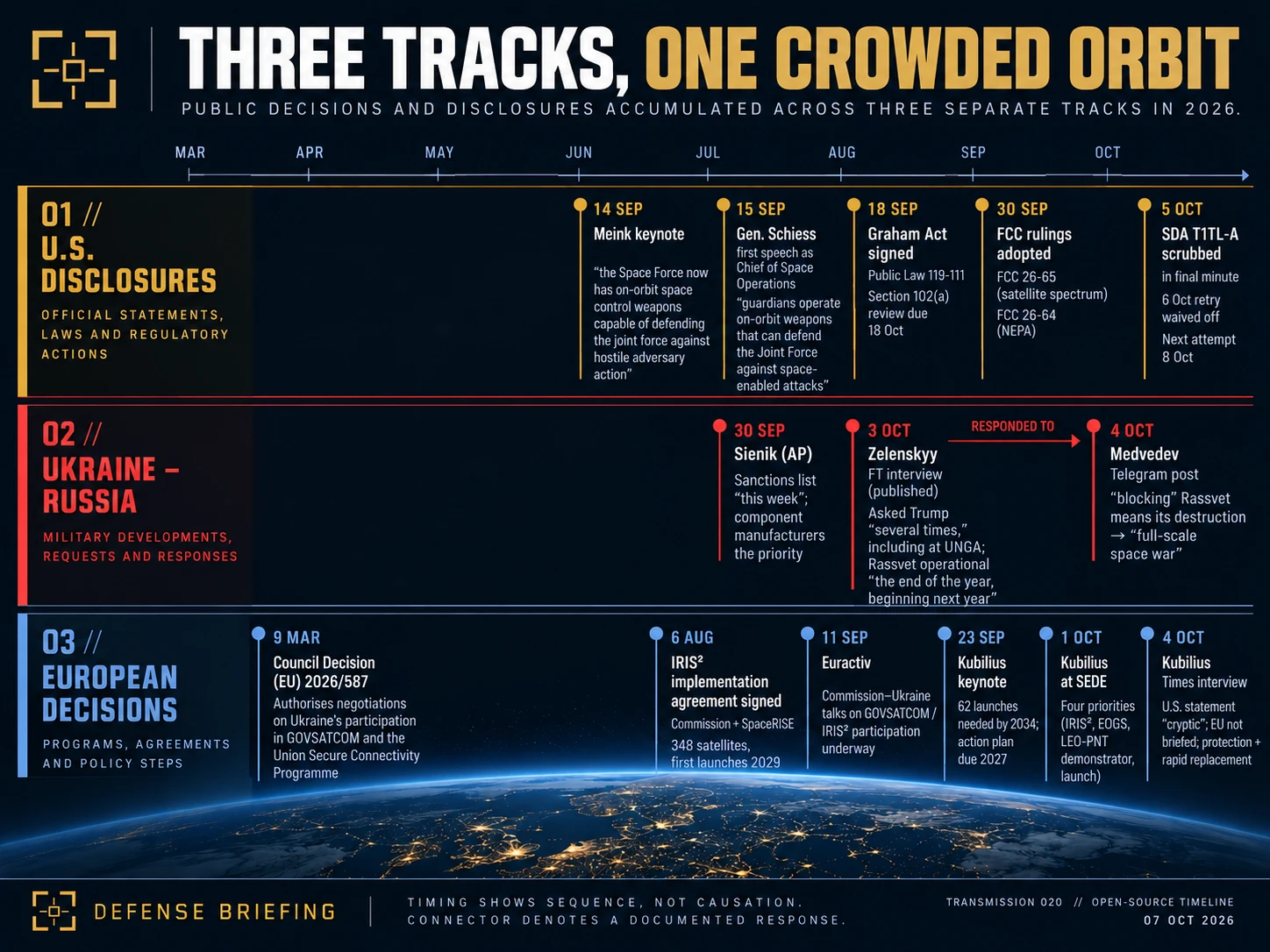
On 4 October Dmitry Medvedev, deputy chairman of Russia's Security Council, posted a warning to Telegram. If the West moves against Russia's new satellite internet network, he wrote, America's Starlink satellites "will come tumbling down like ornaments from a dried-out Christmas tree."1
He was answering Ukraine. A day earlier, President Volodymyr Zelenskyy had told the Financial Times that he had repeatedly asked President Trump to sanction the Russian and Chinese firms behind Rassvet, the constellation Russia is building as its alternative to Starlink.2
Three weeks before that, the Secretary of the Air Force said the United States has weapons in orbit.3, 4 Transmission 017 argued that the acknowledgment mattered: it confirmed, explicitly and on the record, that the United States has operational weapons in orbit, while withholding the inventory, the orbits and the rules for using it.
The words themselves were not new. "Space control" has been in Air Force doctrine since 1998, and joint doctrine defined its offensive and defensive halves by 2018.5, 6 What was new in September was the claim of possession.
This issue follows three developments since then. Ukraine is trying to choke off Rassvet's supply of parts. Russia's best-known saber rattler is threatening retaliation against an American commercial constellation. And Europe is putting protection and rapid replacement of satellites at the center of its space program. They belong in one story because they are all about the same thing: governments planning, in public, for conflict that reaches orbit.
Ukraine's request is about Rassvet's value on the battlefield. Medvedev was responding to Ukraine. Much of Europe's program was agreed before September. Only one of these threads runs directly back to Washington: the European space commissioner says the U.S. statement was "cryptic" and that Europe was never told what was deployed or why.7
For national security, the questions Transmission 017 said the acknowledgment left open now carry more weight. What exactly the American systems defend, against what and at whose request matters more when a Russian official is naming Starlink as a target and allies say they are guessing. For capital, the firmest signal is in Europe: Brussels projects more launch demand than its rockets are scheduled to meet, and it is directing defense money toward protecting satellites and replacing them quickly.
Primary-source briefings on conflict in orbit, every Wednesday.
Get Orbital Intel FreeThe Threat and What Set It Off
Ukraine's push started before Zelenskyy's interview. On 30 September Ukraine's chargé d'affaires in Washington, Denys Sienik, told the Associated Press that Kyiv would present the White House and Congress with a sanctions list that week. The top priority was the companies producing components for "Russia's version of Starlink." His framing: "The main firm setting up the network is already under U.S. sanctions but those producing the components for it are not."8
Zelenskyy raised the stakes on 3 October. He told the FT he had asked Trump "several times," including at the United Nations General Assembly in New York in September, to sanction Russian and Chinese firms behind Rassvet, and that the network would be operational by "the end of the year, beginning next year." The FT asked China, the Kremlin and the White House for comment. None responded.2
Medvedev posted the next day. In our translation of the Russian text as reproduced by Russian outlets: "'Blocking' of the Russian satellite constellation 'Rassvet' at the request of the Kyiv moron means only its destruction. And that will lead to a full-scale space war." Starlink's satellites, he continued, "will come tumbling down like ornaments from a dried-out Christmas tree." He closed: "Space is a very crowded place; we need to be mutually courteous."1
The most important move in the post is the first one. Ukraine asked for sanctions on suppliers. Medvedev recast that as "blocking," then blocking as destruction, then destruction as grounds for war. Treating economic pressure as an act of force is the argument he wants Western audiences to absorb.
Context matters for weighing it. Medvedev has posted threats in this register frequently since February 2022, including nuclear warnings in May 2022, September 2022, July 2023 and May 2024. None was followed by nuclear use. We found no Kremlin, Foreign Ministry or Roscosmos announcement corroborating this post as operational policy. We also found no earlier case, in the sources we reviewed, of Medvedev applying the formula to orbit.
What Rassvet Is, and What It Can Do Now
The company. Rassvet, Russian for "dawn," is a low Earth orbit broadband constellation built by Bureau 1440. The company was founded in 2020 and has been owned since June 2022 by IKS Holding. It has had state backing since January 2023 and draws federal money through the "Data Economy" national project. Kommersant reported an allocation of 102.8 billion rubles in federal funds plus 329 billion rubles from the company through 2030.9 That is money allocated, not money spent.
What has been launched. After two experimental batches of three satellites each in 2023 and 2024, Russia launched 16 production satellites from Plesetsk on 23 March 2026 and 16 more on 19 July, the second batch with no advance announcement.10 Three numbers need to stay separate:
- Launched: 32 production satellites.
- Still in orbit: 31, according to the public CelesTrak catalogue on 5 October. One reentered in June.10
- Working: not publicly established. A Business Insider report citing Space Force tracking data suggested problems with the second batch. The Ukrainian outlet Militarnyi said on 13 September that it was too early to judge.11, 12
The first batch sits at roughly 510 kilometers. The company advertises 800. That discrepancy is unexplained.10
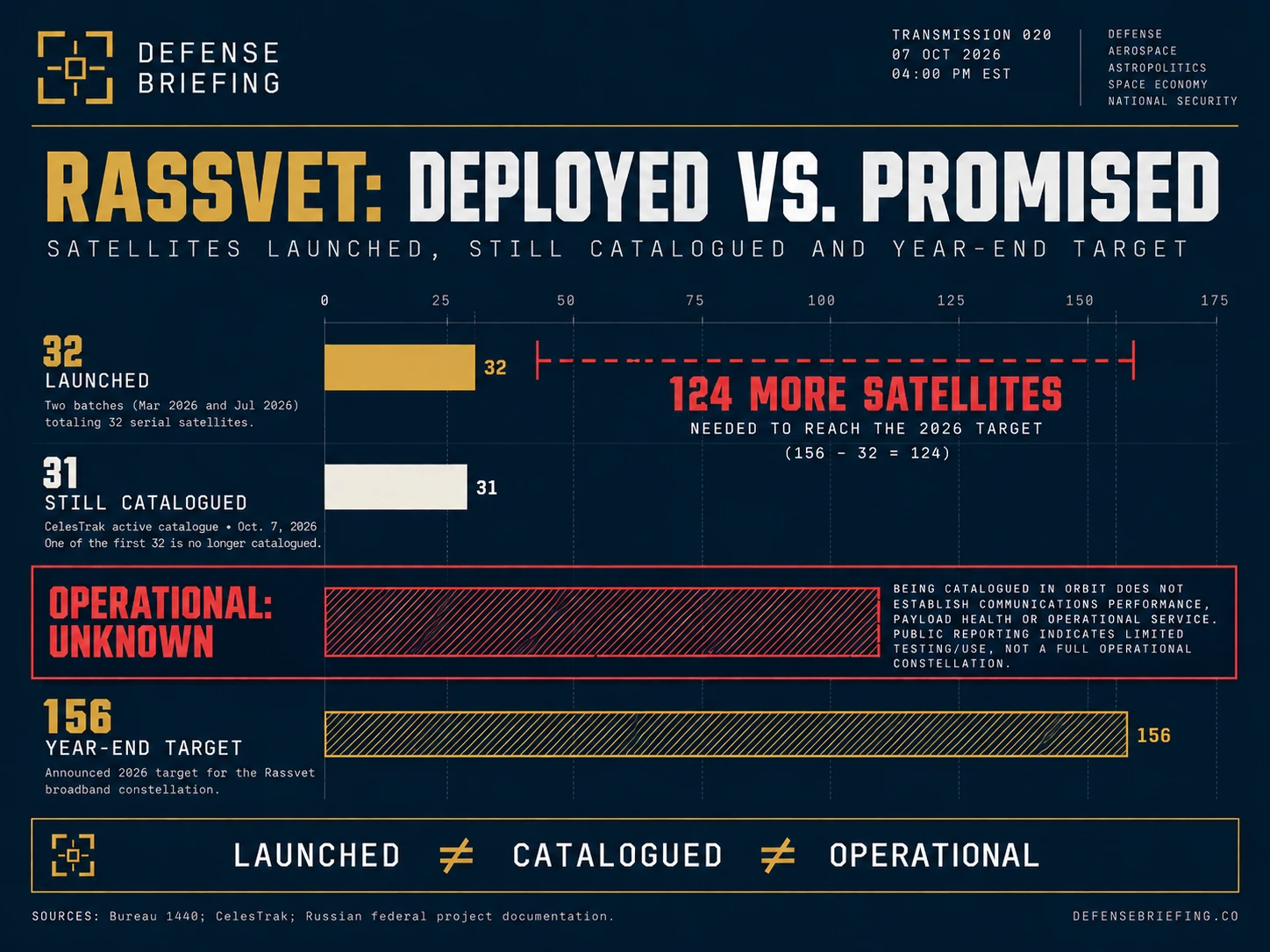
What is promised. Bureau 1440 says 156 satellites by the end of 2026, 292 and the start of commercial service in 2027, and more than 900 by 2035. Reaching 156 from 32 means 124 more satellites, or eight more launches at the current batch size of 16, in under three months. Russia has flown two production launches since March.
What it may already do. Ukraine's military intelligence directorate says Rassvet is already intermittently usable over the battlefield. That is a Ukrainian intelligence claim and we have not seen the evidence behind it. What is documented is the gap Rassvet is meant to fill: Reuters reported in February that Starlink blocked the gray-market terminals Russian forces had been using.13 Rassvet's intended role is to give Russia a satellite internet service of its own. Whether it can yet do that at useful scale is not established in the public record.
Launched, catalogued and operational are three different numbers. We keep them separate.
Subscribe FreeWhat Ukraine Wants Sanctioned, and What the Law Allows
Who is already covered. Bureau 1440's parent, IKS Holding, has been under U.S. sanctions since February 2023. The companies building Rassvet's parts are not, according to Ukraine's embassy.14, 8
The China allegation. Zelenskyy also told the FT: "We know that China works on satellites, works on the possibility of helping Russia with a similar Starlink."2 That is his claim. He named no company. In the public sources we reviewed, no specific Chinese firm is credibly tied to Rassvet, and Beijing has previously denied giving Russia military support. We report it as an allegation by a head of state with an evident interest in it.
The legal tool. The Lindsey O. Graham Sanctioning Russia and Iran Act of 2026, Public Law 119-111, was signed on 18 September. It contains several 30-day requirements, not one general deadline. The one that matters here is Section 102(a): within 30 days of enactment, which is 18 October, and every 180 days after that, the President must review and sanction persons supporting Russia's defense industrial base.15
Two limits matter. First, designation is not automatic. Section 102 applies to persons the President determines knowingly supply defense industrial goods or services to Russia, or conduct significant transactions with its armed forces. The goods the act lists include advanced sensors, military-grade fiber optic cable and propellant components. Whether a given Rassvet supplier qualifies depends on that determination. Supplying satellite parts does not establish it by itself.15
Second, the act's tariff provision is narrower than some coverage suggests. Section 113 requires the President, within 30 days, to raise duties of up to 100% on goods from qualifying countries. A country qualifies if it was among the five largest importers of Russian crude oil or natural gas over the prior 12 months and knowingly makes new purchases after the 30-day mark, or if it is among the top five facilitators of Russian oil sanctions evasion. There is an exception for some natural gas imports.15 Any action touching Chinese firms, under either section, would land on top of the current U.S.-China trade truce. Beijing has formally rejected the act's unilateral sanctions.
What sanctions have done before. Western export controls have hurt Russian space programs. The GLONASS-K2 navigation satellites slipped by one to two years for lack of radiation-hardened electronics. The Tundra missile-warning program slipped by years. Russian reporting described several reconnaissance programs at the satellite maker ISS Reshetnev as de facto halted. Kommersant attributed part of Rassvet's own slip, from late 2025 to March 2026, to the consequences of sanctions.9 Russia has also adapted, shifting toward Chinese and Southeast Asian microelectronics and simpler satellites.16
Our assessment. Sanctions on component suppliers could slow Rassvet's production and deployment. How much depends on three things the public record does not settle: how dependent Bureau 1440 is on foreign parts, how large its stockpiles are and how quickly it can substitute. Sanctions would not remove the satellites already in orbit.
Ukraine has also tried the diplomatic channel. Foreign Minister Andrii Sybiha petitioned the International Telecommunication Union (ITU) in late August to exclude Ukrainian territory from Rassvet's service areas. The ITU has no enforcement power. The petition puts Ukraine's objection on the record; it does not block service.
The 18 October sanctions review is next. Get the follow-up when it lands.
Get Orbital Intel FreeWhat Medvedev's Threat Establishes, and What It Does Not
Medvedev's post establishes that a senior Russian official has publicly linked Rassvet's survival to Starlink's, and has named an American commercial constellation as a target.
It does not establish a Russian decision, a capability against Starlink or a plan. The imagery should not be read as an attack plan.
Russia's capabilities are known in outline, and Transmission 017 laid them out. Russia has demonstrated a ground-launched missile that destroys satellites; its November 2021 test left debris that endangered the International Space Station. But one missile per satellite does not scale against a constellation of thousands. U.S. Army Lt. Gen. Rick Zellmann, deputy commander of U.S. Space Command, made that point on a panel at the Space and Missile Defense Symposium in Huntsville in August, as reported by The War Zone:17
"If you have 10,000 satellites that are providing you with service, surely you're not going to try and attack with a direct ascent ASAT [anti-satellite interceptors fired from within the Earth's atmosphere] 10,000 satellites. I encourage our adversaries to try and shoot down 10,000 satellites that way. I don't think they will. And, so, just like we do, our targeting folks will try to find the various nodes where you can get a one-to-many solution."
His last sentence is the one that matters for Starlink. The limit on missiles does not dispose of the threat to the service. As Transmission 017 explained, the effects that matter against large constellations are the ones that reach many targets at once. Jamming, cyber intrusion, directed energy and attacks on shared ground infrastructure can disrupt a service without destroying every spacecraft. How far their effects reach depends on the target and the method. Russia jammed satellite navigation across the Baltic, Black Sea and Mediterranean regions through 2025, causing flight diversions, according to written testimony that Gen. Stephen Whiting, commander of U.S. Space Command, submitted to the Senate Armed Services Committee on 26 March 2026.18 A threat to a service is not the same as a threat to every satellite.
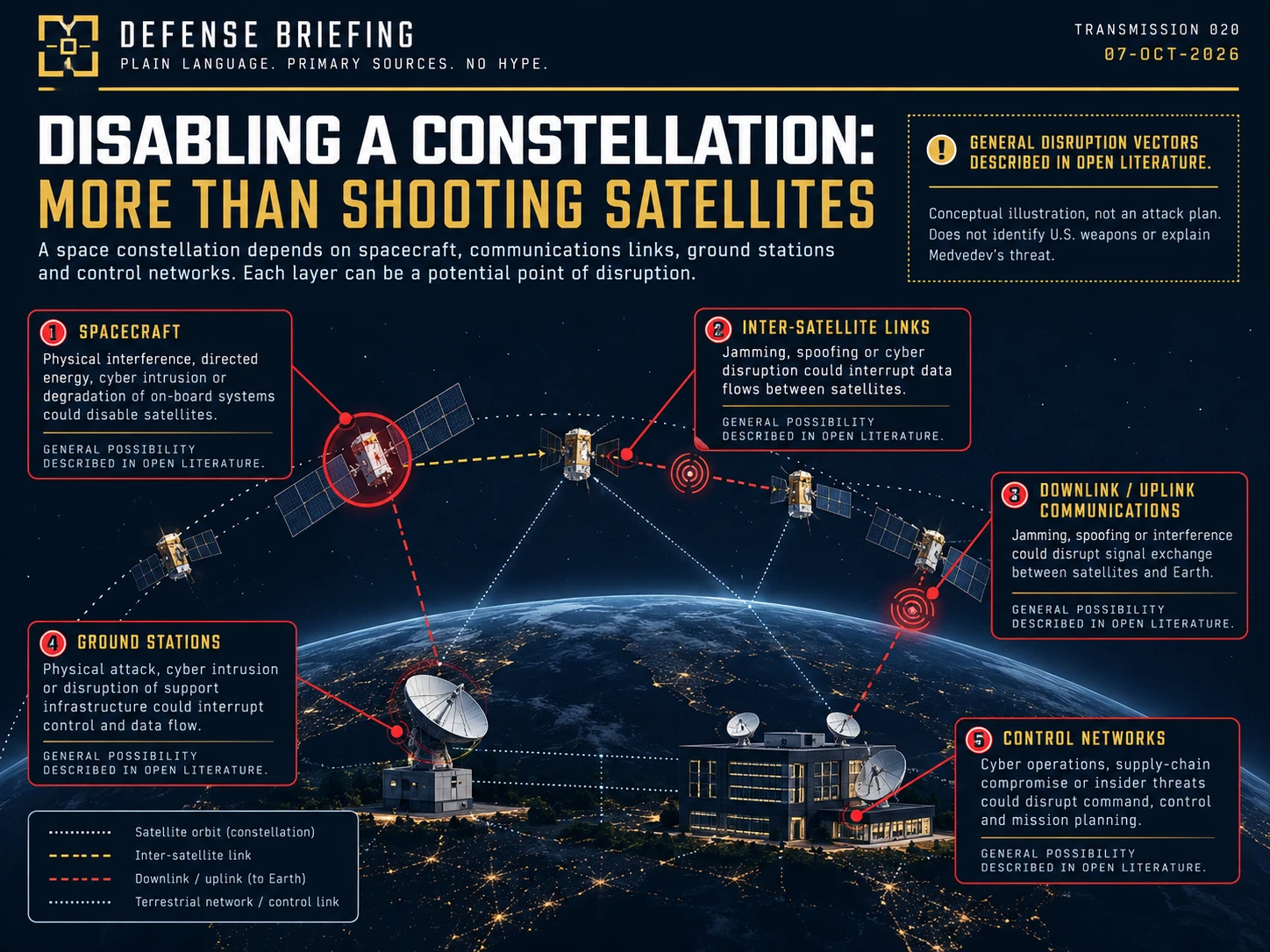
Destructive attacks also carry a cost Russia shares. Any intercept in low Earth orbit creates debris that raises collision risk for spacecraft at nearby altitudes, Russian ones included. How much depends on where the intercept happens and where the fragments end up. Read that way, Medvedev's closing line, "we need to be mutually courteous," may be the most accurate sentence in the post. Low orbit is shared, and Russia now has more of its own hardware there than it did a year ago.
Two open questions, not one. The first is about American mission scope. The U.S. statement said the acknowledged weapons can defend "the joint force against hostile adversary action."3 Whether Washington would use them to defend a commercial American constellation that the U.S. military also relies on, and who would authorize that, is not answered by that language. Medvedev's post makes the question less theoretical.
The second is legal, and it would remain even if the first were settled. Whether a commercial spacecraft serving military users counts as a military objective under the law of armed conflict, and whether its operator is directly participating in hostilities, are separate questions. Transmission 017 flagged them as unresolved. Medvedev's post does not settle them; it puts a named commercial constellation at the center of them.
Threats, capabilities and the difference between them. Plain language, every Wednesday.
Subscribe FreeEurope: One Direct Response, and a Plan Already Underway
The direct response. Andrius Kubilius, the European Commissioner for Defence and Space, gave The Times an interview published on 4 October. He called the American statement "cryptic" and said the European Union (EU) was not told what was deployed or why.7 Transmission 017 listed allies as one possible audience for the disclosure. By Kubilius's account, Europe's senior space official was not briefed.
On what Europe should do: "we need to develop our capabilities, how to defend our assets in space with all the necessary instruments, how we can replace our satellites." On Russia: "I would be very surprised if the Russians… would not look at how to really damage or destroy our capabilities. We're looking into that in a very calm way. We need to be ready."7
The Times also reported details we have not independently verified: that Germany says two satellites used by its armed forces were shadowed by Russian spy satellites, that Berlin plans €35 billion in military and dual-use space spending by 2030, and that France plans a 100-kilogram "bodyguard" satellite called Flamhe, carrying a dazzling laser, by 2030. Treat all three as reported by The Times.7
The existing program. Most of what Kubilius is describing was already in motion before September, and defense was already part of it: the August IRIS² announcement described defense, security and resilience explicitly.19 What the Times interview adds is the commissioner responsible stating protection and replacement in plain terms.
- IRIS², the EU's secure communications constellation. The implementation agreement, signed on 6 August and announced by operator SES on 7 August, sets the design at 348 satellites, 330 in low orbit and 18 in medium orbit, including a 66-satellite defense set. First launch is planned for 2029. The figure has changed before; it was 290.19
- A governmental Earth observation service (EOGS), building on European Space Agency (ESA) work.
- A low Earth orbit positioning, navigation and timing (LEO-PNT) demonstrator, to finish deploying in 2027. That is a test system, not an operational service.
- Launch capacity, which Kubilius listed alongside the other three before the European Parliament's Subcommittee on Security and Defence (SEDE) on 1 October, with an action plan due in 2027.20
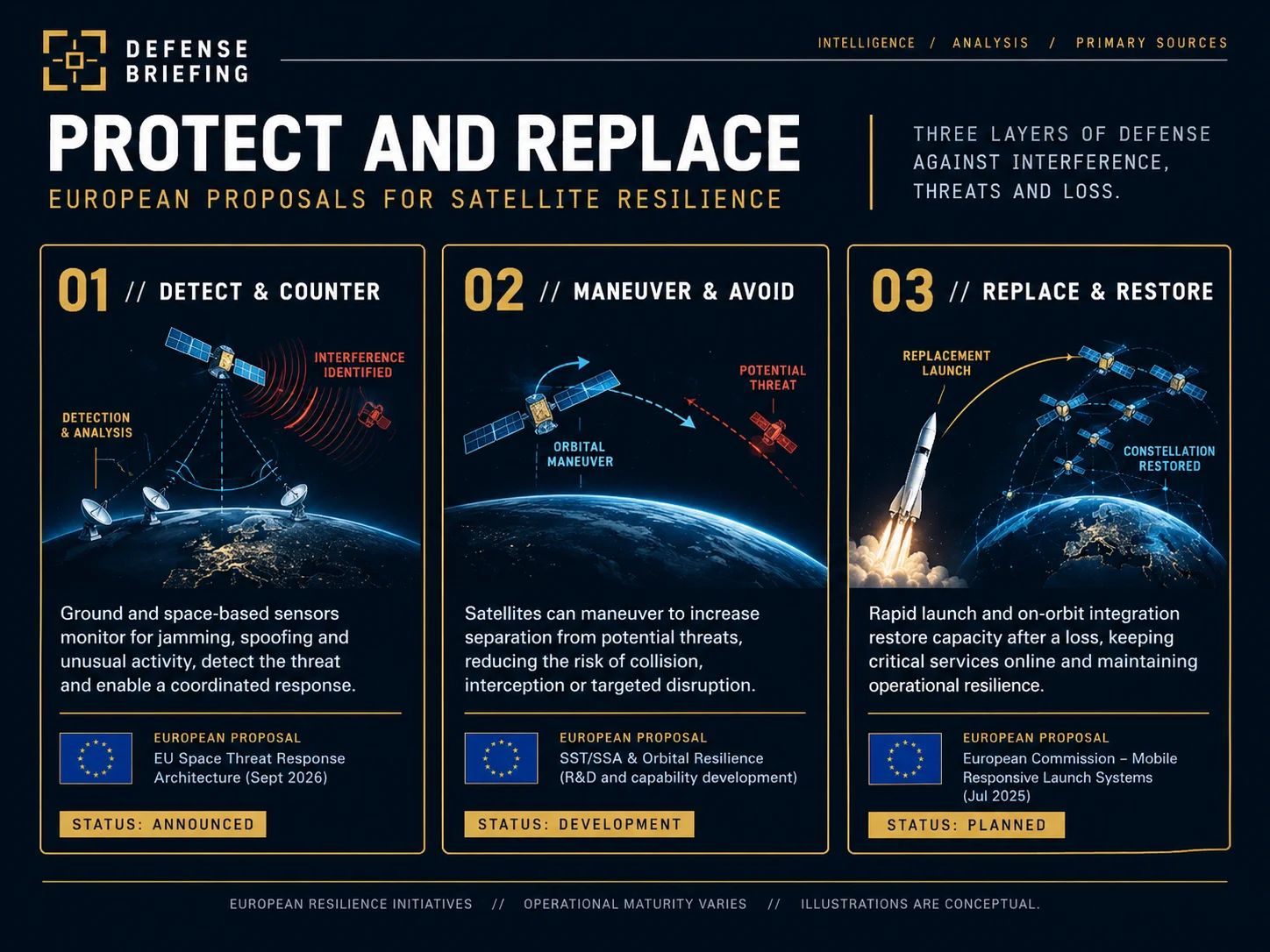
The launch gap. At the EU Access to Space Conference on 23 September, Kubilius put Europe's projected need at 62 launches by 2034 for Galileo, Copernicus, IRIS² and EOGS. That is a cumulative figure, not an annual rate. The Commission's own account shows where the pressure falls: 14 Ariane missions needed in 2031 against roughly 10 a year planned, and 8 Vega missions needed in 2030 against 6 a year.21, 22
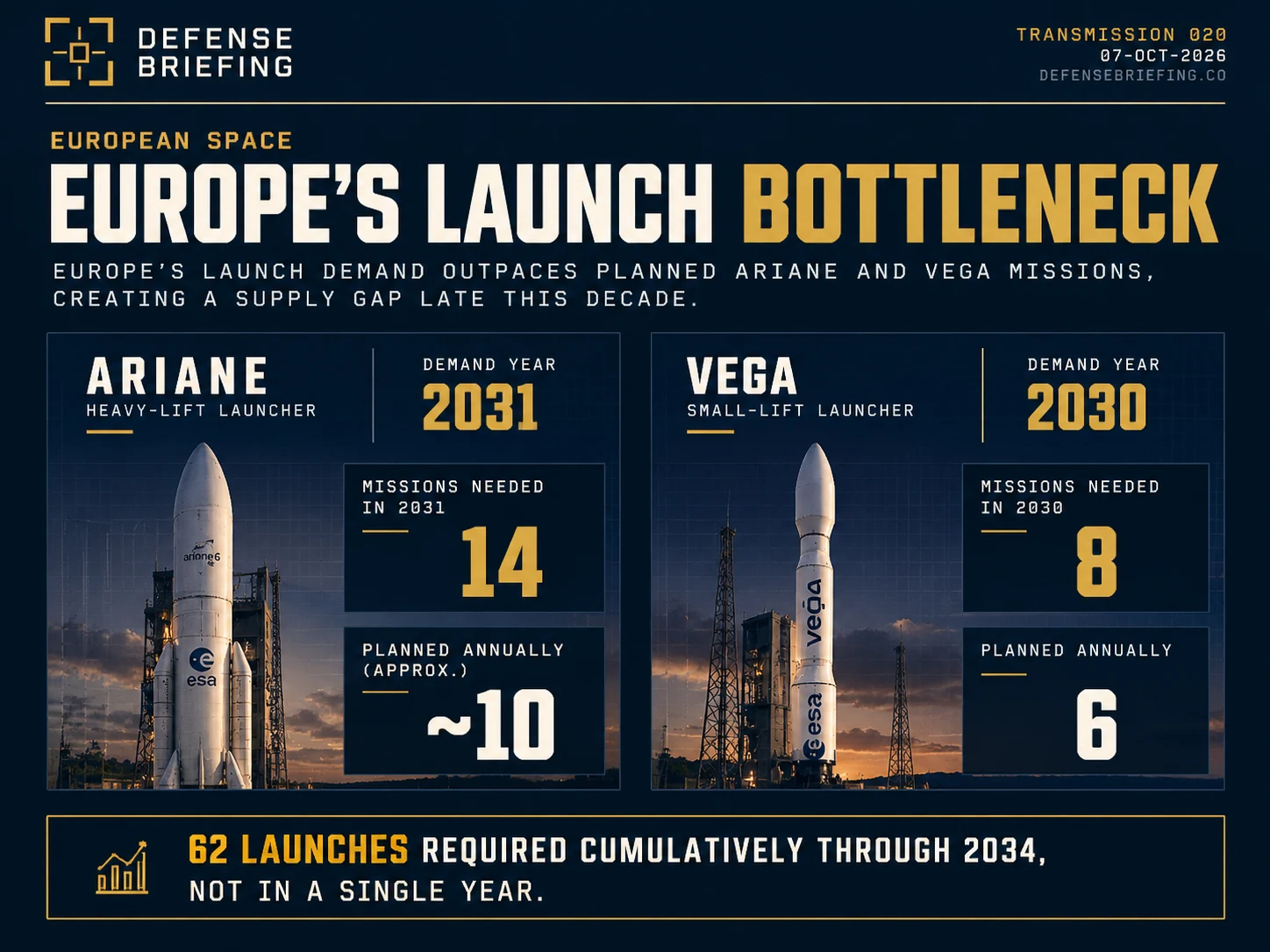
Supply is tight now. Ariane 6 flew four times successfully this year before a turbopump anomaly, which ESA acknowledged on 21 September, cut the 2026 plan to about six flights from eight. One new data point runs the other way: on 5 September Isar Aerospace's Spectrum rocket reached orbit from Andøya, Norway, the first successful orbital launch from continental Europe.
Where the defense money is going. In September the European Defence Fund awarded €6 million to EOBLINDING, a project covering tracking, radio jamming and laser dazzling to counter space surveillance. On 28 September EU governments approved five European Defence Projects of Common Interest, including a space project that covers missile warning, communications, surveillance, positioning and rapid replacement launch. Rapid replacement is the capability Kubilius named in The Times, and it is the clearest commercial consequence in this story: demand for launch on short notice and for satellites built to be replaced quickly.
Europe's space buildout, tracked against primary sources. Free every Wednesday.
Get Orbital Intel FreeWhat to Watch
- Thursday, 8 October. The Space Development Agency (SDA) launch retry; see sidebar.
- 18 October. Under Section 102(a) of the Graham Act, the President must complete the first review by this date and impose sanctions on any persons he determines are covered.15 Watch whether any Rassvet component supplier is designated, and whether any designation reaches a Chinese firm.
- Rassvet's next launch. Eight more are needed to meet the company's year-end target. A launch before December would suggest the pace is improving. None would put pressure on the 2027 commercial service date.
- A Pentagon reply to Brussels. Whether anyone in Washington now briefs European officials on what the acknowledgment covers is a development to watch. A briefing would show engagement with allies; it would not show whether they were the original intended audience.
- Europe's 2027 launch action plan. The demand projection is public. The plan to meet it is not yet.
The Angle
Three weeks ago Washington confirmed a category of weapon and withheld the rest: the inventory, the orbits, the rules for using it. Since then three other capitals have made their own moves on space in public. In Moscow, Medvedev issued a threat. Kyiv pressed for sanctions on Rassvet's suppliers. Brussels recast a building program as protection and replacement. The argument about conflict in orbit is now being conducted openly and on the record, and the country that says it already has weapons there is saying the least about them.
As of publication, the Pentagon has not answered Brussels and the White House has not publicly answered Kyiv's sanctions request. The Kremlin, the Russian Foreign Ministry and Roscosmos have not followed Medvedev's post with anything official, and no EU or NATO body has followed up on Kubilius. That silence is the most current fact in this story.
Forward this to the colleague who covers Russia, European defense or space policy.
SIDEBAR: THE SDA LAUNCH THAT KEEPS WAITING
The Space Development Agency's T1TL-A mission, 21 Northrop Grumman-built Tranche 1 Transport Layer satellites on a SpaceX Falcon 9 from Vandenberg Space Force Base, was scrubbed in the final minute of its 5 October attempt. The 6 October retry was called off. The next attempt is targeted for Thursday, 8 October, around 12:54 a.m. Pacific.23 These are the data-relay satellites at the center of Transmission 019's SDA scorecard. If the mission flies, it is the first data point for the next issue.
SIDEBAR: MEANWHILE, AT THE FCC
On 30 September the Federal Communications Commission (FCC) opened about 525 MHz of new satellite downlink spectrum, which it says adds about 25% capacity for high-throughput low orbit satellites. In a separate 2-1 vote, it ruled that licensing space operations is not a "major federal action" under the National Environmental Policy Act (NEPA).24 More in a future issue.
Sources: This briefing relies primarily on the enacted text of Public Law 119-111, the Department of the Air Force announcement of 14-SEP-2026, U.S. Space Command posture testimony of 26-MAR-2026, European Commission and SES releases on IRIS² and European launch demand, FCC orders 26-65 and 26-64 and the CelesTrak public satellite catalogue. Statements by Ukrainian, Russian and European officials come from the Associated Press, the Financial Times, The Times, EU Perspectives and Russian outlets that reproduced Medvedev's Telegram post; the FT and Times interviews are paywalled, and the Medvedev translation is Defense Briefing's own. The claim that Rassvet is already usable over the battlefield is Ukrainian military intelligence's. As of our last check before publication we found no Kremlin, Foreign Ministry or Roscosmos statement following Medvedev's 4 October post, no further EU, ESA or NATO statement following Kubilius's 4 October interview, no Pentagon or Space Force response to his comments on the U.S. statement and no public White House response to Ukraine's sanctions request. The numbered list below is authoritative. No classified information was used and all material is publicly accessible.