
SDA Promised 2026. The Fiscal Year Ends With 63 of 154 and None of the Missile Trackers.
The Space Development Agency (SDA) reset its launch date once already. As Fiscal Year 2026 ends, it has now missed the revised target too, its second major launch delay. Sixty-three data-relay satellites are on orbit, but none of the 28 planned missile trackers has launched, and the agency's director confirmed the laser network has yet to start. Without missile tracking and laser links between satellites, the system is not operating as intended. That record now feeds a broader debate over whether SDA should continue to exist as an independent agency.
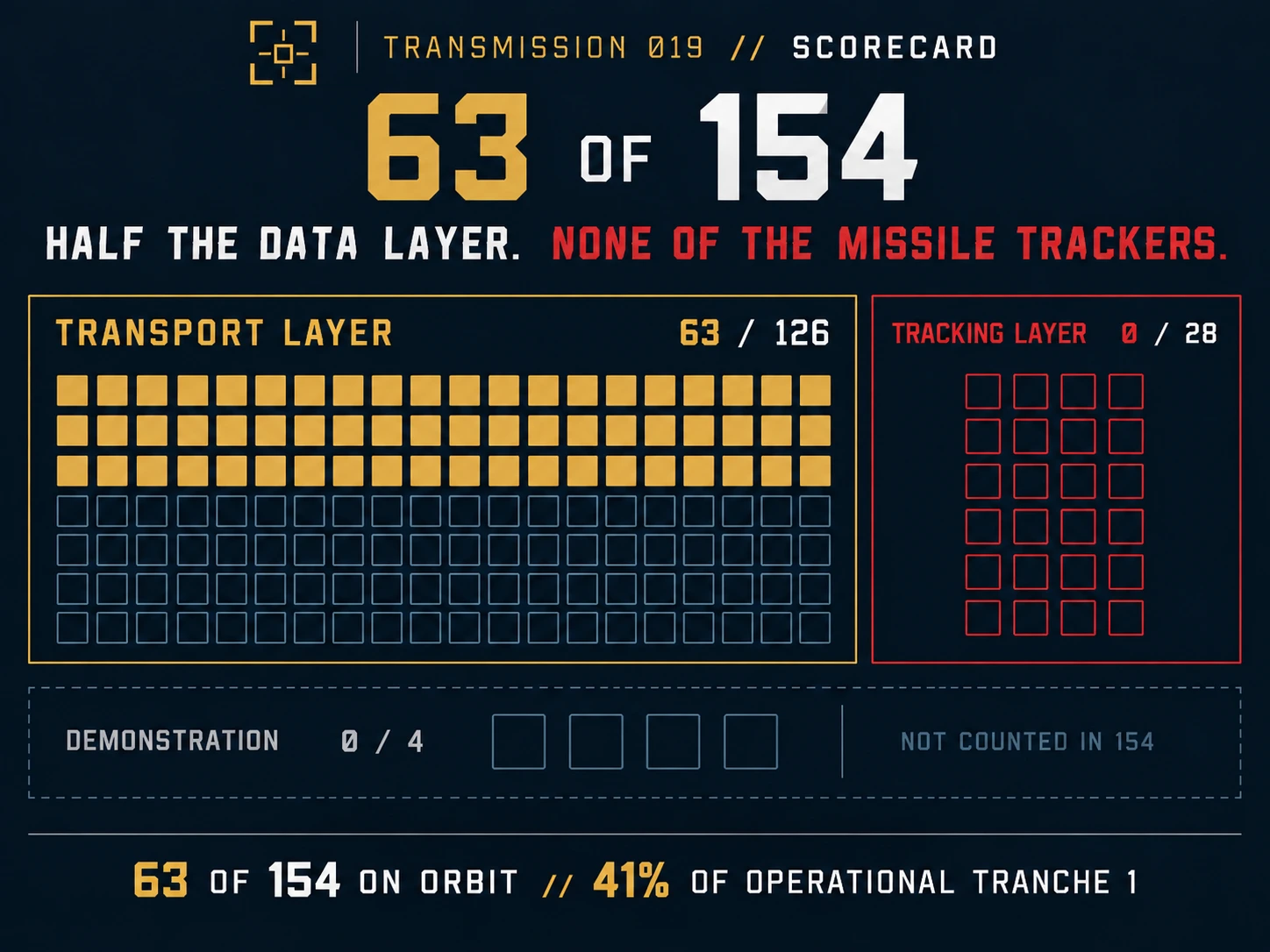
SDA TRANCHE 1 IN 30 SECONDS
- • The promise: SDA's September 2025 fact sheet said Tranche 1 deployment "will complete in 2026," spread across 10 launches. Five days later, the agency announced a pace of "one launch per month for the next nine months."1, 3
- • The record: 3 launches. 63 of 154 operational satellites on orbit, or 41 percent of the planned total. All 63 are Transport satellites built to relay data. None of the 28 Tracking satellites built to detect and track missiles has launched.3, 4, 5
- • The reset before the reset: Under the 2022 contracts, the first satellites were to be ready for launch by September 2024. That target later slipped by roughly a year.2, 6
- • What did not move: Initial warfighting capability is still listed as "beginning in 2027" in official releases.3, 5
- • Why it matters now: Congress is weighing repeal of the law that created SDA as a distinct organization. Speed was the primary justification for keeping it independent, so these missed dates are the record lawmakers will weigh.14
The Situation
The Space Development Agency built its reputation on operating against a ticking clock, one it set for itself.
As Fiscal Year 2026 (FY2026) draws to a close, only 63 of the planned 154 operational Tranche 1 satellites sit in orbit. Every one of them is a data-relay node. None of the 28 missile-tracking satellites has flown. The optical laser network meant to weld these spacecraft into one military communications system remains switched off. That matters more than usual here, because the satellites come from rival manufacturers and the laser links are what make them work as a single system.
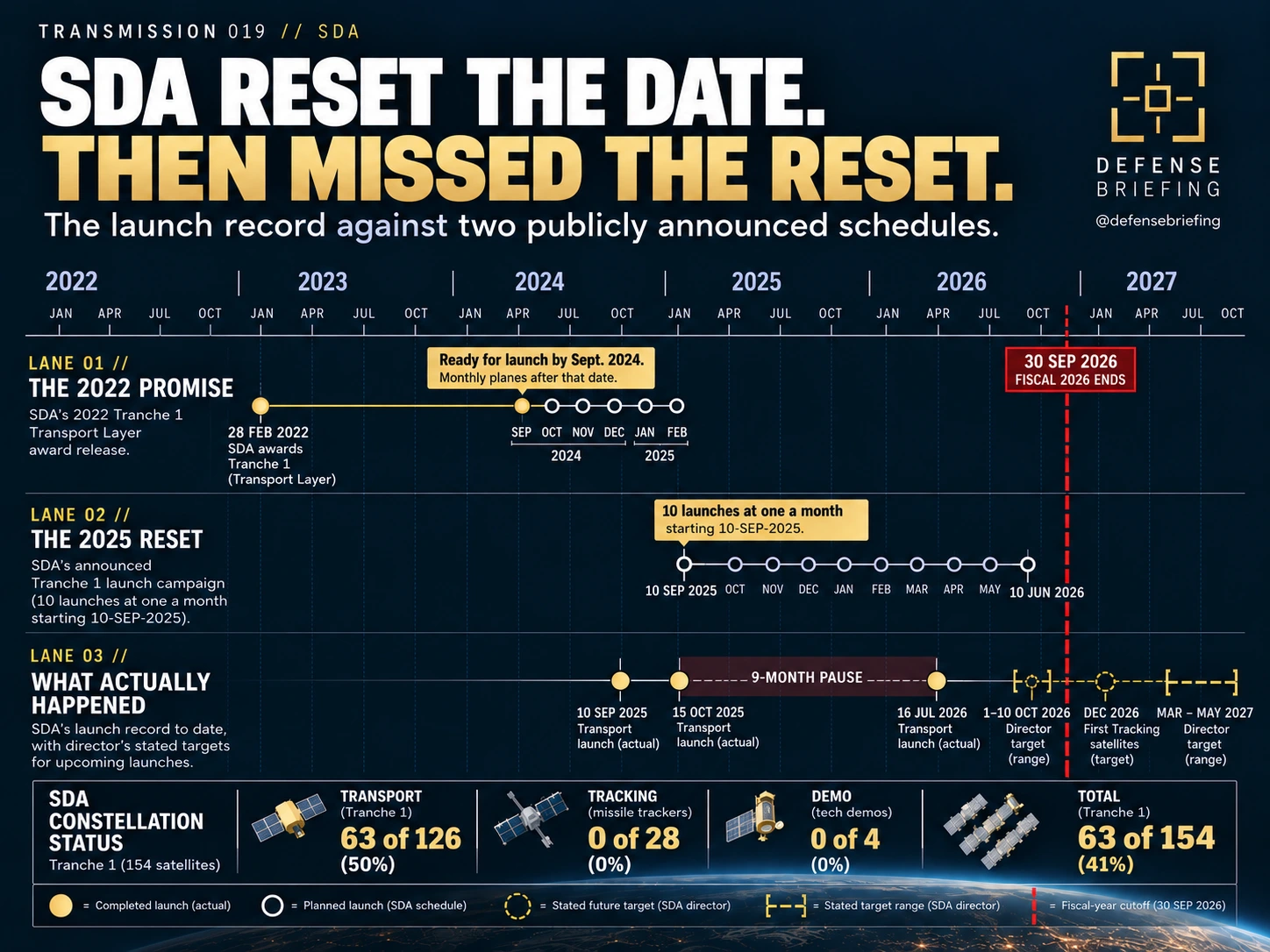
The timeline was supposed to unfold differently. Under the schedule announced on 10-SEP-2025, the agency's initial operational constellation was expected to finish launching around JUN-2026.3 June and the summer have come and gone, and the agency's director now points to spring 2027.10, 13
These benchmarks were not deadlines imposed by outside critics or the Department of War. SDA drew its own line in the sand. A 05-SEP-2025 fact sheet detailed a 10-launch campaign to put 154 operational satellites and four missile-defense demonstration satellites in orbit, promising in plain terms: "Deployment of T1 will complete in 2026."1 Five days later, the agency specified the tempo: "one launch per month for the next nine months."3 That cadence put the final flight in JUN-2026, safely inside the fiscal year that ends today.
Even that target was already a revised baseline. When the agency awarded contracts for 126 Transport satellites on 28-FEB-2022, the original terms required spacecraft to be "ready for launch by September 2024," with later orbital planes following at monthly intervals.2 As the Government Accountability Office (GAO) later noted, supply-chain bottlenecks pushed that start back by approximately a year.6
The issue facing the agency is not a single slip in the schedule. SDA set a deadline, reset the clock and has now missed the reset.
The Breakdown
Tranche 1 is the first operational generation of SDA's Proliferated Warfighter Space Architecture (PWSA): a planned low Earth orbit (LEO) network of hundreds of small satellites designed to pass data to one another through optical communications terminals. It has two main parts. The Transport Layer provides high-speed data relay, including Link 16 tactical communications for U.S. and allied battlefield targeting. The Tracking Layer uses infrared sensors to detect and track missile threats, including hypersonic weapons.
Here is what is off the ground so far:
| Launch | Date | Rocket | Builder | Layer | Satellites |
|---|---|---|---|---|---|
| T1 Launch 1 | 10-SEP-2025 | Falcon 9, Vandenberg | York Space Systems | Transport | 21 |
| T1 Launch 2 | 15-OCT-2025 | Falcon 9, Vandenberg | Lockheed Martin | Transport | 21 |
| Pause | OCT-2025 to JUL-2026 | None | None | None | 0 |
| T1 Launch 3 | 16-JUL-2026 | Falcon 9, Vandenberg | York Space Systems | Transport | 21 |
Sources: SDA releases and launch coverage.3, 4, 5
The scoreboard by layer:
- Transport: 63 of 126 launched. Half the data layer is up.
- Tracking: 0 of 28. The missile warning layer has not flown.
- Missile defense demonstration satellites: 0 of 4.
- All operational Tranche 1 satellites: 63 of 154, or 41 percent.
SDA public documentation and official statements give the following details on satellite totals and launch schedules:
- Satellite count: SDA documents define Tranche 1 as 154 operational satellites plus 4 demonstration satellites, for a total of 158 spacecraft.1, 3
- Launch schedule: Following the third launch in July, SDA Director Gurpartap Sandhoo cited seven remaining missions (three Transport and four Tracking), consistent with the original 10-launch plan.8 In September, Sandhoo referenced six remaining launches.11 SDA has not published an updated launch schedule explaining the shift from seven to six remaining missions or how it affects the satellite count.
- Demonstration program reductions: Eleven of twelve planned experiment satellites were canceled. The agency has not said whether that reduction accounts for the change in planned launches.11
Primary-source scorecards on the Pentagon's space bets, every Wednesday.
Get Orbital Intel FreeWhy the Plans Changed: The Nine-Month Launch Pause, in the Agency's Words
Following its second launch, SDA halted its launch campaign. The reason was not a shortage of spacecraft. It was a need to resolve problems with satellites already in orbit.
Director Gurpartap Sandhoo attributed the pause to several technical and logistical factors:
- On-orbit deficiencies: Software and hardware anomalies, thermal behavior that diverged from predictive models, ground station connectivity issues and electric propulsion failures that prevented several satellites from reaching their target orbits.7, 8
Sandhoo framed the pause as a deliberate tradeoff: "I'd rather take the three-week launch delay versus the four-month checkout delay."8
GAO Risk Assessments
The pause reflects conditions GAO had already flagged. GAO reported that SDA launched its first Tranche 1 satellites before completing ground testing, explicitly accepting the risk of discovering defects in orbit.6 (p. 28) The agency's ground readiness review remained incomplete as of October 2025.6 (p. 32)
Analytical note: Official records document that SDA accepted on-orbit risk and later paused launches to fix defects in orbit. The public record does not explicitly confirm a direct causal link between incomplete ground testing and the launch pause.
The Laser Links
Putting metal in the sky is the simple part. The trouble is getting it to talk. The entire architecture relies on optical communications terminals: lasers that send data across the gap between moving spacecraft. In July 2025, GAO exposed a structural weakness: all five Tranche 1 Tracking and Transport contracts relied on different terminal suppliers, "none of which had demonstrated the ability to make an optical link on orbit."6 (p. 29) Five vendors, five different terminals and no proof yet that they could connect in orbit. Then the calendar slipped:
- March 2026: Sandhoo conceded the agency had not yet begun building the Tranche 1 optical mesh, placing the effort roughly three months behind schedule.7
- September 2026: The network remained offline. Sandhoo called the laser mesh SDA's top priority and pushed the target to year-end.10, 12
Satellites in LEO make for dramatic press photos and clean balance sheets. But a constellation is not an ornament. It has to move information quickly and reliably.
Faster Checkout, Missing Rockets
There are signs of progress inside the agency, at least by the director's count.
Sandhoo says checkout for York's second satellite plane, launched in July, ran two to three times faster than the first.9 That is an encouraging claim, though SDA has published no test data to support it as of this writing.
A faster checkout can claw back time once a satellite is overhead. No amount of efficiency in orbit can launch a satellite that has not reached the pad.
The Missing Master Schedule
Beneath the hardware troubles lies a deeper structural gamble. GAO found that while SDA monitors individual contractor timelines, it maintains no architecture-level master schedule for the full constellation.6
That sounds trivial. But without an integrated schedule, there is no single ledger showing how a delayed laser terminal, a software bug or a late launch cascades through the rest of the system. To keep its revised timeline from collapsing, the agency turned to a familiar Pentagon remedy: cash.
GAO reported SDA paid $40 million in incentive fees to two contractors to keep the revised Tranche 1 schedule alive.6 (p. 36) SDA's defense is lean and unapologetic. The agency argues each tranche operates as its own fast-track sprint, and imposing a single master schedule would cripple the agility the agency was built to deliver.6 (p. 38) That argument has some merit. SDA was created specifically to escape a Pentagon acquisition apparatus that spends more time updating schedules than building satellites. But freedom from bureaucratic routine rests on a single justification: speed. Whether that trade was worth making now rests on the Tracking record.
The Tracking Ladder
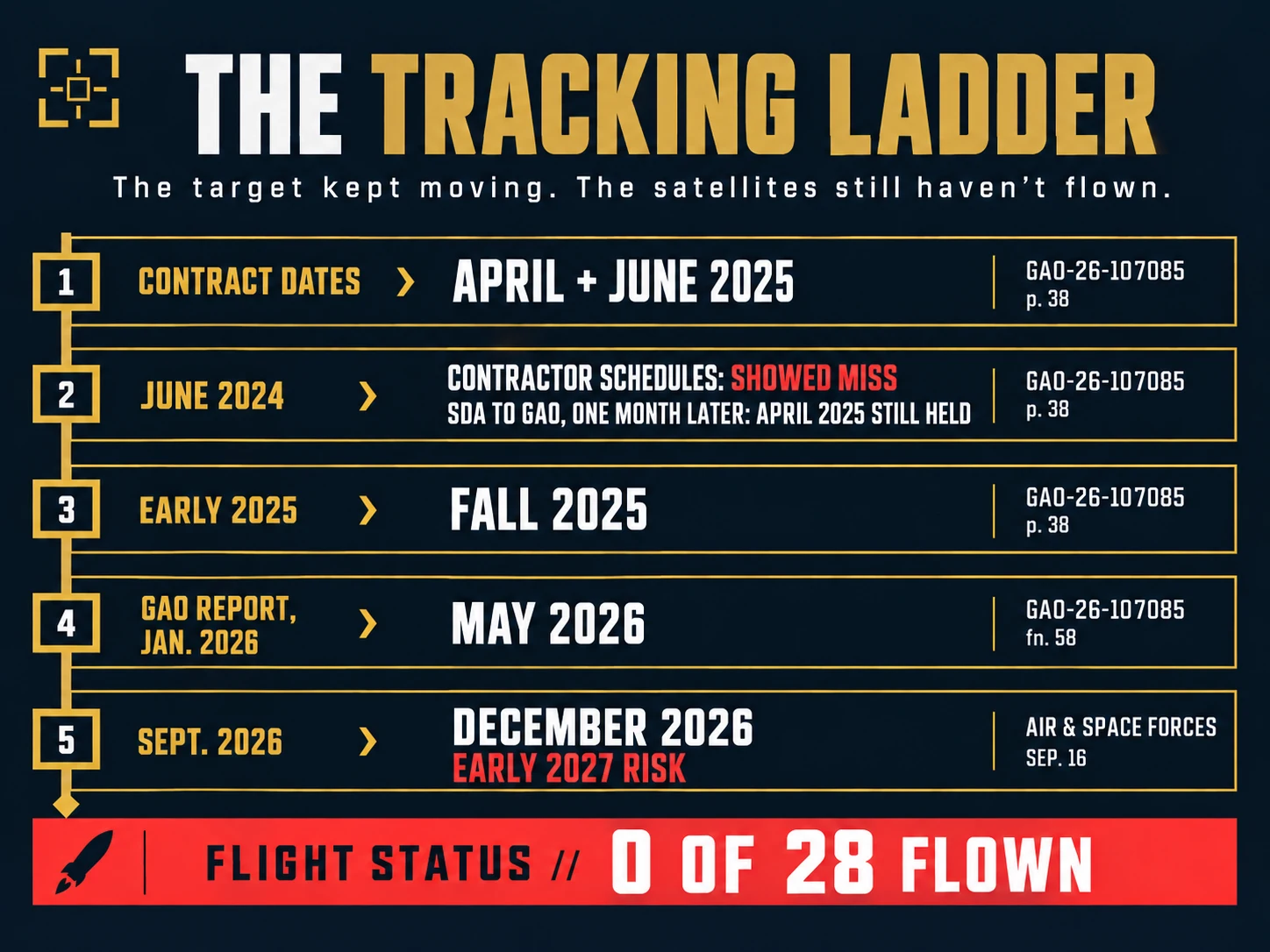
The Tracking Layer is the eye of the constellation: infrared sensors designed to spot heat signatures and follow missile trajectories. On the public calendar, its launch date has been a moving target, sliding across five positions:6, 10
- The contract baseline: April and June 2025.
- June 2024: Internal contractor schedules showed both builders missing those dates. One month later, SDA told GAO that launches remained on track for April 2025.
- Early 2025: Re-anchored to fall 2025.
- January 2026: Pushed to May 2026 as GAO's audit became public.
- September 2026: Reset to December 2026, with Sandhoo conceding that flight software and optical terminal delays risk a further slip into early 2027.
Five dates on paper. Zero of 28 Tracking satellites in space.
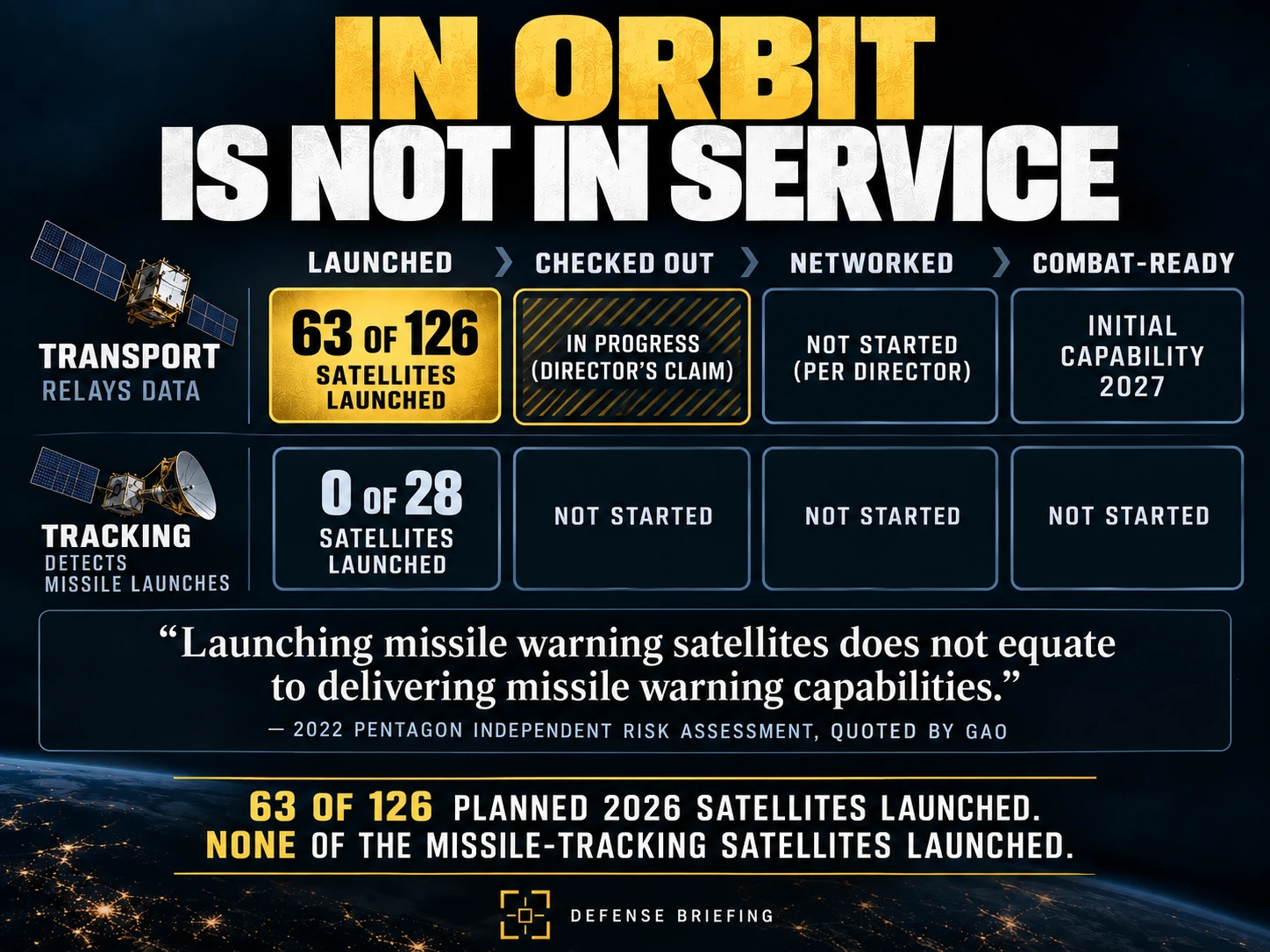
Even when a rocket clears the pad, the work has barely begun. A 2022 Pentagon independent risk assessment made the distinction plain:
"Launching missile warning satellites does not equate to delivering missile warning capabilities."
2022 Pentagon independent risk assessment, quoted by GAO.6 (p. 36)
The operational pipeline has four steps: launch, checkout, networking and combat integration. Transport is working through the middle steps. Tracking has yet to reach the pad.
Know someone who tracks SDA contracts? The next scorecard lands in their inbox free.
Subscribe FreeThe Director's Horizon
SDA's forward roadmap relies on a tight sequence of upcoming targets:
- Next up: 21 Northrop Grumman Transport satellites. Northrop confirmed hardware delivery to Vandenberg Space Force Base on 28-SEP-2026, with launch projected within three weeks.16
- December 2026: A second launch aimed at orbiting the first batch of Tracking satellites, with acknowledged slip risk into early 2027.10, 13
- Spring 2027: Targeted completion of the entire Tranche 1 launch campaign.10, 13
- 2027: Target for initial warfighting capability remains officially unchanged.5
Fairness demands a distinction. Tranche 1 was never promised as the complete missile-defense shield. SDA planning documents reserve full operational capability for Tranche 3, slated to begin launching in 2029.6 (p. 15) Tranche 1 does not need to complete the architecture. It needs to start getting its share of hardware into the sky. So far, it has not managed even that for Tracking.
The Scoreboard
Behind the hardware stands a roster of defense contractors, and the smallest contract delivered the fastest results:
- York Space Systems ($382M award): 42 of 42 Transport satellites launched across two orbital planes.2, 5
- Lockheed Martin ($700M award): 21 of 42 Transport satellites launched.2, 4
- Northrop Grumman ($692M award): 0 of 42 Transport satellites launched, with the first 21 delivered to Vandenberg. Northrop also builds Tracking Layer satellites alongside L3Harris.2, 16
- General Dynamics Mission Systems: building the ground segment.
- Command hubs: Grand Forks Air Force Base, North Dakota, and Redstone Arsenal, Alabama.
- The ride: SpaceX Falcon 9 rockets launching from Vandenberg Space Force Base for all flights to date.
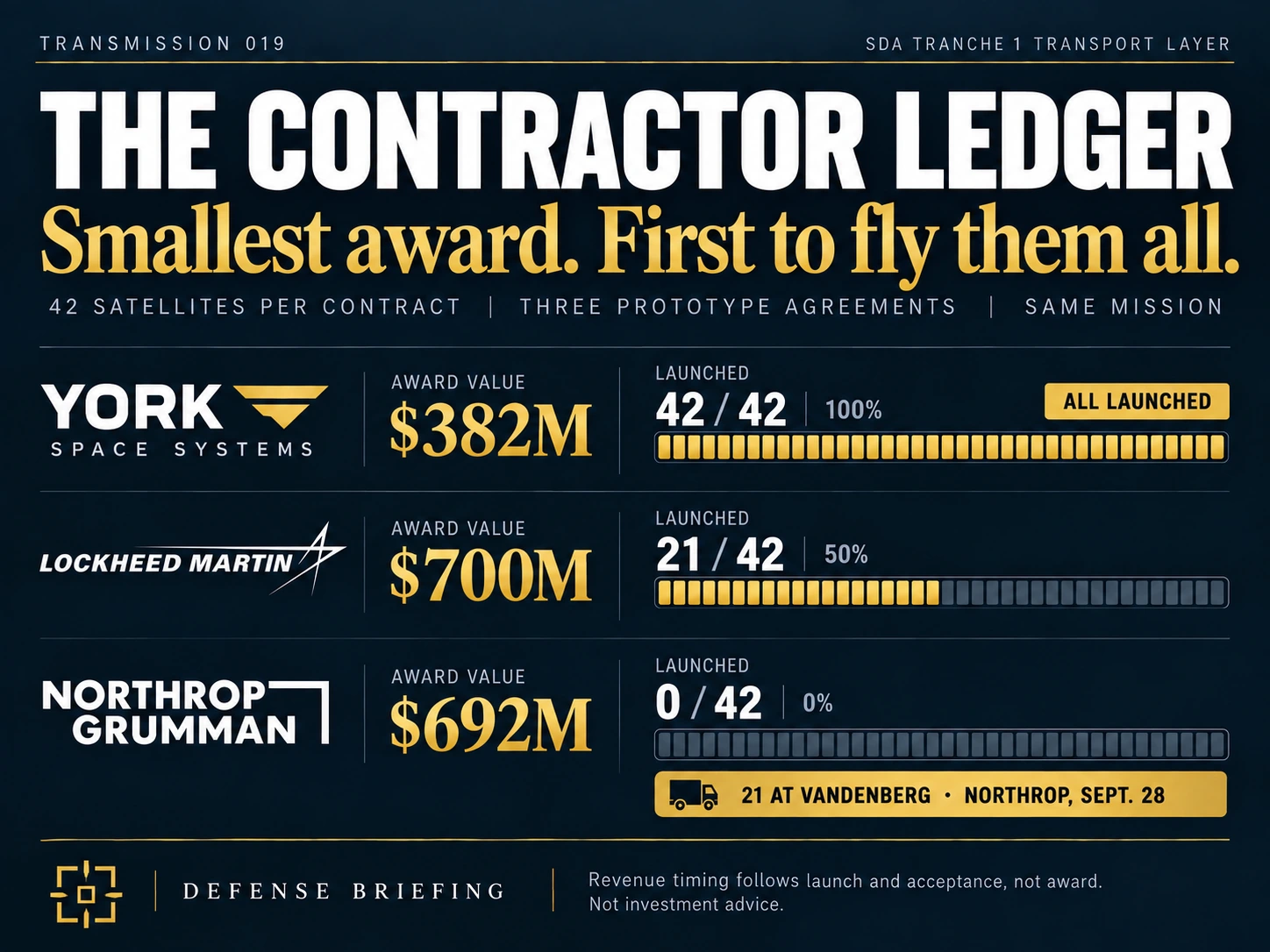
Pentagon acquisition produces strange scoreboards, but rarely one this stark: the vendor handed the smallest paycheck is the only one to finish its homework.
The Angle
Speed was never merely an ambition for SDA. It was its raison d'être. Established in 2019 to bypass legacy Pentagon procurement, SDA set out to field satellites on two-year cycles, keep vendor competition fierce and lap the traditional space acquisition apparatus next door.
Now that founding premise faces a congressional reckoning.
Drafts of the FY2027 defense authorization bill in both chambers propose repealing the statutory mandates behind both SDA and the Space Rapid Capabilities Office, absorbing them into the Space Force's broader acquisition structure. Sandhoo contends that as long as the agency keeps its specialized hiring, classification and contracting authorities, "it's just a name change." On whether Capitol Hill will preserve those carve-outs, he was candid: "They may choose to keep it. They may not."14
The budget fight tells the same story.
The Space Force's FY2027 request zeroed out funding for Tranche 3 Transport, folding those requirements into its broader Space Data Network (SDN) architecture.15 But a request is not an appropriation. Congress overruled the service when it attempted a similar zero-out in FY2026, restoring $500 million for Tranche 3, driven in part by concerns about concentrated dependence on SpaceX. House appropriators are again pushing to preserve the Transport Layer.17
The Golden Dome project complicates matters further. The Pentagon directed $10 billion toward the missile defense initiative in part to accelerate space-based tracking and the Space Force's data transport pipeline.18 Yet tracking from LEO is precisely the mission SDA was built to deliver, and not one of its Tranche 1 Tracking satellites has reached orbit.
As the fiscal year closes, the agency created to prove the Pentagon could move fast finds itself in a defensive crouch: protecting its institutional autonomy while its constellation is 41 percent launched, its missile-tracking layer remains grounded and its optical mesh awaits its first true link.
This friction does not prove SDA's rapid-acquisition thesis is broken. It defines the record Congress must now weigh. The decisive question is no longer whether SDA can draft an ambitious timeline, but whether this tranche delivers fast enough to save the agency that set it.
Key Implications
- National security: The missile warning component of Tranche 1 remains entirely on the ground, and its connecting data mesh has yet to activate. Legacy missile-warning satellites in higher orbits will keep carrying the mission until LEO capability comes online.
- Capital and markets: Contractor revenue recognition depends on launch and operational acceptance, not contract award. York Space Systems has delivered and launched its entire Tranche 1 Transport allocation, while Lockheed Martin and Northrop Grumman still have half or more of their hardware waiting for orbit. Whether SDA's two-year cadence survives the reorganization will shape the addressable pipeline for Tranche 3 and beyond. This is analysis, not investment advice.
Congress decides SDA's future next. We will read the bill text so you do not have to.
Get Orbital Intel FreeThe Speed Paradigm on Trial
SDA's problem is not that it failed to launch satellites. It is that it tied its institutional existence to a single, uncompromising metric: speed.
By trading exhaustive ground testing for rapid trial in orbit, SDA set out to prove that learning on orbit beats the slow cadence of legacy defense procurement. But when hardware defects, software glitches and unproven laser terminals triggered a nine-month stand-down, the agency fell behind the very calendar it claimed to master.
Now, with less than half of Tranche 1 in orbit and the missile-tracking layer entirely grounded as FY2026 closes, Capitol Hill is preparing its own audit. The legislative push to fold SDA into the Space Force is not routine bureaucracy. It is a formal verdict on whether "good enough, fast" ever arrived fast enough.
If SDA keeps its autonomy, it will not be because Tranche 1 hit the deadline SDA set for itself. It will be because lawmakers judge that an outfit delivering about 41 percent of the promised constellation is still faster than the acquisition system that would absorb it. Or it will be simpler than that: Congress may put off a final decision long enough for SDA to get a few Tracking satellites on orbit, close a laser link in the dark and let the constellation argue its own case.
Forward this to the portfolio manager who still thinks a contract award means satellites in service.
Sources: This briefing relies primarily on Space Development Agency fact sheets and releases (28-FEB-2022, 05-SEP-2025, 10-SEP-2025 and 16-JUL-2026) and GAO report GAO-26-107085. Director statements are drawn from trade and specialist reporting by Defense Daily, DefenseScoop, Via Satellite, Air & Space Forces Magazine, Breaking Defense and Federal News Network. Budget and appropriations context draws on DefenseScoop and Inside Defense. GAO page numbers refer to the standard (non-accessible) PDF. The numbered list below is authoritative. No classified information was used and all material is publicly accessible.