
Space Control: The Acknowledgment Is New. The Argument Is Not.
He would not say what they are, how many exist, what orbit they fly or whether any has been tested. What changed on 14-SEP-2026 was the public record, not necessarily anything in orbit.

On 14-SEP-2026, the secretary of the Air Force told a ballroom full of people in Maryland that the United States has weapons in orbit. Then he sat down for a fireside chat where he was asked to clarify what weapons he was referring to. He declined to elaborate. He declined again at a media roundtable. He would not identify their type, capabilities or test history. He did not disclose how many exist, what orbits they fly in, when they went up or whether any have been used. Asked about the wording, he said the phrase had been "very well thought out, so whatever I said before is what I say again."10, 16
That is not a man who misspoke. That was deliberate language.
The argument for such weapons was already in the paperwork. On 26-MAR-2026, in written posture testimony to the Senate Armed Services Committee, Gen. Stephen N. Whiting, commander of U.S. Space Command, put it in print: "To maintain deterrence, we cannot just rely on a resilient or defensive posture. Acquiring credible space superiority capabilities, or integrated space fires, is a strategic imperative. These weapons are essential to deter conflict." A four-star publicly argued for American space weapons before Congress six months before a service secretary said they were already in orbit.1
These two statements serve different purposes, and that distinction is central to the story. The March document establishes a requirement and the reasoning behind it. It does not confirm deployment. The September speech asserts that weapons are already in orbit. The public record does not reveal when they arrived or whether the two men were describing the same systems.
What changed on 14-SEP-2026 was the public record, not necessarily the reality in space. Meink presented acknowledgment as a tool of deterrence. Investors should resist treating disclosure as a new revenue event: a classified program may already have funding. Acknowledgment creates neither a fresh budget nor a new capability, though it can make existing capabilities easier to discuss publicly. It also does not identify a specific adversary incident or technical milestone that prompted the timing.
An acknowledgment, not an unveiling
At the Air and Space Forces Association’s Air, Space and Cyber Conference in National Harbor, Maryland, Air Force Secretary Troy Meink made the claim explicit: "Today, we continue to ensure we remain ready to meet the challenges of evolving threats, wherever they exist. This is why the United States now has on-orbit space control weapons capable of defending the joint force against hostile adversary action."7, 8, 9
ABC News presented that sentence as a direct quotation. The Financial Times and Ars Technica published the same wording. A Space Force spokesman subsequently confirmed the substance and described space control as encompassing kinetic and non-kinetic capabilities for offensive or defensive purposes. That description of the mission did not identify the particular weapons Meink acknowledged.7, 32
Reporters pressed for details and met a brick wall. Asked about the systems and their testing, Meink said: "I’m not going to talk about the specifics of what we’re doing, whether we’ve tested or not tested." He offered deterrence as the reason to acknowledge the capability while arguing that disclosing its mechanics would give too much away. The claim entered the public record. The inventory stayed behind the curtain.10, 15
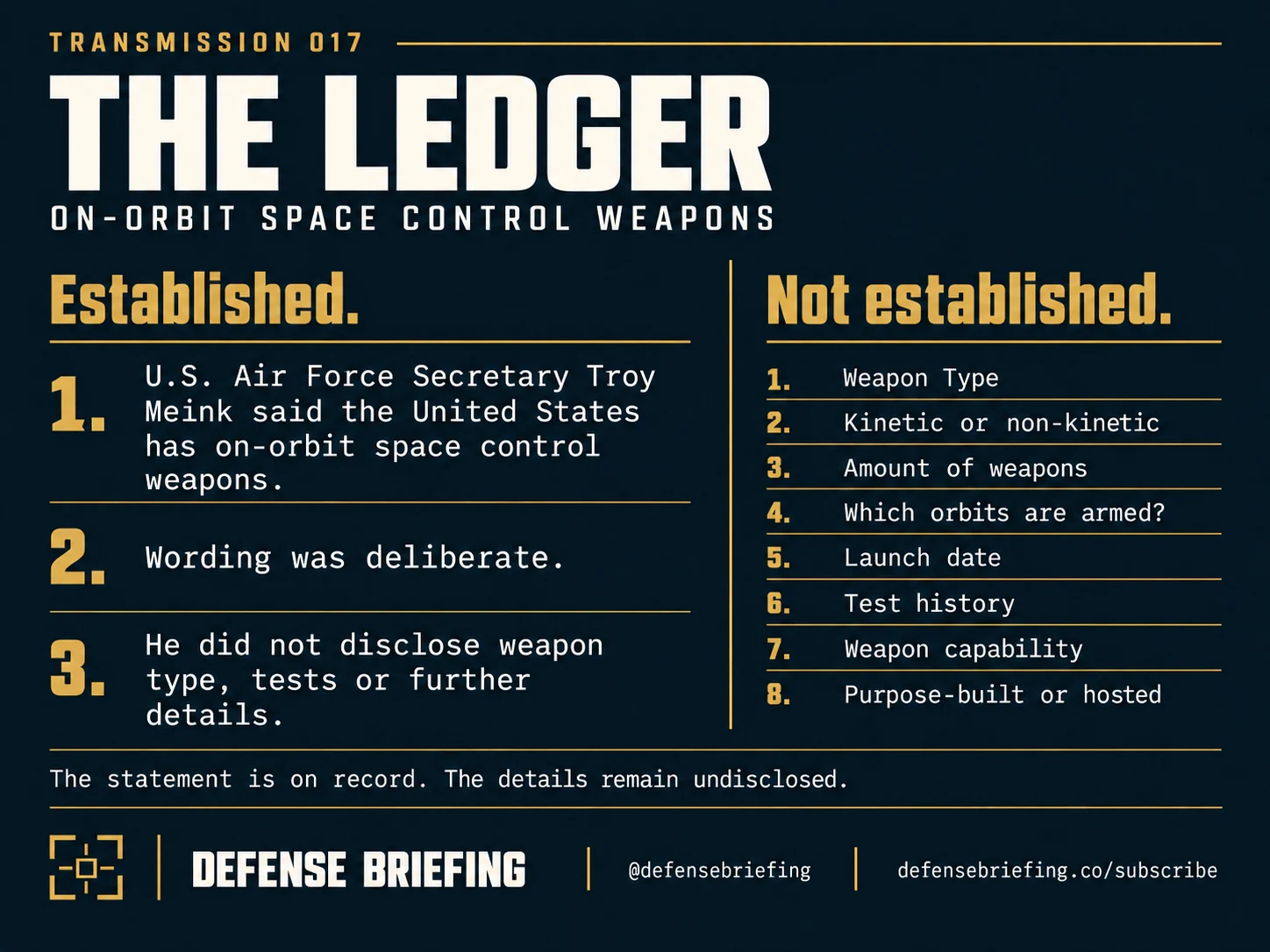
Established. A senior civilian official of the Department of the Air Force said in public that the United States has space control weapons on orbit and confirmed under questioning that the wording was chosen with care.10
Not established. What are the weapons? Are they kinetic or non-kinetic? How many exist? Which orbits do they occupy? When were they launched? Have they been tested or used? Are they purpose-built systems or capabilities hosted on spacecraft with another stated mission? What can they target?
Contested. Whether this was a first depends on the definition. Victoria Samson of the Secure World Foundation characterized it as the first public acknowledgment of a designed weapon placed in space. That is her interpretation of the announcement, not a technical description of the systems. The United States has previously acknowledged counterspace weapons, including ground-based satellite jammers. The narrower question concerns a weapon already in orbit. Calling this America’s first space weapon erases that distinction and decades of history.11, 12
Follow the evidence behind the headlines.
Get Orbital Intel FreeWhat is actually being controlled
To the uninitiated, "space control" sounds like a bureaucratic real estate grab. The mission is about access, not ownership. Article II of the Outer Space Treaty prohibits national appropriation by sovereignty, use, occupation or any other means. It does not settle every question about commercial activity in space.
Space Warfighting: A Framework for Planners, the unclassified Space Force framework published in April 2025, describes space control as operations to achieve space superiority. The objective is a degree of control that lets friendly forces operate at a chosen time and place without prohibitive interference while denying an adversary the same freedom. That is not a claim to total control of the cosmos.2
Alongside defensive operations, the framework identifies three offensive counterspace mission areas:
Orbital strike: Actions to destroy, disrupt or degrade adversary space platforms using kinetic or non-kinetic effects. Pursuit operations involve rendezvous before weapons employment. Standoff operations use long-range fires from space or terrestrial platforms.
Space link interdiction: Operations to disrupt or degrade the links within an adversary’s space architecture, including through electromagnetic or cyber means.
Terrestrial strike: Attacks on the terrestrial components of an adversary’s space architecture, including command, tracking and launch infrastructure.2
Seventeen months on a public server. The framework describes the shape of the mission, not the address of a weapon. It establishes how the Space Force thinks about counterspace operations. It does not establish what has been deployed.
The framework also explains why "defending the joint force" does not identify a weapon’s method. Offensive and defensive operations can overlap: an attack on an adversary’s counterspace system may protect friendly forces. Purpose and effect are different questions. Meink supplied the purpose. He withheld the effect.2
You do not have to destroy a satellite to defeat its mission
Public debates over space warfare tend to fixate on explosions. But a satellite’s mission depends on sensors, communications links, software and ground infrastructure. Disrupt one of those dependencies and you may defeat the mission without touching the spacecraft. The satellite can remain intact while the people relying on it lose a vital service.
Two distinctions matter. First, where a weapon sits does not tell you what it hits. A truck-mounted jammer can disrupt a satellite communications link. A cyber intrusion can reach a space system through its ground network. An orbital payload could interfere with a receiver on Earth. Location, target and effect are separate entries in the ledger.
Second, temporary does not mean trivial. The Space Force framework includes reversible interference as well as destructive effects. A short outage during a missile attack could matter more than a long outage in a less critical service. Non-destructive interference need not create debris, but its strategic consequences depend on what is interrupted and when. Duration belongs to the attack. Consequence belongs to the minute it lands in.2, 31
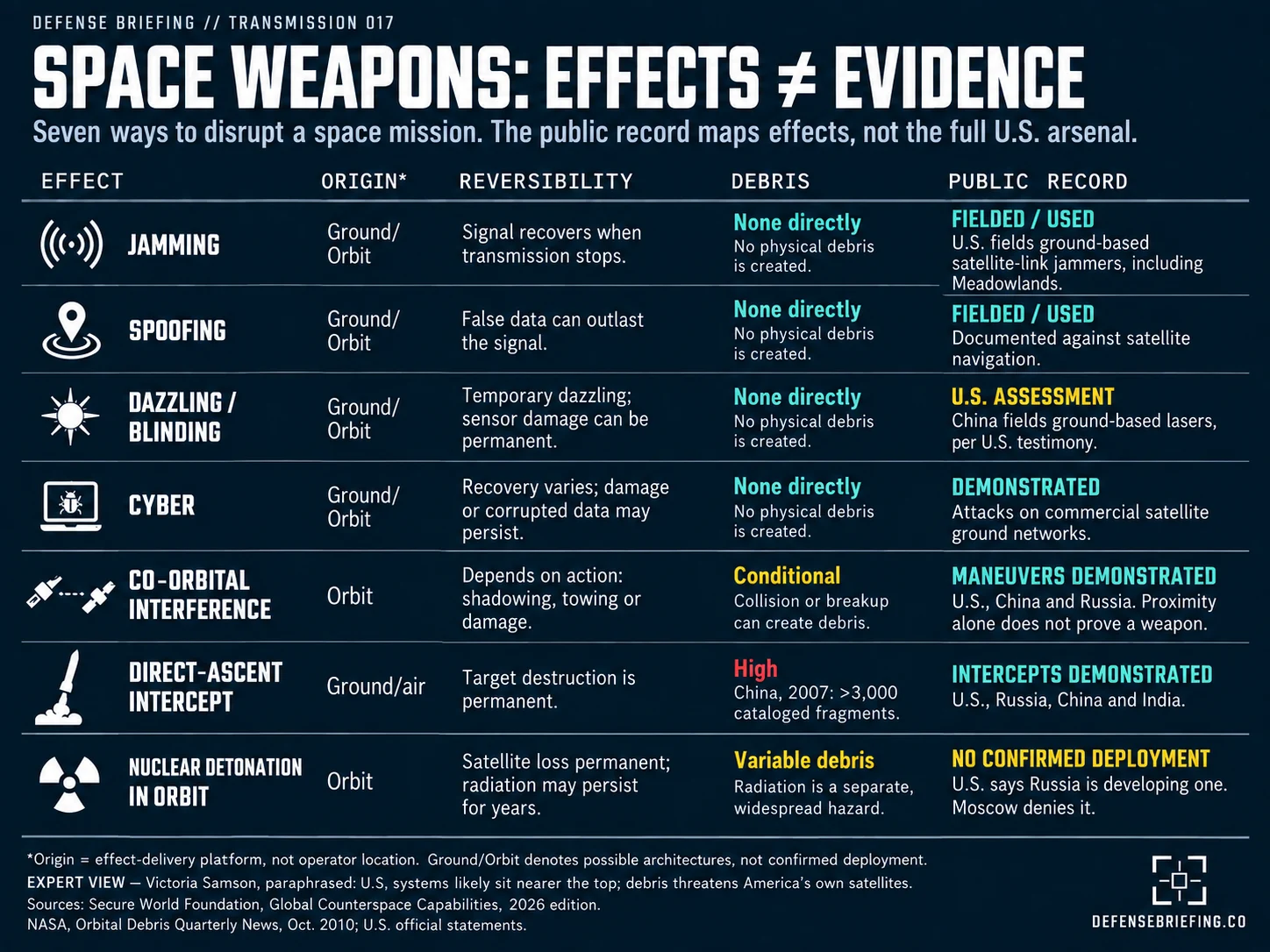
Read the effects matrix as text
| Effect | How it works | Duration | Debris risk | Evidence status |
|---|---|---|---|---|
| Jamming | Interferes with a radio link. | Usually temporary; recovery may lag. | None directly. | Ground-based U.S. satellite jammers are acknowledged. |
| Spoofing | Supplies false navigation or other data. | False data can outlast the signal. | None directly. | Documented against satellite navigation. |
| Dazzling / blinding | Interferes with or damages a sensor. | Temporary dazzling; damage can be permanent. | None directly. | U.S. testimony assesses Chinese ground-based lasers. |
| Cyber | Compromises networks, software or data. | Access, corruption or damage can persist. | None directly. | Attacks on satellite ground networks are documented. |
| Co-orbital interference | Acts from another spacecraft. | Depends on the action. | Conditional: collision or breakup can create debris. | Maneuvers demonstrated. Proximity alone does not prove a weapon. |
| Direct-ascent intercept | Missile launched from ground or aircraft. | Target destruction is permanent. | Potentially substantial; persistence depends on orbit. | U.S., Russia, China and India have demonstrated intercepts. |
| Nuclear detonation in orbit | Blast and radiation affect spacecraft. | Satellite losses can be permanent; radiation can persist. | Variable debris; widespread radiation hazard. | U.S. alleges Russian development. No confirmed deployment. |
Samson's guess, offered merely as a guess, is that the acknowledged American systems sit nearer the top of that table than the bottom, reasoning that debris punishes whoever has the most satellites to lose, and that is the United States by a wide margin.11
Follow the evidence behind the headlines.
Get Orbital Intel FreeThree missions, not one story
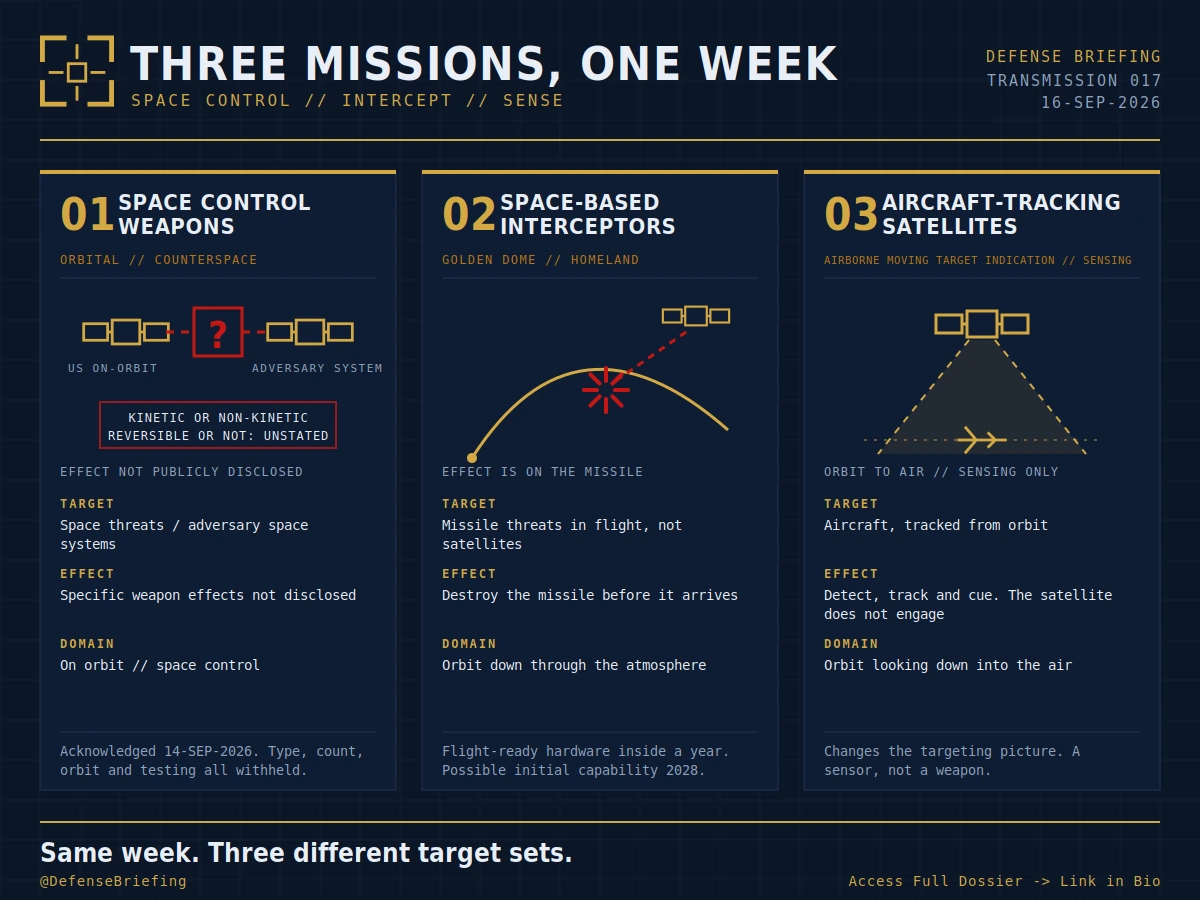
Golden Dome space-based interceptors. The stated mission is to destroy missiles in flight. Meink said the program had moved from initial contracts to flight-ready hardware in under a year. The competition could lead to an initial capability by 2028. Flight-ready hardware is not the same as an operational constellation. This is a different target set from counterspace operations.10
Aircraft-tracking satellites. Space-based air moving target indication uses sensors in orbit to detect and track aircraft. It can improve the targeting picture without the satellite itself engaging the target. Sensing aircraft, intercepting missiles and controlling an adversary’s access to space are three different missions. The week’s announcements should not be collapsed into one.10
This has a history
American counterspace work is older than the Space Force by about sixty years. The point of the following is to keep old experiments separate from a present acknowledgment, not to hint at some unbroken secret program humming along since Eisenhower.
1959. Bold Orion. A missile dropped from a B-47 passed near the Explorer VI satellite. A proof of concept, not an intercept.31
1960s. SAINT and Program 437. SAINT was a satellite-inspection program that never reached operations. Program 437 did. Nuclear-tipped Thor missiles on Johnston Island, operational from 1964 to 1975. The United States has fielded an operational antisatellite weapon before. It was nuclear, it sat on an island and it was retired half a century ago.27, 31
1985. ASM-135. A missile launched from an F-15 destroyed the Solwind P78-1 satellite, which was American. The program was canceled.26
2008. Operation Burnt Frost. A modified Standard Missile-3 (SM-3), fired from the cruiser USS Lake Erie, destroyed USA-193, a failing American intelligence satellite. Officials cited the danger posed by its hydrazine tank during reentry. The operation also demonstrated that a modified missile-defense interceptor could destroy a satellite.28
Now. Jammers on trucks. The Counter Communications System and its successor Meadowlands are transportable ground systems that jam adversary satellite communications. The Space Force accepted Meadowlands for operational use on 26-JUN-2026. Mission Delta 3 at Peterson Space Force Base operates it. These are acknowledged offensive counterspace weapons. They are also on the ground, which is exactly why one sentence about orbit made news in September.29
Now. Inspection satellites. The Geosynchronous Space Situational Awareness Program flies spacecraft that maneuver around the geostationary belt. The official mission is inspection and space domain awareness. Outside analysts and foreign governments have long noted that a spacecraft able to sidle up to another one has uses beyond looking. That dual-use potential creates ambiguity, regardless of the official mission.31
The physics was not new. The public language was changing.
Follow the evidence behind the headlines.
Get Orbital Intel FreeWho else can do what
The United States has spent a decade describing Chinese and Russian counterspace programs in more detail than it has ever described its own. Read what follows on a ladder: demonstrated, officially acknowledged, assessed by outside analysts, alleged. A rendezvous demonstration is not a deployed weapon. A research paper is not a fielded capability.
China. Whiting’s Senate testimony put China’s active satellite fleet above 1,300, a 600 percent increase since 2015, including more than 500 intelligence, surveillance and reconnaissance (ISR) satellites. He also assessed that China had fielded direct-ascent antisatellite missiles, ground-based lasers, electronic jammers and co-orbital antisatellite capabilities. These are U.S. official assessments of a competitor, not an independently verified inventory.1
In 2022, China’s Shijian-21 docked with a defunct Beidou navigation satellite and towed it into a graveyard orbit. Whiting said Shijian-25 likely refueled Shijian-21 in 2025 and described coordinated maneuvers among multiple satellites in 2024. Those activities demonstrate or suggest servicing and maneuver capabilities. His testimony also discusses potential rearming. Servicing technology has military uses, but a rendezvous alone does not prove a weapon.1
China’s 2007 destructive test shattered its FY-1C weather satellite into thousands of cataloged fragments. The debris created a long-lived hazard for other spacecraft. A target can be destroyed in seconds while the consequences remain in orbit for decades.34
The evidence is uneven. The destructive intercept and satellite maneuvers are part of the public record. Claims about the readiness and purpose of particular counterspace systems rely heavily on official assessments. Those assessments should be reported as assessments, without turning every close approach into proof of a combat-ready weapon.1, 31
Russia. Whiting identifies Russia’s reported effort to develop a nuclear antisatellite weapon as a grave threat. His testimony warns that an orbital detonation could disable thousands of satellites and leave radiation hazards for years. The outcome would depend on the weapon and its location, but the effects could reach well beyond the intended target. Article IV of the Outer Space Treaty prohibits placing nuclear weapons in orbit, even before any detonation. Moscow denies the U.S. allegation. The underlying intelligence has not been made public.1, 6
The conventional record is clearer. Russia destroyed Cosmos 1408 in a November 2021 direct-ascent test, creating debris that endangered other spacecraft, including the International Space Station. Whiting’s Senate testimony says testing of the Nudol system has continued. A demonstrated intercept is evidence of capability. It is not a complete account of readiness or inventory.1
Whiting also described extensive Russian jamming of Global Positioning System (GPS) and other navigation signals across the Baltic, Black Sea and Mediterranean in 2025, including disruption to commercial aviation. The operational logic is straightforward: a country need not destroy a navigation satellite to deny someone its service.1
Keep the categories separate. Russia’s destructive antisatellite test is documented. U.S. officials assess its jamming and other counterspace capabilities. Inspector-satellite maneuvers do not, by themselves, prove a weapon. The alleged nuclear program is a different claim again, with no publicly confirmed deployment.
Everyone else. India demonstrated a destructive direct-ascent intercept in March 2019. Whiting’s testimony describes North Korean cyber capabilities and GPS and satellite communications jamming, while its Iran section emphasizes missiles and space launch vehicles. It does not identify fielded orbital counterspace weapons belonging to either country. Silence in a posture statement is not proof of absence.1
Whiting also describes U.S. rendezvous and proximity operations with France and the United Kingdom. Close-approach skills can support inspection, servicing or military operations. Assessing their significance requires more than a position on an orbital map: payload, behavior and mission matter.1
On 15-SEP-2026, China criticized U.S. space militarization while Russia called for weapons-free space, according to AFP. Those are official positions, not independent evidence about the American systems.33
Follow the evidence behind the headlines.
Get Orbital Intel FreeWhy say it now
Here is where the temptation to speculate is strongest and the evidence is also the thinnest, so it is worth walking through it slowly.
Documented. Meink offered a deterrence rationale and said the wording was deliberate. That is the only stated reason anyone actually has.
The paper trail. Everything below is public and none of it establishes deployment.
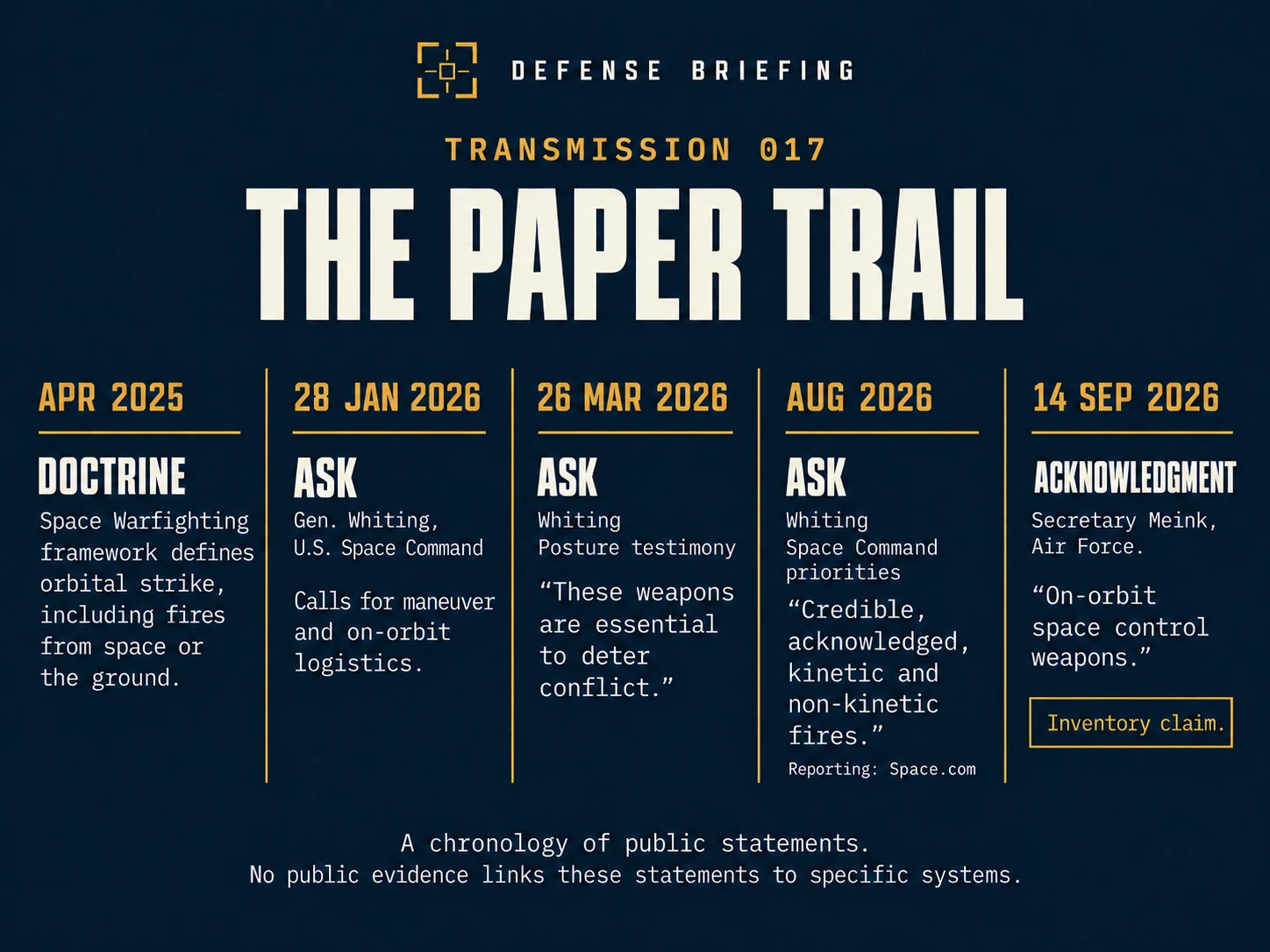
APR-2025: the Space Force publishes Space Warfighting: A Framework for Planners, defining orbital strike, space link interdiction and terrestrial strike. On 08-APR-2025, Whiting had publicly called for space fires, weapons systems and orbital interceptors. Requirement language, still not an inventory.2, 25
28-JAN-2026, at the Space Mobility Conference in Orlando, Whiting argues for maneuver and on-orbit logistics. The United States cannot allow competitors "to have superior maneuver capabilities in space any more than we would allow it on the land, at sea or in the air." Today's satellites, he says, are like "an aircraft carrier strike group across the Pacific with only the fuel in their tanks."4
26-MAR-2026, the Senate posture statement quoted at the top of this piece rejects reliance on a purely defensive posture and calls integrated space fires "these weapons," essential "to deter conflict, providing a clear and convincing message to potential aggressors that the costs of threatening U.S. and allied interests in space will be too high." Advocacy, in public, for weapons. Still a requirement rather than an inventory.1
12-AUG-2026, at the Space and Missile Defense Symposium in Huntsville, Whiting unveils his command's integrated priority list for fiscal years 2029 through 2033. Integrated space fires first, counter-pLEO second, meaning the ability to degrade proliferated low Earth orbit constellations, an architecture that can make one-interceptor-per-satellite attacks costly. Then the sentence that matters most here: "We're a combatant command and we fight to win wars. To win, we need credible, acknowledged, kinetic and non-kinetic fires."5, 19, 20
Acknowledged. A four-star asking, on the record, for weapons the public is allowed to know about.
Talking to reporters afterward, Whiting said he did not want U.S. forces put at risk by an adversary’s large satellite constellation. He asked industry for "one-to-many" effects rather than one interceptor per target. That could mean reaching a shared dependency, ground segment or control network rather than physically touching many satellites.24, 19
His deputy, Lt. Gen. Rick Zellmann, supplied the arithmetic: "I’d encourage our adversaries to try to shoot down 10,000 satellites, but I don’t think they will." He pointed to cyber and directed energy as potentially cheaper alternatives. Intercepting one satellite at a time can be costly against a large constellation. Repeatable effects or attacks on shared dependencies may offer another approach. That logic applies to threats against American constellations, too.22
A note on that event. Whiting spoke on 12-AUG-2026 at the Space and Missile Defense Symposium in Huntsville. The quotations here rely on contemporaneous reporting from the event, rather than an official transcript. The full fiscal 2029 through 2033 priority list was not available in the public material reviewed for this article.5
Read in sequence, August and September are consistent. What they are not is evidence of coordination. Nothing shows one statement was arranged in response to the other, or that either man knew the other's plans, or that the two were describing the same hardware. Whiting was naming a requirement for fiscal 2029 through 2033. Meink was describing something he said exists now. The direction of policy was legible well before September. That is all the sequence proves.
Worth investigating, none of it settled. The intended audience could have included allies, Congress, industry, the American public or foreign governments. Nothing in the available record settles the question.
Not established. No adversary incident and no technical milestone has been identified as the trigger. The absence of a stated trigger is not evidence that one exists.
The case for silence. Secrecy preserves advantage. An adversary who does not know what you have cannot design around it. Meink made that argument himself when he said the details would not help deterrence.
The case against. A deterrent works when the other side understands what is being deterred and what happens if they try. A sentence confirming that weapons exist while specifying nothing communicates resolve without communicating a threshold. It may deter. It may also invite an adversary to assume the worst and build for it, or to decide that since Washington has planted the flag, their own programs need no further excuse. Samson's warning goes precisely here: "The US also now has to accept the Chinese and Russians doing/saying the same."12
Both effects are plausible. A sentence this vague cannot tell you which one wins, and anyone who says otherwise is guessing in a confident voice.
Follow the evidence behind the headlines.
Get Orbital Intel FreeHow far does the mission extend
Cislunar space is the region around Earth and the Moon, including the space between them and nearby gravitational balance points. It is migrating from a science topic to a planning topic, and it is where this story is most likely to go off the road.
Meink’s acknowledgment did not identify an orbital regime or establish a deployment in cislunar space.
The official language that does exist is about ground, not guns. Space Command's 2026 publication The Space Warfighting Environment 2040, from its future concepts branch, carries a section on printed page 33 headed "First-Mover Advantage in Cislunar Space." The region, it says, "contains areas of gravitational stability, maneuver corridors, and vantage points where presence confers positional advantage," and whoever first maps it, finds the chokepoints and sets the behavioral norms "will shape the foundation upon which all others must operate." Then a line more careful than most of the coverage it has received: "What makes cislunar relevant now is not speculation about future conflict, but the terrain itself."3
The document describes itself as a framework rather than a forecast. It tells you what Space Command is planning around, not what it has. None of the documents reviewed for this article claims weapons have been deployed in cislunar space. Calling the region key terrain describes a planning problem, and a planning problem is not a deployment.3
What changes for the space economy
The commercial consequence is another reason to distinguish a spacecraft from the service it provides. That leads straight into the subject of our last issue.
From losing a satellite to losing a service. An outage can impose costs even when the spacecraft survives. Navigation and timing disruptions can affect aviation, shipping or other systems that rely on those signals. The effect depends on duration, geography and available backups. Nothing has to break for a bill to arrive.
Resilience is a product as well as a planning principle. Proliferated constellations, on-orbit servicing and refueling, rapid replacement launch and distributed ground segments can serve both efficiency and survivability. Whiting calls the fuel limit on today’s satellites a "psychology of scarcity" that discourages maneuver. His January remarks also identify hydrazine production and commercial launch capacity as priorities. Those are industrial requirements, not guarantees that any particular company will win an award.4
Ground systems matter. The 2040 framework warns that static ground nodes will be vulnerable and frequently targeted. That is a planning judgment, not a forecast of a particular attack. It deserves attention in a sector whose most visible hardware is in orbit. Whether markets have priced that risk is a separate question, and we have not measured it.3
Commercial participation raises two separate legal questions. A dual-use satellite may become a military objective when its use effectively contributes to military action and disabling it offers a definite military advantage in the circumstances at the time. The status of civilian operators is separate and depends on whether their own acts amount to direct participation in hostilities. Neither answer follows merely from a company supporting a military customer. The distinction is not academic for a company with investors. Even when an object qualifies as a military objective, proportionality and precautions still apply. These are context-dependent legal tests.30
And insurance. Transmission 016 covered how little of the space economy is actually insured and how thin the underwriting bench is. Do not assume a spacecraft policy covers deliberate state action. Coverage and exclusions turn on the contract, including any war, hostile-acts, cyber or governmental-action provisions. The disclosure changed the public information available to anyone pricing this risk. Whether the underlying risk changed on 14 September, earlier or at all is not something the statement establishes. The wording is worth reading before an incident rather than after one.
Follow the evidence behind the headlines.
Get Orbital Intel FreeThe unanswered operational questions
What are the targets and hardware?
What do these systems threaten: communications links, sensors, control networks or the spacecraft itself? Are they purpose-built weapons or capabilities hosted on a platform with another stated mission? Neither design approach establishes a deployment date. Without knowing the effect and target, we cannot reliably assess the military reach of the announcement.
How long do the effects last?
How long do the effects last, and who else could be affected? Reversible interference can have serious consequences. Destructive attacks can create debris that threatens spacecraft beyond the intended target, although the scale and persistence depend on the event and orbit. Neither category comes with a predictable escalation script.
Who can use them, and how quickly?
Who can authorize use, under what rules and at what readiness level? Command authority is one part of the answer. Training, system readiness and communications also influence how quickly a capability can be employed. The announcement supplies none of those details.
The Angle
Washington has named a capability while withholding the inventory: type, count, orbit, timing and test history. That acknowledgment matters. It is not a technical disclosure. The public paperwork explains why commanders want space weapons and how they think about using them. It does not identify the weapons Meink says are already there. The task now is to follow the evidence without filling the silence with hardware of our own invention.
Forward this to someone following the changing military role of space.
Notes on evidence. The September quotation is attributed to ABC News and the reporting linked above; the Space Force separately confirmed the substance in a statement. August quotations rely on reporting from the symposium. Assessments of Chinese and Russian capabilities draw heavily on U.S. official testimony, an interested party describing competitors. Analyst speculation is labeled. The public sources reviewed do not identify the American systems Meink acknowledged.