
The Space Economy is Learning to Fly Bare
Space insurance is not disappearing. But proliferated constellations are changing the economics of when it makes sense to insure a spacecraft and when the operator may be better off carrying the risk itself.

The fragment was smaller than a grain of rice. At orbital closing speeds it hit with the energy of a rifle round.
It struck SpainSat NG II while the Spanish military communications satellite was climbing toward geostationary orbit (GEO). Hisdesat, the satellite operator, described the object as "millimetric in size" and weighing "only a few grams," two figures that do not sit easily together. The spacecraft survived structurally. The impact still found what Hisdesat called a vital area and caused non-recoverable damage.1
Hisdesat and Spain's Ministry of Defence began the process of procuring a replacement.1
Then the financial damage landed in London.
Broker Gallagher said underwriters received notice of the potential loss on 26-DEC-2025. SpainSat NG II carried more than $400 million of insurance, according to Gallagher, and the potential claim moved its estimate of the market's 2025 loss ratio from roughly 15 percent to roughly 75 percent.2
Aon, using its own occurrence-year estimate, later put 2025 claims near $503 million and the loss ratio at 77.4 percent. Two brokers, two different methods, nearly the same answer.3
Indra Group's 2025 audited accounts approach the same spacecraft from another direction. They carried the asset at roughly €352 million and said it was insured for 100 percent of that value through two Mapfre launch and in-orbit policies. Converted to dollars, that book value sits in the same range as the coverage figure Gallagher cites, but the two are not the same measurement.4
Three numbers. Three different things. Gallagher's estimate of coverage placed. Aon's estimate of claims incurred across the market. Indra's accounting value for the spacecraft.
One damaged satellite was large enough to reshape the economics of an entire global insurance class.
The rockets multiplied. The satellites accumulated. The underwriting room did not.
Aon counts 25 insurers writing space risks in 2026, excluding Chinese markets, with underwriting offices in the United Kingdom accounting for roughly 43 percent of theoretical launch capacity.3
But a more interesting change is happening among the buyers.
Some operators have decided not to insure every spacecraft. They are flying naked. Not all of them. Not even most of them. But enough of them to change how the market prices what is left.
SPACE INSURANCE IN 30 SECONDS
- • Spacecraft hull insurance is a commercial choice. U.S. launch and reentry operators must demonstrate financial responsibility for third-party and government-property risk, but they do not have to insure the satellite itself.5, 6
- • Unique, high-value spacecraft can still justify hundreds of millions of dollars of coverage because one loss can erase a major asset or capability.
- • Proliferated constellations change the math. If a fleet can tolerate a lost node and the factory can replace it, the operator may retain more in-orbit risk itself.3
- • That does not mean constellation operators usually fly uninsured. It means some operators have decided outside insurance is not worth buying for every spacecraft.
- • SpainSat NG II shows why the traditional market still matters: one insured loss above $400 million was enough to move the estimated 2025 market loss ratio by roughly 60 percentage points.2
Insurance is a Chain of Bets
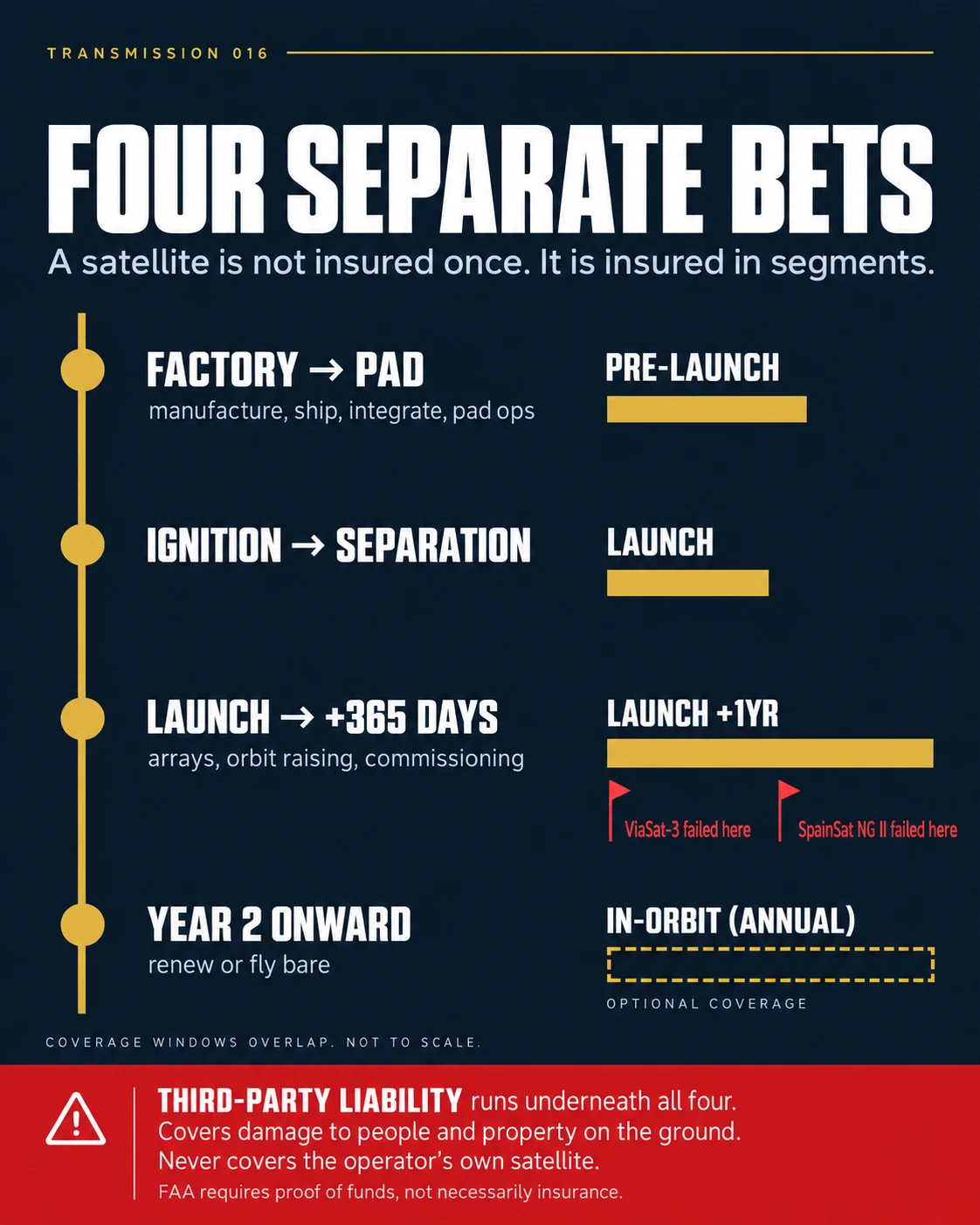
There is no single moment when a spacecraft is simply "insured." The risk changes as the hardware moves from factory to launch pad to orbit, and insurers sell coverage around those different stages.
Pre-launch insurance can protect the satellite during manufacturing, shipping, integration and pad operations. Launch coverage takes over for the ascent. Launch-plus-one-year policies typically extend through separation, solar-array deployment, orbit raising and commissioning. That is the tumultuous period when a satellite may survive the launch perfectly and still become commercially useless for a variety of reasons.
Once the spacecraft is established on orbit, annual in-orbit coverage becomes another decision. The owner can purchase another year of coverage or it can continue on carrying the risk itself. Third-party liability operates differently.
For licensed U.S. launches and reentries, the Federal Aviation Administration (FAA) calculates a maximum probable loss (MPL) and requires operators to demonstrate financial responsibility up to that level. Operators can meet the requirement through commercial insurance, escrow or qualifying financial reserves.5 By statute, the required amount cannot exceed the lesser of available insurance or the caps written into law: $500 million for third-party claims and $100 million for damage to U.S. government property.6
Above the required financial-responsibility layer, federal law provides a risk-sharing mechanism for certain successful third-party claims up to $1.5 billion adjusted for inflation, subject to the statutory framework and congressional appropriations. Congress most recently extended that regime to license applications received through 30-SEP-2028.6
Financial responsibility for launch and reentry liability can be a license requirement. Insurance on the spacecraft itself is a commercial decision. There is no equivalent of compulsory automobile hull insurance requiring a satellite owner to insure the machine it puts into orbit. If the antenna refuses to deploy, the propulsion system fails or debris destroys the satellite, the owner can insure that risk. Or it can also choose not to.
The space economy is changing faster than the language used to describe it.
Get Orbital Intel FreeOne Space Economy. Two Balance Sheets
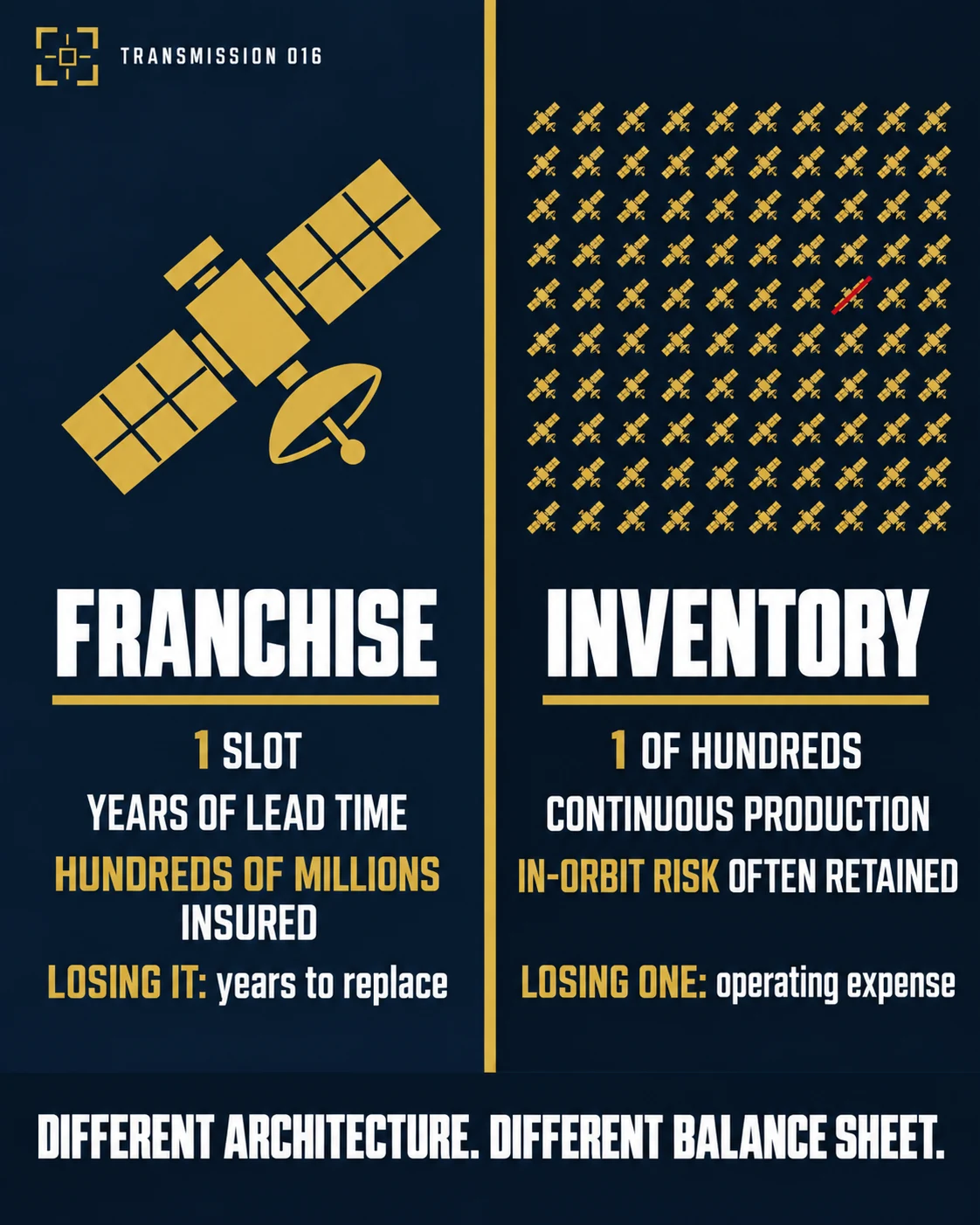
That choice makes more sense when the dividing line is drawn correctly. It does not run neatly between commercial and government spacecraft. It does not run between public and private companies. It does not even run cleanly between low Earth orbit (LEO) and GEO. It runs between the unique asset and the replaceable node.
A traditional geostationary communications satellite can be a hardware franchise. It may cost hundreds of millions of dollars, require years to manufacture, occupy a valuable orbital slot and support years of contracted service. Losing one can eliminate a major piece of revenue-producing infrastructure in a single event. Insurance has obvious value there.
A proliferated constellation works differently. One satellite can be one unit inside a much larger network. Production lines can remain active. Replacement spacecraft can already be under construction. The architecture itself may assume that individual nodes will eventually fail. That changes what a loss means.
Instead of losing a singular capital asset, the operator loses one unit in a fleet. And that changes what insurance is worth. Aon says many operators are retaining in-orbit risk as capital moves from legacy GEO spacecraft toward constellation programs including IRIS² and Telesat Lightspeed. Gallagher expects lower space-insurance premium income in 2026, citing a lighter schedule of heavily insured GEO launches and continued resistance among constellation operators to buying coverage.3, 2 That does not mean constellation operators generally fly uninsured. It means some do.
For an operator with sufficient scale, manufacturing capacity and financial strength, paying an outside underwriter to absorb the loss of an individual satellite may cost more than keeping that risk on its own balance sheet. For another operator, the exact opposite may be true.
The Small Market Behind Very Large Machines
Three numbers explain why the space insurance market can move so violently: premium, capacity and insured value.
Premium is the money flowing into the underwriting pool. Aon estimates the global space hull market collected roughly $550 million in premium during 2023 and absorbed about $1.43 billion in claims. Those are occurrence-year figures and can still develop as claims settle. The following year swung the other way. Aon estimates the market produced roughly $383 million of underwriting profit in 2024 on similar premium volume. Its occurrence-year estimate for 2025 shows more than $650 million in premium, approximately $503 million in claims and about $147 million in profit. Every one of these figures is a market estimate at a point in time. The important point is the scale. The annual premium pool for global space hull insurance is measured in hundreds of millions of dollars. One heavily insured satellite can therefore represent a meaningful fraction of an entire year's premium.3
Capacity is how much risk the underwriting market is prepared to place on a mission. Aon separates that into theoretical capacity and working capacity. Theoretical capacity assumes every participating underwriter offers its full line to the same placement. It is a mathematical ceiling. Working capacity is closer to what the market may actually deploy on a strong risk with proven spacecraft and launch-vehicle heritage. Aon estimates roughly $709 million of theoretical launch capacity for 2026 and about $669 million for in-orbit risks. Its working estimates are lower: roughly $425 million for launch and $375 million in orbit. Heritage matters. A proven satellite flying on a proven launch vehicle can attract more capacity. A new spacecraft, new vehicle or new technical architecture carries more uncertainty and may attract less. The market still remembers 2023. Aon estimates roughly $160 million of launch and in-orbit capacity was withdrawn during 2024 after the previous year's losses. Some capacity later returned as experienced underwriters resurfaced through new ventures.3
Then there is insured value. This is where SpainSat NG II stands out. Gallagher said the spacecraft carried more than $400 million of insurance, above Aon's roughly $375 million estimate of working in-orbit capacity.2, 3 That does not mean the market violated its own limit. Working capacity is an estimate, not a hard ceiling. It does show how concentrated the risk can become.
One sovereign military communications satellite can assemble hundreds of millions of dollars of coverage across a specialist underwriting market whose entire annual premium pool is not dramatically larger. The pool is shallow. The machines are not.
Primary sources. Plain language. One focused briefing every Wednesday.
Subscribe FreeThe Failures are Usually Quiet
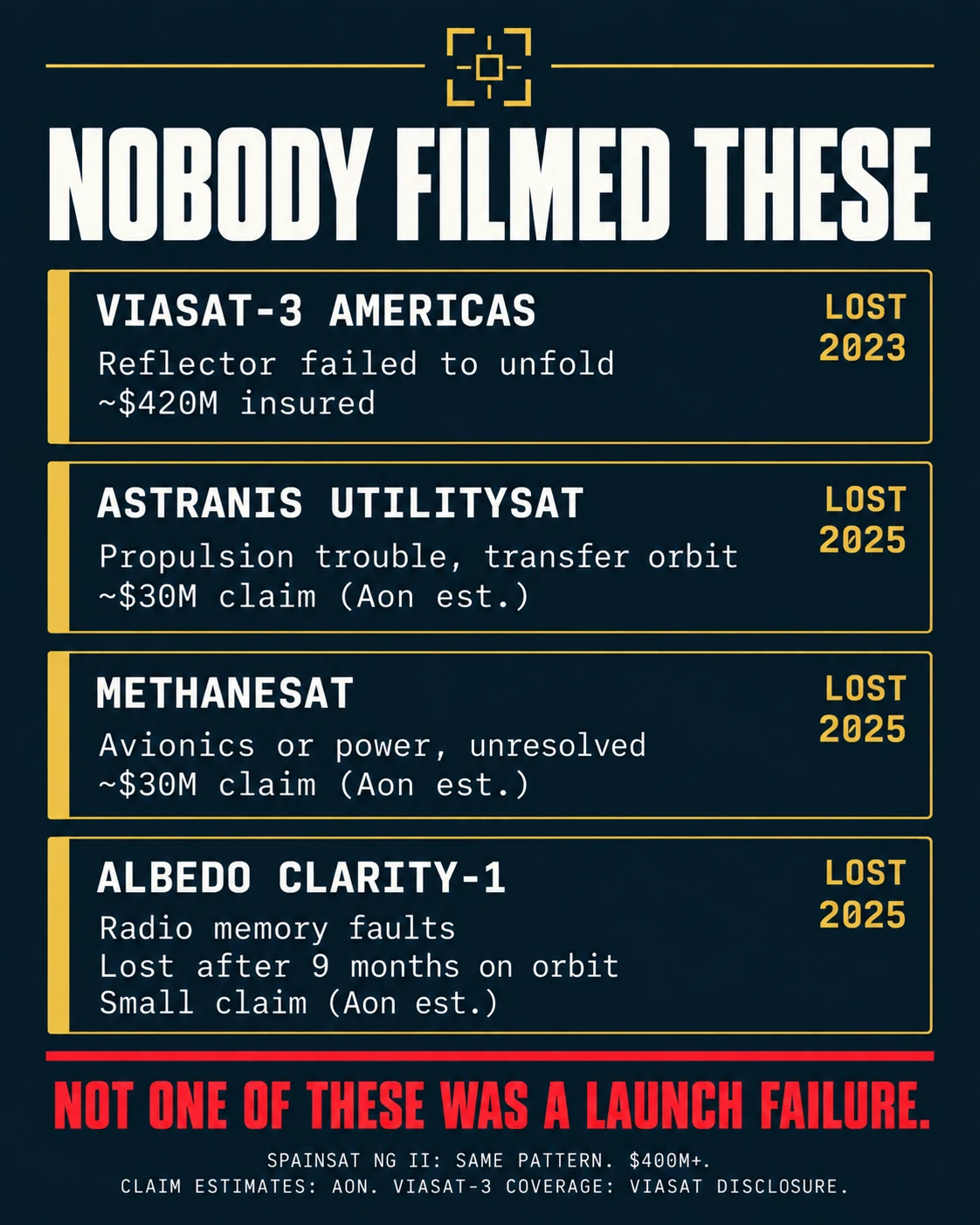
The losses that punish satellite insurers do not always begin with exploding rockets. ViaSat-3 Americas reached orbit in 2023. Then its reflector failed to deploy properly. Viasat disclosed that the spacecraft carried roughly $420 million of insurance. The company ultimately collected on the claim and later put the satellite into limited service at a fraction of its intended capacity.7 The rocket worked. The spacecraft reached orbit. The business case still broke.
Astranis UtilitySat launched on 29-DEC-2024 and subsequently developed propulsion trouble during transfer orbit. Aon estimates the resulting insurance claim at roughly $30 million.3 MethaneSAT went silent on 20-JUN-2025. The mission investigation concluded that the initiating failure began in, or propagated to, either the flight avionics unit or the electrical power subsystem. Investigators did not identify a definitive root cause. Aon estimates the insurance claim at roughly $30 million.8, 3 Albedo lost contact with Clarity-1 approximately nine months into the mission. The company identified intermittent memory faults in the spacecraft's telemetry, tracking and command (TT&C) radio among the evidence surrounding the failure. Recovery attempts did not restore the satellite. Aon describes the insurance loss only as a small claim.9, 3 Then came SpainSat NG II. It launched from Cape Canaveral on 23-OCT-2025. It survived the rocket ride. It was damaged during orbital transfer and never entered operational service.1
That pattern matters. An antenna that will not unfold. A propulsion system that will not cooperate. A spacecraft that goes dark. A particle too small to track before impact. None resembles the popular image of launch risk: a rocket exploding on the pad or a vehicle disappearing in a fireball. But the financial consequences can be enormous. ViaSat-3 and SpainSat NG II were franchise-scale losses. Astranis, MethaneSAT and Clarity-1 were much smaller insurance events. That gap is part of the argument. Space insurers can absorb many modest losses and still have their year defined by one or two extraordinarily expensive spacecraft. Hundreds of routine missions do not financially cancel out a single $400 million claim.
Why Flying Bare Can Be Rational
"Uninsured spacecraft" sounds reckless until the unit economics are separated from the emotion of losing something in orbit.
For a one-off GEO satellite, insurance can convert a unique and effectively unrepairable machine into a transferable financial risk. The asset is difficult to replace. Revenue may be concentrated in it.
The loss can arrive all at once. Transferring some of that risk to insurers can be worth paying for.
Now change the architecture.
Suppose the satellite is one of hundreds. Production is continuous. Replacement units are already moving through the factory. The system can tolerate individual-node failures without losing the mission. The calculation changes. The operator may still buy insurance.
It may insure the launch but not the years that follow. It may insure only part of the exposure. Or it may decide the premium is not worth paying and retain the risk itself.
Aon's 2026 market report says many operators are already retaining in-orbit exposure.3
That is the point of "flying bare." It is not a claim that LEO satellites are normally uninsured. It is not a prediction that space insurance disappears. It is not an argument that buying insurance is irrational. It is simply a choice available to spacecraft operators that would sound strange in many terrestrial industries.
There is no universal requirement that the owner insure the satellite itself. Space is still a frontier market in that sense. The owner can launch a machine worth millions of dollars, put it into an environment where repair may be impossible and decide that the owner itself is the insurer.
Whether that decision is intelligent depends on the mission, the fleet and the balance sheet behind it.
One GEO satellite can still be a franchise. One LEO satellite can be inventory.
If the architecture changes, the economics usually change with it.
Get the Next BriefingThe Market Does Not Have to Cover Everything
The underwriting market rewards heritage. Aon expects more capacity to be available for spacecraft using proven technology and flying on flight-proven launch vehicles.3
New systems face the inverse problem. Less history means more uncertainty. More uncertainty can mean higher pricing, tighter terms or fewer underwriters willing to participate. Aon says rates for launch and in-orbit risks more than doubled on some placements in late 2023 and remained elevated through 2025, with those conditions expected to persist into 2026.3
That creates an unusual asymmetry. The operators most capable of retaining risk can decide they need less insurance. The operators least capable of absorbing a catastrophic loss may need the market most. A large constellation operator with an active factory, a fleet already in orbit and sufficient capital can treat some spacecraft losses as part of operating the network. A small operator with one spacecraft cannot.
Neither approach is inherently superior.
They are different balance sheets attached to different architectures. The same distinction matters for national security. A sovereign communications satellite can concentrate hundreds of millions of dollars and a critical military capability in one machine. If that spacecraft is lost, replacing the hardware may take years.
A proliferated military architecture distributes capability across more nodes.
That does not make the constellation invulnerable. It does not eliminate the need for insurance. It does reduce the consequence of losing any single spacecraft if the network has enough redundancy and the industrial base can replace what is lost.
That is resilience in orbit. It is also resilience on a balance sheet.
Space insurance therefore is not becoming obsolete.
For some missions it remains extremely valuable. For a unique spacecraft carrying concentrated revenue or national capability, the ability to transfer hundreds of millions of dollars of risk may be indispensable. But it is no longer obvious that every spacecraft should be insured simply because it is expensive and difficult to reach.
The architecture matters. The factory matters. The fleet matters. The owner's ability to absorb loss matters.
SpainSat NG II sits at one end of that spectrum: a singular military communications satellite, insured for hundreds of millions of dollars, struck before entering service and large enough to move an entire year's insurance results.
At the other end are spacecraft built as nodes in systems designed around numbers, redundancy and replacement.
One GEO satellite can still be a franchise. One LEO satellite can be inventory.
Both can be insured. Neither has to be.
That is the change worth watching.
The space economy is not learning that insurance no longer matters.
It is learning that sometimes the cheapest insurer is the operator itself.
Forward this to the person who still thinks every spacecraft has to be insured.
Sources: Hisdesat and Indra Group, Gallagher, Aon, Federal Aviation Administration, U.S. Code, Viasat, MethaneSAT and Albedo. Broker reports are used as primary sources for market estimates. Operator and government records are used for spacecraft events and legal requirements. No classified information was used and all material is publicly accessible.