
The Retail Counter Closed
SpaceX has made no public announcement about the future of its rideshare program. What it has disclosed is a capacity-allocation problem. Its own satellite networks, a growing national-security manifest, NASA crew and science missions and a lunar campaign that needs more than ten Starship tanker flights per landing all draw on the same industrial base. The scarce asset may be neither the rocket nor the pad. It may be the launch slot SpaceX is willing to sell.
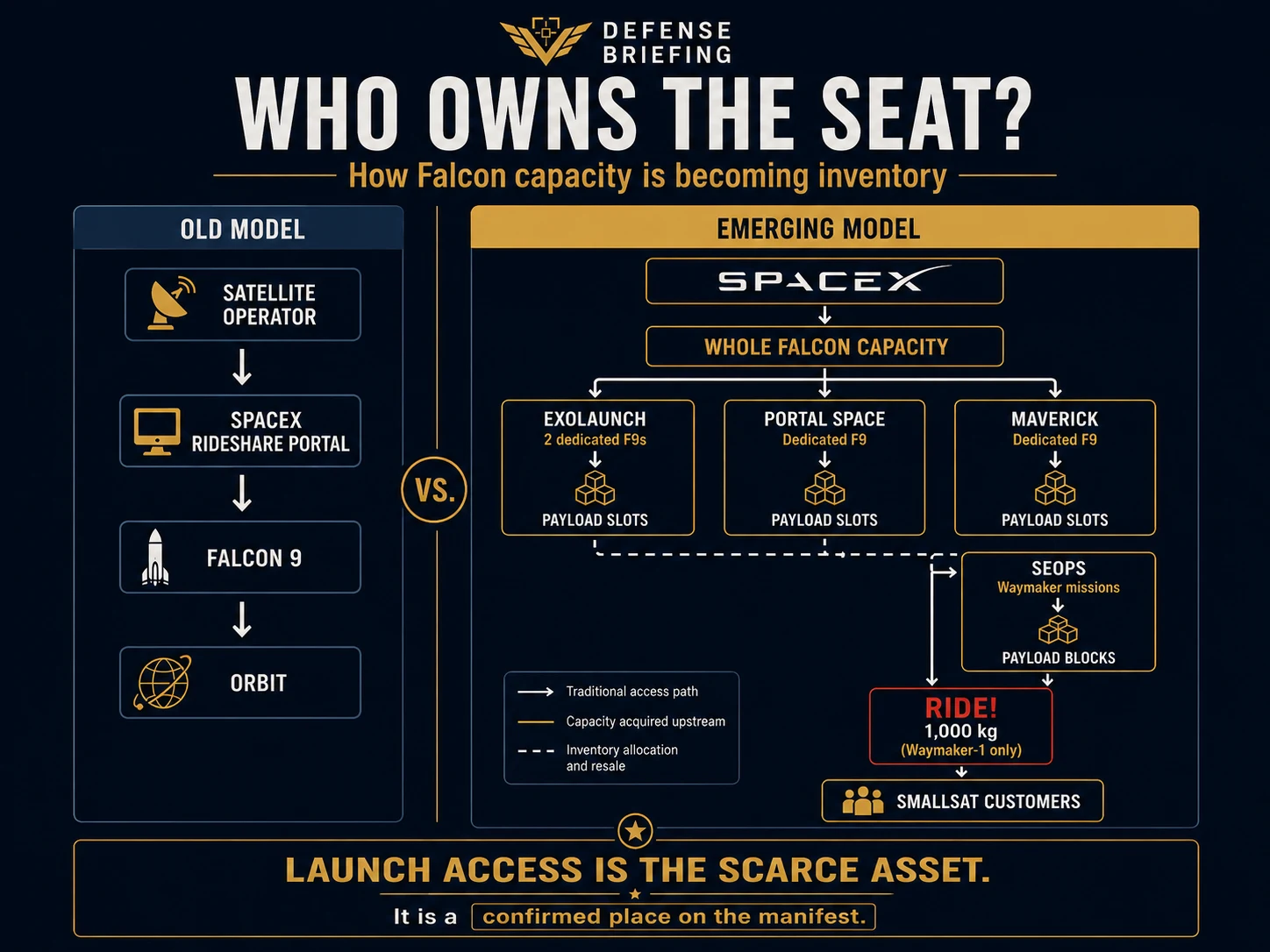
The media narrative surrounding SpaceX is that the rocketmaker has decided to stop launching other people's satellites after 2028. SpaceX has not said that. The stronger and more defensible conclusion is that 2028 sits at the intersection of enough competing demands that SpaceX has little reason to promise new Falcon capacity until it knows what its own businesses, its government customers and the Starship transition will require.
That distinction matters because the evidence is no longer only anonymous reporting. In its second-quarter 2026 Form 10-Q, filed 04-AUG-2026, SpaceX disclosed its Falcon launch split as a key business metric. Of 37 Falcon launches in the quarter, 10 were customer launches and 27 were internal. Across the first six months of 2026, 60 of 77 Falcon launches were internal, or about 78 percent.1
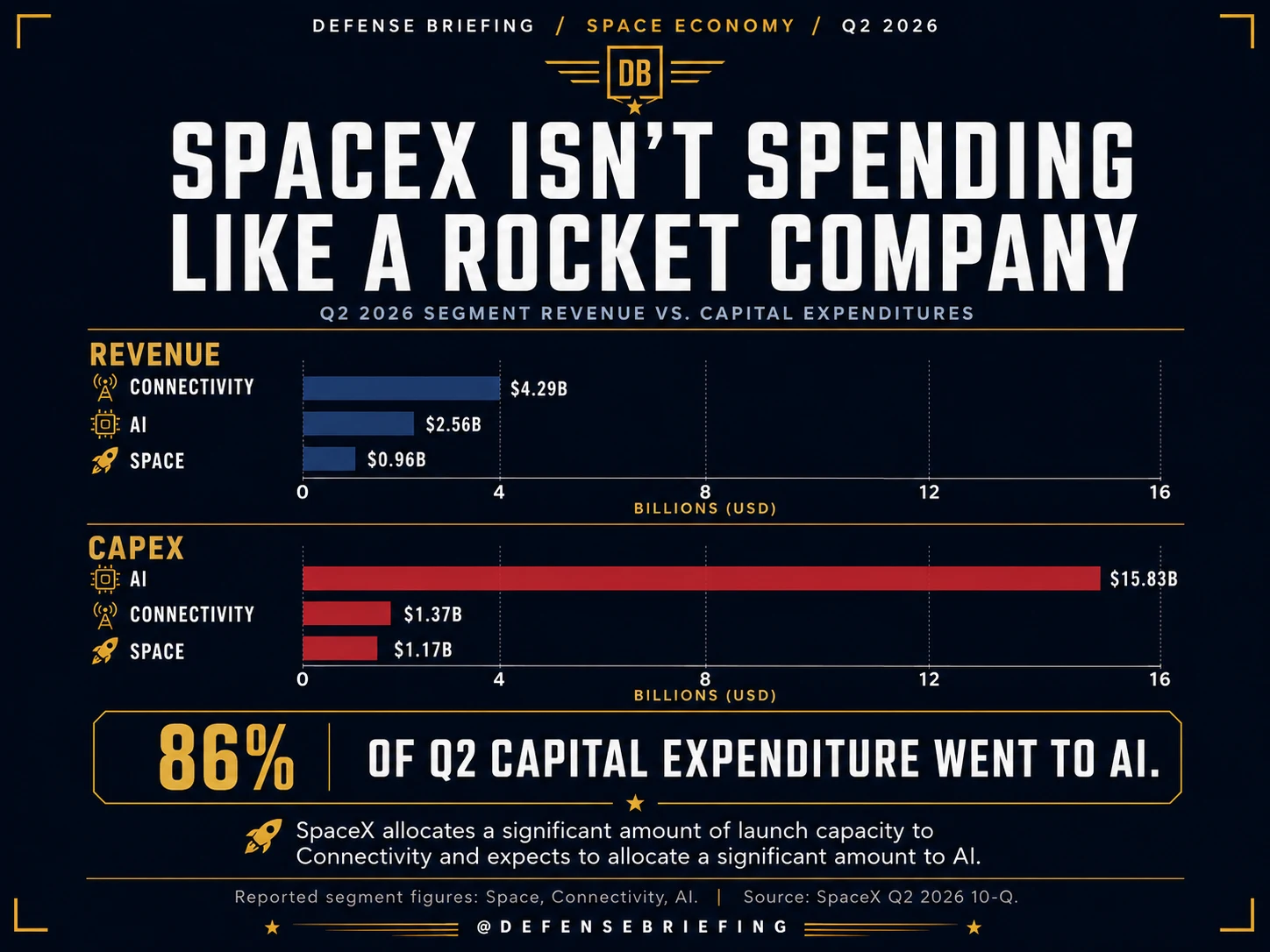
The same paragraph that defines the metric states the mechanism: "We allocate a significant amount of launch capacity to our Connectivity segment, and expect to allocate a significant amount to our AI segment in the future. Our Space segment revenue only reflects our customer launches and customer activities."1
Read the internal row across both years and a second fact appears that complicates the simple version of this story. Internal Falcon launches were 60 in the first half of 2026 and 60 in the first half of 2025. Flat. Customer launches fell from 21 to 17. Total Falcon launches fell from 81 to 77.
Internal payloads did not crowd customers out by growing. The internal share rose from 74 percent to 78 percent because the customer numerator shrank while everything else held. The quarterly figures cut the other way, with internal down from 36 to 27 and customer up from 9 to 10, a reminder that quarterly launch counts are small samples. The half-year direction is the one that matters: customer launches declining against flat internal demand and falling total cadence.
That is what a closing retail counter looks like from the inside. SpaceX defines the terms narrowly. A launch counts as a customer launch "if an external customer payload constitutes the primary payload (i.e., where the principal objective is to deliver the customer payload) and the mission parameters (e.g., launch window, orbital parameters, mission profile) are designed around the primary payload's requirements."1 A Starlink mission carrying a hosted payload is an internal launch. Only missions built around the customer count.
The financials show why internal payloads can outrank outside launch revenue. SpaceX reported $7.814 billion in second-quarter revenue: $4.291 billion from Connectivity, $2.561 billion from AI and $962 million from Space. Capital expenditure totaled $18.369 billion, allocated entirely across the same three segments: $15.828 billion to AI, $1.367 billion to Connectivity and $1.174 billion to Space.1
Space, the segment that sells launch to outside customers, is the smallest revenue line in the company. AI absorbed approximately 86 percent of quarterly capital expenditure.
The accounting reinforces the incentive. For Starlink launches, SpaceX "does not recognize any inter-segment revenue, rather those launch costs are capitalized in satellites in Property, plant, and equipment, net."1 A customer launch produces launch revenue once. An internal launch creates a depreciating asset that supports recurring service revenue for years.
The offering documents go further. Under "Risks Related to Our Space Segment," SpaceX tells investors: "For those reasons and in order to achieve our orbital compute goals, we may prioritize our own launch payloads over additional U.S. government contracts or third-party customers. This prioritization of launch capacity may limit revenue growth in our Space segment, and impact our relationship with regulators, and could invite litigation from customers or competitors."2
The stated driver is orbital compute. The operative word is additional: existing awards are not the same thing as future capacity SpaceX has not yet sold. And a company does not write the litigation clause into a risk factor casually. That creates a different way to read the reporting that followed.
Reuters reported on 04-AUG-2026 that at least seven spacecraft companies had been told Falcon 9 was fully booked across mission types until 2028 or 2029, attributed to eight sources, and that Starlink's share of the Falcon 9 manifest had risen from 54 percent in 2020 to about 79 percent in 2026 based on its own analysis of data compiled by astrophysicist Jonathan McDowell. Reuters named none of the seven companies.3 Bloomberg reported on 23-JUL-2026 that SpaceX had begun turning away operators seeking dedicated Falcon 9 launches beyond 2028 and had stopped accepting new rideshare reservations.4 Ars Technica reported on 17-AUG-2026 that SpaceX had told the federal government it intended to stop commercial Falcon launches after 2028 while retaining a smaller number of federally contracted missions.5
"We manage our Space segment to support our businesses and those of our customers. We plan launches and allocate payloads in advance, although it can be difficult to manage the timing of customer payload arrivals. When an expected customer payload for a planned launch is not available, we instead use launch capacity for our satellites. As a result, we adjust expected launch payloads frequently, impacting period-to-period financial comparison."
Space Exploration Technologies Corp., Form 424(b)(4) prospectus dated June 11, 2026. SEC filing
SpaceX has confirmed none of it. It did not respond to Reuters. It has issued no statement. Its 04-AUG-2026 earnings call, the first since June's initial public offering, contains no mention of the rideshare program, Transporter, Bandwagon, the forward manifest or Falcon retirement.6
Meanwhile the public rideshare page still posts a price: "$350k for 50kg to SSO with additional mass at $7k/kg."7 Existing contracts continue to be signed. Portal Space Systems bought a Falcon 9 for 2028 on 20-AUG-2026. Exolaunch and SEOPS already control dedicated missions in 2027 and 2028.8, 9, 10
So the retail counter is not literally closed. The inventory behind it is becoming harder to buy.
What Is Confirmed, What Is Likely and What Is Still Speculation
Four evidence tiers keep this story honest.
SpaceX uses most Falcon launches for internal payloads and discloses the split. It says significant launch capacity goes to Connectivity and expects significant capacity to go to AI. Its offering documents say internal payloads may take priority over additional government and third-party customers. The federal government has awarded SpaceX a substantial forward national-security manifest. NASA has Falcon 9 and Falcon Heavy missions under contract into 2028 and a crew-transport contract running through 2030. NASA's Inspector General has documented a lunar architecture requiring more than 10 Starship tanker flights before a single crewed landing.1, 2, 11, 15, 19, 21, 23
The inability of outside customers to buy future Falcon capacity reflects more than a temporary scheduling glitch. The same 2028 boundary appears across three independent reports working separate sourcing, and it lines up with a visible stack of internal, government and exploration demand. The weight of each factor is not public.3, 4, 5
SpaceX has made a private policy decision to end most commercial Falcon flying after 2028. Ars Technica reported a version of that claim. SpaceX has not confirmed it and no Securities and Exchange Commission filing declares a commercial Falcon shutdown.5
That SpaceX is protecting Starship resources for a lunar campaign. The timing is suggestive and the resource contention is real, but no SpaceX or NASA official has said on the record that lunar work is a reason for limiting forward Falcon sales. The important analytical change is that there does not have to be one reason. There can be five or six that all point the same direction.
The signal is in the primary record. Get Orbital Intel every Wednesday.
Subscribe FreeThe Capacity Ledger
The clearest way to understand the 2028 problem is to separate Falcon demand from Starship demand and then ask how the two fleets interact. This is not a table that sums to a single number. Some government programs overlap architecturally. Some awards specify launches while others specify satellite services. Some Starship demand is conditional on technical readiness. Some missions can move.
| Demand source | Primary vehicle | Timing | What is actually known | Evidence status |
|---|---|---|---|---|
| Starlink and Connectivity | Falcon now, Starship increasingly | Ongoing | 60 of 77 Falcon launches in 1H26 were internal; SpaceX says significant capacity goes to Connectivity | Confirmed |
| Orbital AI compute | Starship long term | Forward | SpaceX expects significant future launch capacity for AI and says orbital compute can outrank additional outside contracts | Confirmed priority, launch count unknown |
| Space Based Sensing and Targeting | Falcon 9 | Through end-2027 | Two task orders, $1.6B, covering 18 Falcon 9 launches from Vandenberg | Contracted |
| SDA and NRO Lane 1 | Falcon 9 | 2026 through at least 2Q FY2028 | Four task-order tranches covering Transport Layer, Tracking Layer and NRO mission sets | Contracted |
| NSSL Phase 3 Lane 2 | Falcon family | Awards FY2025-29, launches FY2027-32 | SpaceX anticipated to receive 28 missions; 12 assigned across FY25 and FY26 | Partly assigned, partly projected |
| Space Data Network Backbone | SpaceX constellation | Prototype by end-2027 | $2.29B delivery order under a multi-vendor program | Contracted, launch count and vehicle not disclosed |
| NASA Commercial Crew | Falcon 9 and Dragon | Contract through 2030 | Ordered missions run through October 2027 | Contracted |
| NASA science | Falcon Heavy | 2028 | Dragonfly 05-JUL to 25-JUL-2028; Rosalind Franklin no earlier than late 2028 | Contracted and selected |
| Artemis lunar campaign | Starship | 2027-28 | Depot, more than 10 tankers and a lander per crewed landing | Contracted development, 2028 demand conditional |
| Commercial Moon cargo | Starship | No earlier than 2028 | SpaceX publicly markets lunar cargo at $100M per metric ton | Company offering, no manifest |
| Existing commercial bookings | Falcon 9 | 2027-28 | Exolaunch, SEOPS, Portal and others already control future missions | Contracted |
The ledger shows why a customer asking SpaceX in 2026 for a new 2029 Falcon mission may get a different answer from a customer who booked years earlier. SpaceX is not looking at an empty calendar.
The Government Already Owns Part of the Manifest
Most coverage treats SpaceX's government demand as a future policy problem. That understates what has already been contracted. One structural note first, because it is the easiest place to go wrong. All of the Lane 1 task orders below draw against a single indefinite-delivery contract awarded in June 2024, with a ceiling near $5.6 billion and at least 30 missions. The ceiling is the container. The task orders are the contents.
On 29-JUL-2026, Space Systems Command awarded SpaceX two National Security Space Launch Phase 3 Lane 1 task orders worth a combined $1.6 billion, assuring 18 Falcon 9 launches supporting the Space Based Sensing and Targeting portfolio. Every flight is scheduled from Vandenberg Space Force Base and the Space Force expects all 18 completed by the end of 2027.11
Eighteen launches do not explain the Falcon squeeze on their own. They matter because they are firm government demand rather than prospective business, because they are concentrated at Vandenberg alongside heavy Starlink and rideshare traffic, and because they sit on top of an already growing national-security book.
That book has been building for two years. In the week of 18-OCT-2024, Space Systems Command issued its first two Lane 1 task orders, both to SpaceX, worth $733,566,001 combined: SDA-1 covering seven Tranche 2 Transport Layer launches and NTO-2 covering a National Reconnaissance Office mission set from Vandenberg.12
On 09-JAN-2026 it awarded $739 million across three more task orders covering nine launches. SDA-2 covers three launches carrying Tranche 2 Tracking Layer satellites built by L3Harris and Millennium. SDA-3 covers two carrying Lockheed Martin Tracking Layer satellites. NTO-5 covers four NRO launches projected for the first quarter of fiscal 2027 and the second quarter of fiscal 2028.13
On 02-APR-2026 the Space Force added SDA-4, worth $178.5 million, covering two launches of Sierra Space missile-tracking satellites from Cape Canaveral and Vandenberg beginning in the third quarter of fiscal 2027.14
Those awards should not simply be added to the 18 launches awarded in July and presented as one total, because the July release describes a broad portfolio without identifying every payload. The defensible conclusion is that separate launch-service awards have flowed to SpaceX continuously and the public record now stretches into fiscal 2028.
The longer tail is Phase 3 Lane 2. When the Space Force awarded the three-provider contracts on 04-APR-2025, SpaceX was anticipated to receive 28 missions at $5,923,580,297, United Launch Alliance 19 missions at $5,366,439,406 and Blue Origin seven at $2,386,234,812 beginning in the second order year, with launches running from fiscal 2027 through fiscal 2032.15
SpaceX's share is often reported as about 60 percent. That figure describes SpaceX against ULA only, 28 of 47. Against all 54 anticipated missions it is 51.9 percent, and against contract value 43.3 percent.
Twelve of the 28 are already assigned. Seven fiscal 2025 missions went to SpaceX for $845.8 million, including three NRO missions, GPS IIIF and classified Space Force payloads.16 Five fiscal 2026 missions followed for $714 million, including WGS-12, NROL-86 and additional classified missions.17
One number in those rounds deserves more attention than it has received. Blue Origin has been assigned zero Lane 2 missions in both fiscal 2025 and fiscal 2026, while ULA took two in each. The government built a three-provider structure to guarantee assured access, and after two assignment cycles the third provider has yet to receive a mission. Its next opportunity is fiscal 2027.
The 28-mission figure is not 28 guaranteed launches. It is an anticipated allocation, and later assignment boards can change it. It is still strong evidence that the government expects Falcon-class capability to remain part of national-security access well past 2028.
That leads to a distinction the coverage keeps missing. If SpaceX reduces commercial Falcon sales after 2028, that does not imply Falcon disappears. It may imply the opposite. Falcon could remain active precisely because government and human-spaceflight customers have missions that are hard to move to a new vehicle quickly.
The Space Data Network Is a Different Kind of Demand
The Space Data Network Backbone complicates the ledger because the government is not buying a rocket. On 26-MAY-2026 the Space Force awarded SpaceX a $2.29 billion firm-fixed-price Other Transaction Authority delivery order for the SDN Backbone, a proliferated low Earth orbit constellation providing what Space Systems Command describes as "robust, resilient, high-capacity, and low-latency data transport for the Joint Force." The award requires a fully operational prototype by the end of 2027.18
Three things the award does not say are as important as what it does. It does not specify how many satellites SpaceX must launch. It does not state a number of Falcon missions. It does not require Falcon at all. Converting $2.29 billion into an invented launch count would be a serious error.
It is also not a sole-source program, and the record on that got substantially clearer two weeks ago. Space Systems Command said in the May award that its acquisition strategy is "designed to foster competition and broaden our industrial base," describing an SDN consortium "working across multiple vendors." On 13-AUG-2026 it went further, announcing awards to five companies, Amazon Leo for Government, Lockheed Martin, Northrop Grumman, Rocket Lab and York Space Systems, each receiving a $10 million fixed-price contract plus a $2 million Other Transaction Authority award to build Space Exchange Point satellites acting as orbital routers into the SDN Backbone. Space Systems Command framed it as deliberate: "By investing in standardized interfaces now, we are creating a clear runway for any capable and innovative company to come in and compete."19
Structurally multi-vendor, operationally SpaceX-anchored, is the accurate description. The strategic context is what makes SDN matter here. The Space Development Agency's Proliferated Warfighter Space Architecture Tranche 3 has split in two directions. The Tracking Layer was awarded on 19-DEC-2025, 72 satellites worth roughly $3.5 billion across four vendors at 18 each, with launches in fiscal 2029.20 The Transport Layer was zeroed in the fiscal 2027 request, and its requirements are migrating into the SDN and MILNET architectures. SDN is not a contract standing alongside Tranche 3. It is substantially the replacement for the part of Tranche 3 that was cancelled.
The Space Development Agency itself remains in place. The fiscal 2027 National Defense Authorization Act chairman's mark would eliminate SDA and the Space Rapid Capabilities Office and transfer their authorities to the Space Force's new Portfolio Acquisition Executives, but that language has not been enacted by either chamber.
The broader point for this ledger is that government business can consume SpaceX launch capacity two ways. The government can buy a Falcon mission. Or it can buy an orbital service that requires SpaceX to deploy its own infrastructure, in which case SpaceX controls the spacecraft, the network integration and potentially the launch decisions inside the service it is delivering.
The public record does not let anyone measure the second category. That argues for more caution, not less.
NASA Keeps Falcon Relevant
NASA adds a different kind of inertia. SpaceX's Commercial Crew Transportation Capability contract carries a total value of $4,927,306,350 with a period of performance running through 2030. Dragon launches on Falcon 9.21 The distinction worth preserving is that the contract runs to 2030 while the ordered missions do not. NASA's Inspector General reported on 30-JUN-2026 that SpaceX's contracted Crew-13 and Crew-14 missions maintain station crew transport through October 2027.22
Crew transport is not a high-cadence business. It is a certification-heavy mission set that cannot simply move to Starship because Starship becomes available.
Falcon Heavy has its own 2028 work. NASA selected Falcon Heavy for Dragonfly, its nuclear-powered rotorcraft mission to Titan, with a launch period from 05-JUL-2028 through 25-JUL-2028 and a firm-fixed-price value near $256.6 million.23 The Government Accountability Office's July 2026 assessment lists Dragonfly with no schedule change and no cost growth against the prior year.
NASA also selected Falcon Heavy to launch the European Space Agency's Rosalind Franklin rover to Mars, targeting opportunities no earlier than late 2028.24
NASA's Launch Services II contract runs further out. In March 2025 NASA added Starship to SpaceX's existing Falcon 9 and Falcon Heavy offerings, with an ordering period through June 2030 and a period of performance through December 2032.25 An indefinite-delivery contract is not a booked mission, but the structure shows NASA expects to procure across Falcon and Starship during exactly the period when commercial Falcon availability is reportedly shrinking.
The Moon Is the Near-Term Starship Demand
The part of this story that has changed most is not Falcon. It is what Starship is being built to do first.
On 08-FEB-2026 Elon Musk posted that SpaceX had "already shifted focus to building a self-growing city on the Moon," arguing the Moon can be reached every 10 days with a two-day transit while Mars requires a planetary alignment every 26 months and a six-month trip. He added that SpaceX "will also strive to build a Mars city and begin doing so in about 5 to 7 years, but the overriding priority is securing the future of civilization and the Moon is faster."26
Two qualifications belong with that. It is a personal social-media post, not a corporate statement. No filing, no press release, no company comment accompanied it, and none has followed. And Musk revised the number the next day, saying Mars would start "in 5 or 6 years" and proceed in parallel. Either way, the operative verb is begin. That places the start of Mars city work somewhere around 2031 to 2033, not 2028.
What the Moon requires is documented and it is enormous. NASA's current architecture, set out on 03-MAR-2026, targets Artemis III in 2027 as a low Earth orbit demonstration rather than a landing, with SpaceX and Blue Origin each flying a lander test article to practice rendezvous and docking with Orion. Artemis IV in early 2028 is the first crewed lunar landing. NASA says "lander readiness will determine which provider will safely carry them to the surface and back to Orion in lunar orbit."27
The propellant campaign behind a SpaceX landing is the number that matters. NASA's Inspector General reported on 10-MAR-2026 that the architecture uses three Starship configurations, a storage depot, tanker vehicles and the lander. Before a lunar mission SpaceX plans to launch the depot followed by more than 10 Starship tankers, each rendezvousing and transferring propellant. Aggregation "begins more than 200 days prior to crew launching to allow for sufficient schedule margin," and SpaceX "is targeting to launch one tanker flight every 6 days until sufficient propellant is aggregated."28
When people say Starship will free Falcon capacity, they usually treat each Starship flight as one Falcon flight, only larger. Lunar Starship does not work that way. A single crewed landing can require an entire launch sequence before the crew leaves Earth.
That capability is not demonstrated. The Government Accountability Office reported in July 2026 that as of May, SpaceX "has not yet demonstrated a critical technology it is developing to store and transfer propellant while in orbit, which is necessary for it to execute its plan for landing astronauts on the moon."29 The Inspector General is blunter: orbital refueling at that scale has never been attempted.
Nor has the vehicle. After 13 flights Starship has never reached orbit. Flight 13 on 24-JUL-2026 deployed 20 Starlink V3 satellites and returned the ship to an intact splashdown, but the booster failed its landing burn when not all of the engines lit. Flight 14, billed as the first orbital flight, has slipped from the end of August to no earlier than September. No ship has been caught on the tower, and Musk said on 20-AUG-2026 that a catch is "probably" a few months away. Two Starship flights have occurred in 2026.
If NASA selects Blue Origin for Artemis IV, or the landing slips, SpaceX loses a major 2028 demand. If refueling proves more efficient than planned, the tanker count falls.
Mars belongs in this story only as an inconsistency. SpaceX's public Starship page still advertises cargo flights to the Martian surface starting "no earlier than 2028, at a rate of $100 million per metric ton," with identical language and pricing for the lunar surface.30 That copy has not been revised in the six months since the Moon pivot, and it sits awkwardly beside a chief executive who now puts the beginning of Mars city work five to seven years out. Corporate collateral says 2028. The founder says the early 2030s. The gap is evidence that the pivot was never formalized, and it is a reason to treat the 2028 Mars framing as stale boilerplate rather than a planning input.
The date collision that matters is lunar, not Martian. Artemis III in 2027, a crewed landing targeted for early 2028 and a tanker campaign of more than 10 Starship flights per landing all fall inside the same window in which commercial Falcon access reportedly becomes hard to buy.
Space infrastructure is becoming national infrastructure. Follow the buildout with Orbital Intel.
Subscribe FreeStarship Does Not Automatically Solve the Shortage
SpaceX's offering documents make the intended vehicle transition explicit. The company expects a single Starship launch to deploy up to 60 V3 Starlink satellites, "representing a potential twenty-fold increase in Starlink downlink capacity deployed relative to a Falcon 9 launch," and states that "our current operational rockets, including Falcon 9 and Falcon Heavy, are not capable of deploying V3 satellites and V2 Mobile satellites."2
Starlink's next deployment architecture is designed around Starship. In one sense that is the strongest argument against this entire thesis. If Starship reaches high cadence it can absorb the internal demand currently occupying Falcon, and the 60 internal Falcon launches of the first half of 2026 migrate to a vehicle with far greater throughput.
Two catches. The first is timing: Starship has to become operational, reusable and predictable enough to absorb that demand before SpaceX can safely stand down Falcon capacity that works today.
The second is consumption. SpaceX is creating new uses for Starship at the same rate it creates Starship supply. V3 Starlink is one, V2 Mobile another, orbital compute a third, and the scale SpaceX describes there is extraordinary: deploying 100 gigawatts per year via satellites carrying over 100 kilowatts of compute per metric ton "will require thousands of launches per year and the transport of approximately one million metric tons to orbit annually."2 That is a conditional engineering requirement derived from a hypothetical deployment rate, not a target or a forecast. Then come lunar tankers, lunar cargo and eventually Mars.
Starship can increase the total launch capacity available to humanity while creating very little capacity a third-party customer can buy. Total capacity and saleable capacity are different variables. That is the central error in the simplest version of the argument that Starship fixes everything.
The physical footprint is expanding to match. On 25-AUG-2026 SpaceX announced a $100 billion Starship complex in Vermilion Parish, Louisiana, with five launch complexes of two pads each, construction beginning in 2027 and first launches in 2029. Vice president Sheila McCorkle described the requirement as a coastal site able to "launch Starship fully reusable at rate, meaning thousands of launches a year."31
Other Bottlenecks May Matter More Than the Rocket
There is a further reason not to tell this story as though SpaceX ran out of boosters. SpaceX vice president of commercial sales Stephanie Bednarek said at SATELLITE 2026 on 24-MAR-2026: "A unique situation that we're looking at right now is that rockets don't seem to be the limiting factor. It's more about payload processing space."32
That belongs beside the internal-capacity thesis, not underneath it. A launch system is a chain and the rocket is one link. Customer payloads need clean processing areas, mechanical integration, dispenser hardware, licensing, range scheduling and mission-specific engineering. SpaceX's rideshare page states that "payloads are received at the launch site around L-30 and processed in a SpaceX facility."7 The Falcon User's Guide documents named processing facilities at Vandenberg and Cape Canaveral and requires all work needing payload access to be completed before fairing encapsulation.33 If those facilities are full, another reusable booster does not create another customer mission.
Other constraints produce the same behavior. Range and airspace scheduling can bind while a rocket sits ready. Upper stages and fairings are expendable, so cadence depends on a production flow reuse does not help. Crew and national-security missions consume mission-assurance capacity that cannot be measured by counting rockets. And Falcon and Starship share a company and much of an industrial ecosystem, so a deliberate transfer of people and capital can reduce Falcon throughput even while the hardware could keep flying.
Musk described that last one on 22-AUG-2026: once Starship is flying reliably several times per week, "it makes sense to shift super scarce SpaceX engineering and production resources to Starship to get launch rate to several times per day, which means winding down Falcon."34 Super scarce is his phrase, and it is the closest thing to an official explanation on the record.
Some of these create actual scarcity. Others create uncertainty, and a company facing uncertainty has reason to stop selling far-forward inventory before every future slot is physically occupied. That may be the most mundane explanation available. SpaceX may not know what it wants Falcon to be in 2029, so it is declining to make promises it could regret.
The New Middle Layer
Whatever the cause, the market is already adapting. For years the SmallSat Rideshare Program let an operator buy a small amount of mass without buying a rocket. That pushed the launch provider directly to the satellite customer. The new market inserts an inventory holder between them.
Exolaunch bought two dedicated Falcon 9 missions announced 26-MAY-2026, with Exo-1 no earlier than late 2027 and Exo-2 no earlier than late 2028.9 SEOPS bought a dedicated Falcon 9 for its Waymaker program, with chief executive Chad Brinkley describing the missions as "a relief valve for the growing LEO rideshare market." By 17-AUG-2026 the original Waymaker sun-synchronous mission was about 90 percent committed by payload mass, SEOPS had added a second mission ahead of it, and its Darkstar-1 mission had been repurposed from geosynchronous transfer orbit to low Earth orbit.10 RIDE!, a French mission-management company, bought a 1,000-kilogram block aboard Waymaker rather than contracting for a rocket.9
Portal Space Systems completed the pattern on 20-AUG-2026, buying an entire Falcon 9 for 2028, using roughly half the fairing for its own Supernova spacecraft and reselling the remainder through Maverick Space Systems. Chief executive Jeff Thornburg was direct about the motive: "I needed to secure Portal's launch future for the next couple of years. You're very familiar with all of the angst over launch availability."8
The chain now runs SpaceX, then whole-launch buyer, then integrator or broker, then spacecraft operator. The rocket has not changed. Who owns access to it has.
The customer view is blunter. HawkEye 360's chief strategy officer told Payload in April 2026 that "it's actually now a bit of a pain in the butt to get manifested on SpaceX. You have to go through launch integrators. They buy up all capacity." Rocket Lab vice president Brian Rogers, in the same reporting, called it "a new and different monopoly."35
A future launch reservation becomes an asset when new reservations become hard to obtain. The aggregator is not manufacturing capacity. It is controlling a piece of the existing manifest and subdividing it. That does not mean aggregators caused the shortage. It may mean they saw it earlier than smaller customers and bought while they could.
What a Slot Costs
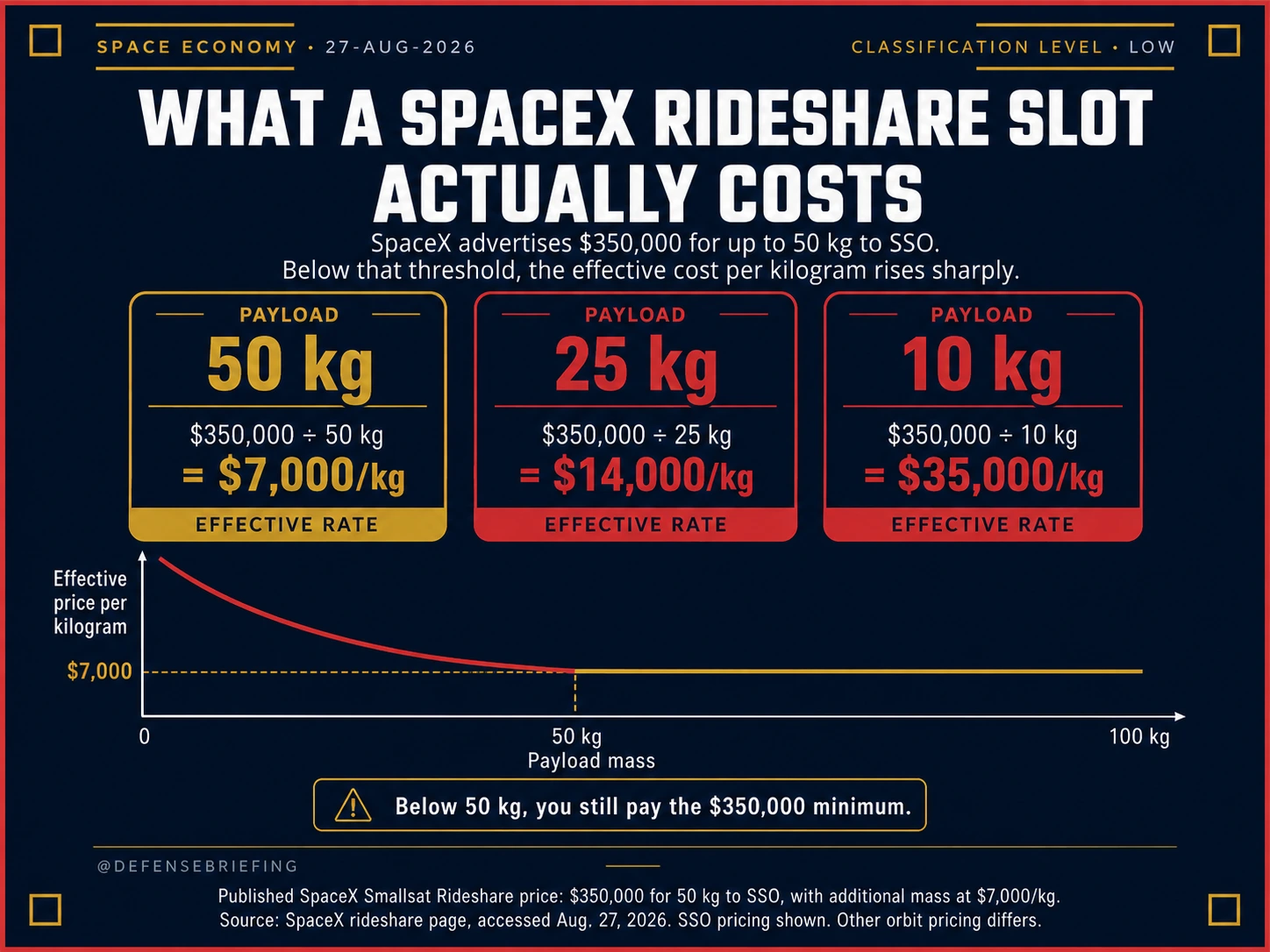
SpaceX's published rideshare rate is quoted constantly and read carelessly. The current posted structure is $350,000 for 50 kilograms to sun-synchronous orbit with additional mass at $7,000 per kilogram.7
The arithmetic deserves stating precisely. $350,000 divided by 50 kilograms is exactly $7,000 per kilogram. The base fee is not a surcharge on top of the marginal rate. It is 50 kilograms priced at the marginal rate. For any payload at or above the minimum, the effective price is $7,000 per kilogram and stays there. The card is linear above the floor.
The floor is where it bites. A 50-kilogram spacecraft pays $7,000 per kilogram. A 25-kilogram spacecraft pays $350,000, or $14,000 per kilogram. A 10-kilogram spacecraft pays $350,000, or $35,000 per kilogram.
The advertised rate is exact for anyone who fills the minimum and becomes a steep premium only for those who cannot. A 3-unit cubesat operator is not being misled. That operator is buying a 50-kilogram slot and flying 10 kilograms in it. Those figures also exclude deployment hardware and integration services.
That low floor is why the program reshaped small-satellite economics, and why losing direct access matters more than finding another rocket. A replacement launch can exist and still be economically useless to a 10-kilogram spacecraft. A dedicated small launcher offers schedule control and a better orbit at far higher cost per kilogram. A larger launcher can have mass available but no mission at the right time. A foreign launcher can be capable and unavailable under United States export rules.
The product was never a rocket. It was low-cost, frequent, legally accessible launch with a standardized integration path. That combination is harder to replace than Falcon 9's number on a spec sheet.
Where Does the Displaced Demand Go?
There is no single substitute, and the reason is specific rather than general. Useful supply requires payload capacity, reliable performance, recurring cadence, competitive economics and inventory a customer can buy. Falcon 9 delivered all five.
Blue Origin has the scale and is grounded. New Glenn publishes 45 metric tons to low Earth orbit and holds an Amazon commitment of 12 launches with options for 15 more. It has flown three times, most recently NG-3 on 19-APR-2026, which recovered a reused booster for the first time while the second stage underperformed and left AST SpaceMobile's BlueBird 7 in the wrong orbit. On 28-MAY-2026 a hotfire of booster GS1-3 destroyed the vehicle at Launch Complex 36. Blue Origin identified the cause only on 05-AUG-2026, the main oxygen valve on one BE-4 engine, and broke ground on a second pad at LC-36B on 12-AUG-2026. It maintains it will fly again before year-end.36
United Launch Alliance has flown Vulcan once in 2026. USSF-87 on 12-FEB-2026 reached geosynchronous orbit directly, but ULA disclosed "a significant performance anomaly on one of the four solid rocket motors," the Space Force paused National Security Space Launch missions on Vulcan, and no public statement has closed that investigation. Amazon holds 38 contracted Vulcan launches with a dedicated integration facility, a second launch platform and a shortened Centaur V built for them. The first Amazon Leo Vulcan is no earlier than September 2026.37
Ariane 6 has demonstrated exactly the work a substitute must perform, flying three Amazon Leo missions between February and June 2026, the third on 17-JUN-2026 carrying 36 satellites, part of a contracted series of 18.38 Amazon holds much of the forward book and Europe needs the vehicle for Galileo, science and strategic missions.
Japan's H3 recovered faster than its flight numbering suggests. Flight 8 failed on 22-DEC-2025, Flight 6 flew the maiden H3-30 configuration successfully on 12-JUN-2026, and Flight 9 deployed the QZS-7 navigation satellite on 11-AUG-2026. Mitsubishi Heavy Industries markets 4 metric tons to a 500-kilometer sun-synchronous orbit and will launch ispace's Mission 3 in 2028.39 Accessible supply, well below Falcon cadence, with no retail marketplace.
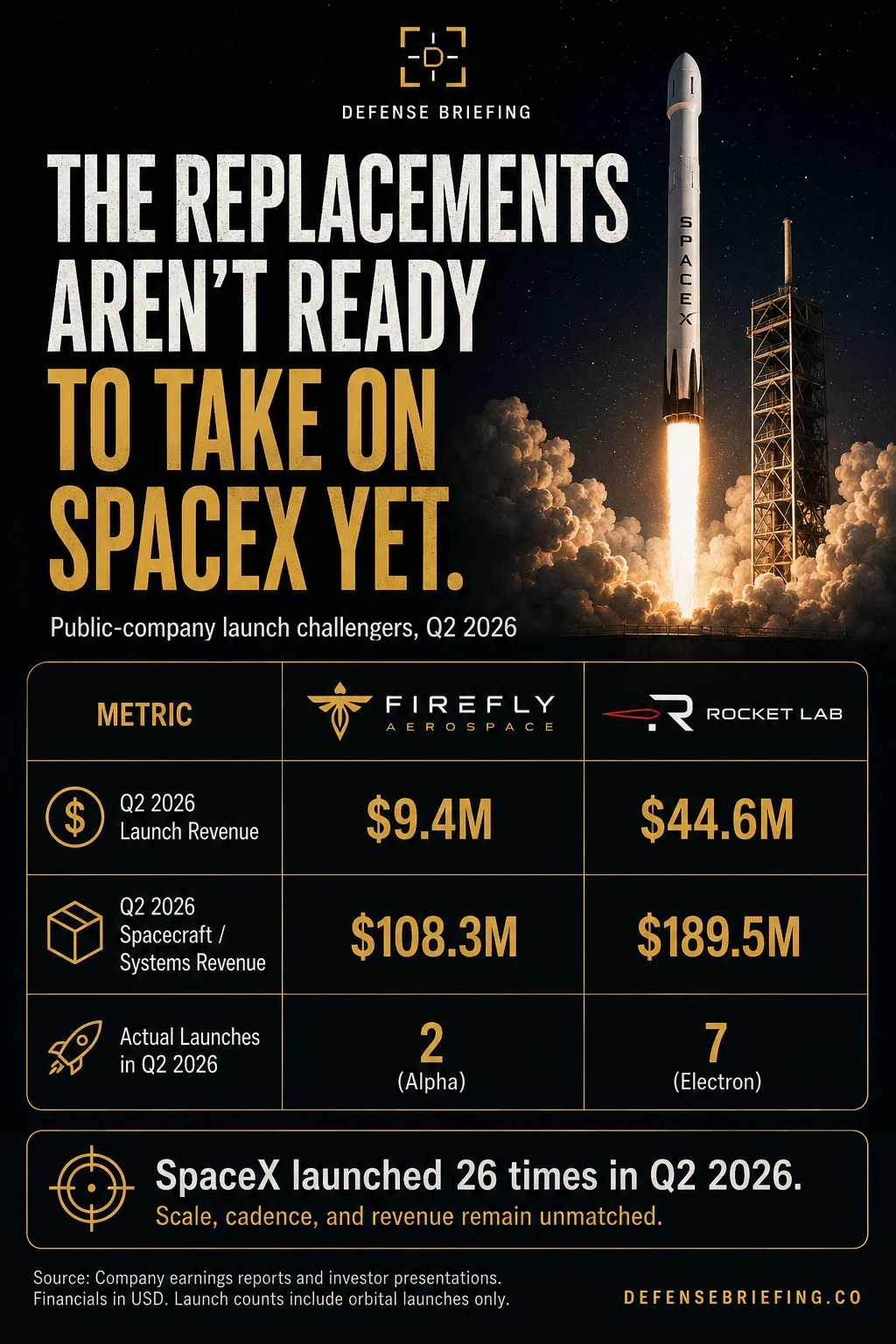
Rocket Lab and Firefly are the American medium-lift hope and neither is available yet. Electron flew its 93rd mission on 20-AUG-2026 in a payload class that cannot absorb a Falcon rideshare manifest. Neutron matters at 13,000 kilograms to low Earth orbit, with a Kepler Communications contract announced 10-AUG-2026, but it has not flown: Rocket Lab targets Stage 1 delivery to the pad in the fourth quarter, which is not a launch, and chief financial officer Adam Spice said the year-end window is narrowing.40 Firefly returned Alpha to orbit on 11-MAR-2026 after a ten-month stand-down, then pushed the Block 2 debut to the fourth quarter. Its second-quarter revenue was $117.7 million, of which launch produced $9.4 million against $108.3 million from Spacecraft Solutions, with remaining performance obligations of $563.7 million, a net loss of $92.3 million and accumulated deficit of $1.209 billion.41 Eclipse, with Northrop Grumman at 16,300 kilograms, is no earlier than 2027.
India and Vega-C are operational supply behind different walls. NewSpace India Limited markets PSLV, GSLV Mk-II, LVM3 and SSLV commercially, plans 15 SSLVs built by private industry over three years, and in August 2026 IN-SPACe chairman Pawan Goenka said the Indian Space Research Organisation will exit launch-vehicle manufacturing entirely.42 The constraint for United States operators is export-control licensing and the absence of a published rate card. Vega-C flew four successful launches across twelve months against an Avio backlog of 2.166 billion euros, and is committed to European institutional demand.43
The development field contains one vehicle that has reached orbit. Skyroot's Vikram-1 succeeded on its first flight on 18-JUL-2026, the first privately developed Indian rocket to do so, in Electron's payload class rather than Falcon's.44 Nothing else has flown. Relativity's Terran R completed Stage 1 qualification in August with no firm date. Stoke's Nova, pursuing the full second-stage reuse no orbital operator has demonstrated, shipped flight engines to Moses Lake. PLD Space targets a Miura 5 demonstration from Kourou this year. Isar's Spectrum has not flown since its 30-MAR-2025 failure, Rocket Factory Augsburg stood down its August attempt after a pad-testing issue, and Gilmour's Eris and Latitude's Zephyr both target late 2026.
Two exits belong in any honest assessment. ABL Space Systems abandoned commercial orbital launch, pivoted to missile defense and renamed itself Long Wall in February 2025. Orbex entered administration on 18-FEB-2026 without ever reaching orbit.45 Falcon scarcity does not make every competing rocket viable. The market can need more rockets while individual rocket companies fail.
China is real capacity that is not accessible capacity. LandSpace landed a ZhuQue-3 first stage on 19-AUG-2026, China's first orbital-class booster recovery, and China had flown 53 orbital missions by the start of August.46 For spacecraft under United States export rules none of it substitutes, and counting it makes the market look more competitive than the actual choice set.
Falcon has competitors on every axis. It has no complete replacement across all of them.
Launch supply is changing fast. Get the next capacity update free.
Subscribe FreeFalcon After Starship: Four Paths
Path 1: Falcon becomes a lower-cadence legacy fleet
This best fits the evidence. Internal payloads migrate to Starship while Falcon keeps flying national-security missions, Dragon crew flights, NASA science spacecraft and commercial contracts that are difficult to move because customers value certification, interfaces and flight history. As Starship proves itself, SpaceX can shrink Falcon production and infrastructure rather than sustain today's cadence. Musk's 22-AUG-2026 statement about shifting "super scarce" engineering and production resources to Starship points in this direction. Falcon need not disappear for the retail market to close; it only has to stop taking most new commercial orders. No SpaceX statement establishes a 2030 or 2032 retirement date.
Path 2: The booking freeze is temporary
SpaceX may be withholding 2029 and later slots because it cannot yet predict the pace of the Starship transition. If Starship absorbs internal demand faster than expected and Falcon production remains healthy, the commercial book could reopen. A meaningful batch of new post-2028 Falcon contracts would materially weaken this thesis.
Path 3: Commercial Falcon survives through inventory holders
SpaceX keeps honoring whole-launch contracts while reducing direct small-customer sales, making aggregators the practical retail channel. The service survives, but access shifts from SpaceX's portal to companies that bought capacity earlier. Exolaunch, SEOPS, Portal and Maverick already show pieces of that model.
Path 4: SpaceX licenses, leases or transfers Falcon
There is no supporting evidence and this is the least plausible path. Falcon's economics depend on SpaceX manufacturing, Merlin engines, refurbishment, fairing recovery, launch sites, software and mission assurance. Transferring the rocket without transferring much of the company would not reproduce the product customers buy.
Washington's Answer, and the Lobbying Record
On 20-AUG-2026 the White House issued the National Space Transportation Policy as National Security Presidential Memorandum 17, published in the Federal Register on 25-AUG-2026. Its stated objective: "By 2030, our space transportation ranges must grow to support more than 1,000 launches and reentries every year."47
For scale, the United States conducted roughly 195 orbital launches in 2025, of which SpaceX flew 165, about 85 percent of the national total. Of those, 122 were dedicated Starlink missions.48
Most of the memorandum addresses ground infrastructure: site capacity, range access, streamlined review, airspace integration, spectrum. Those measures reduce friction. They do not manufacture rockets. A pad does not build a vehicle and an open range does not create a production line.
One provision bears directly on this story. The memorandum directs the Secretary of War, within 180 days, to "develop and promulgate Federal range scheduling criteria to maximize efficient use of range resources for commercial users while ensuring United States Government needs are met."47 A federal range-scheduling rule is the single mechanism that could force allocation away from a dominant self-supplier. How it is written is the policy question to watch into the first quarter of 2027.
The lobbying record adds a quieter signal. Second-quarter 2026 disclosures, filed by the 20-JUL-2026 deadline, show SpaceX spent $1.19 million, comprising $750,000 in-house and $440,000 across nine outside firms. That is nearly unchanged from the first quarter, and up 2.6 percent from $1.16 million a year earlier.49
In the quarter SpaceX completed the largest initial public offering on record, stopped selling Falcon capacity past 2028 and prepared a $100 billion spaceport announcement, its Washington spend did not move.
Two new issue codes did appear. The second-quarter in-house filing added "Artificial Intelligence regulatory matters" and "matters related to onshoring advanced manufacturing," neither present in the first quarter. The quarter SpaceX began reallocating launch capacity toward orbital compute is the quarter artificial-intelligence regulation entered its lobbying disclosures.
The defense-issue text reads oddly against the commercial manifest. SpaceX reported work on "involvement in promoting competition in the National Security Space Launch Program." The dominant launch provider is lobbying for competition in the one launch market where it is not the incumbent, while its commercial forward book is closed.
Peer spending for the quarter: Amazon approximately $5.235 million across all entities, ULA $975,149, Blue Origin $930,000, Relativity $610,000, Rocket Lab $480,000, AST SpaceMobile $80,000, Stoke Space $50,000 and Firefly roughly $40,000.49 ULA outspent Blue Origin and came within $215,000 of SpaceX at a fraction of its size. Rocket Lab cut in-house spending from $300,000 to $280,000 during the quarter it announced the Iridium acquisition.
One filing deserves its own line. The Commercial Spaceflight Federation filed a termination for the second quarter. The trade association representing the constituency being squeezed wound down its registration in the quarter the manifest closed.
None of these filings reference NSPM-17, and none could. It was signed seven weeks after the reporting period ended. Third-quarter disclosures, due 20-OCT-2026, are the first that can.
The Counter-Case
A strong thesis should be easy to falsify. This one has clear tests.
SpaceX reopens post-2028 Falcon reservations, showing the constraint was temporary. Starship reaches high-rate operations and SpaceX sells meaningful third-party capacity, turning an internal-demand problem into genuine commercial supply. Blue Origin, ULA, Arianespace, Rocket Lab and others collectively recreate the missing capacity, which does not require any one replacement. Payload-processing expansion eliminates the bottleneck, making Bednarek's explanation more important than allocation. NASA selects Blue Origin for Artemis IV or the landing slips, removing the near-term Starship lunar load. Or the Space Force shifts more Phase 3 work to ULA and Blue Origin, reducing SpaceX's future government demand.
There is also a live counter-datapoint from this week. On 25-AUG-2026 SpaceX flew what is reported as the last planned Starlink mission from Cape Canaveral until Starship operates from Florida. Cape launch rate is expected to fall from eight or nine missions a month to roughly two, with the Cape flying customer and government payloads while Starlink deployment shifts to Vandenberg.50 That cuts both ways. It is evidence of the Starship pivot, and it frees Cape capacity for outside customers. Whatever is constraining this market, it is not pad access. The thesis should move with those facts.
The National Security Problem Is Also the Cushion
The government appears here in two roles that look contradictory. It is a customer exposed to SpaceX's allocation decisions. It is also among the customers most likely to keep access when commercial customers do not.
SpaceX's offering documents say it may prioritize internal payloads over additional government contracts. That does not suggest SpaceX can abandon missions it has accepted. Government launch contracts carry mission-specific obligations, integration work and consequences for nonperformance.2
At the same time the Space Force has decided it cannot depend on one provider indefinitely. Phase 3 Lane 2 selected three. Lane 1 is designed to on-ramp additional systems. The strategy is not only about price. It is about assured access. The awkward fact is that two assignment cycles have passed and the third provider has yet to receive a Lane 2 mission.
NSPM-17 adds the ground side. It can reduce pad, range and airspace friction. It cannot manufacture a mature launch provider.
If Falcon commercial access contracts while Starship is still proving itself, the government has an incentive to accelerate New Glenn, Vulcan and others even while it keeps buying SpaceX missions. Redundancy becomes national infrastructure.
The Real Asset Is the Manifest
For most of the last decade Falcon rideshare let a small-satellite company treat launch almost like a utility. Raise the money, build the spacecraft, pick a Transporter flight, buy the mass, reach orbit.
That assumption is changing. SpaceX's own filing shows internal payloads dominating Falcon utilization, and shows customer launches falling year over year while internal launches held flat. Its prospectus says orbital compute may outrank additional outside customers. The government has placed a visible block of national-security work into the forward schedule. NASA has Falcon missions in 2028 and a crew contract through 2030. Starship, which is supposed to relieve Falcon pressure, carries its own demand stack: next-generation Starlink, mobile satellites, orbital compute, a lunar tanker campaign of more than 10 flights per landing, Moon cargo and eventually Mars. And customers are buying whole Falcon missions and breaking them into pieces because controlling a future launch has become valuable in itself.
That does not prove SpaceX has a secret retirement date. It proves something more useful. There are enough known claims on SpaceX's launch system that the company can rationally protect its forward optionality.
The 2028 boundary may therefore be less a shutdown date than a planning horizon. SpaceX knows what Falcon can do today. It does not know how quickly Starship will absorb Starlink, how many Starships a lunar campaign will require in practice, whether it will land Artemis IV, how much orbital compute it will deploy or how rapidly other providers will become credible.
Selling a 2029 Falcon mission today converts that uncertainty into a promise. Not selling it preserves the option. That may be the entire strategy.
The retail counter has not been dismantled. Existing customers still have tickets. Government missions continue to be awarded. Brokers and aggregators still hold inventory. But for a spacecraft that needs a new ride after 2028, the question is no longer whether Falcon 9 will still exist.
It is whether SpaceX will have a slot it is willing to sell. And by then, someone else may already own the seat.
Evidentiary limitation. SpaceX has made no announcement that commercial Falcon launches will end after 2028. The forward-market constraint rests on customer reports and independent reporting rather than a company statement. Primary sources establish the mechanism and the competing demand: disclosed internal launch allocation, government awards, NASA missions, the Starship lunar architecture and SpaceX's stated Moon and Mars objectives. They do not establish a single cause for the 2028 boundary. Where this Transmission connects lunar resource demand to Falcon commercial availability, that connection is Defense Briefing analysis and is labeled as such.
Disclosure. Defense Briefing is an editorial and intelligence publication. Nothing here is investment advice.
Sources
- Space Exploration Technologies Corp., Form 10-Q for the quarterly period ended June 30, 2026, filed Aug. 4, 2026, SEC accession 0001628280-26-052535. Key Business Metrics (printed pp. 34–35): Falcon launches, customer and internal split, launch-capacity allocation, customer-launch definition. Segment discussion and Starlink launch-cost capitalization follow in MD&A.
- Space Exploration Technologies Corp., Form 424B4 prospectus, filed June 12, 2026 (prospectus dated June 11, 2026), SEC accession 0001628280-26-042639. Risk factor on the Space segment; Starship and orbital-compute discussion.
- Joey Roulette, “SpaceX's satellite ambitions squeeze out rivals reliant on its rockets,” Reuters, Aug. 4, 2026.
- “SpaceX Is Turning Away Falcon Customers in Major Bet on Starship,” Bloomberg, July 23, 2026 (updated July 24, 2026).
- Eric Berger, “Satellite operators are in panic mode due to a worsening launch crisis,” Ars Technica, Aug. 17, 2026.
- SpaceX Q2 2026 earnings call, Aug. 4, 2026, 4:30 p.m. ET. Official webcast/transcript: ir.spacex.com. Third-party transcript: Motley Fool, posted Aug. 11, 2026.
- SpaceX SmallSat Rideshare Program page, accessed 27-AUG-2026; Rideshare Payload User's Guide, Revision 11, August 2026.
- Portal Space Systems, "Portal Space Systems Signs Contract with SpaceX for Falcon 9 Launch," 20-AUG-2026; Payload and Aviation Week, 20-AUG-2026.
- Via Satellite, Rachel Jewett, "Rideshare Providers SEOPS and Exolaunch Buy Dedicated Falcon 9 Missions," 26-MAY-2026.
- Payload, Douglas Gorman, "SEOPS Doubles Down on Waymaker Dedicated Rideshare Program," 17-AUG-2026.
- U.S. Space Force, Space Systems Command, "Space Force Awards Task Orders to Launch Space Based Sensing and Targeting Capabilities," 29-JUL-2026.
- Space Systems Command, first two NSSL Phase 3 Lane 1 task orders (SDA-1 and NTO-2), announced week of 18-OCT-2024.
- Space Systems Command, "Space Systems Command Awards Task Orders to Launch Missile Warning and Missile Tracking Space Vehicles," 09-JAN-2026.
- Space Systems Command, SDA-4 task order award, 02-APR-2026.
- Space Systems Command, "Space Systems Command awards National Security Space Launch Phase 3 Lane 2 contracts," 04-APR-2025.
- Space Systems Command, NSSL Phase 3 Lane 2 FY25 mission assignments, 07-APR-2025.
- Space Systems Command, NSSL Phase 3 Lane 2 FY26 mission assignments, 03-OCT-2025.
- Space Systems Command, "U.S. Space Force Advances Space Data Network Backbone for Global Warfighter Connectivity," 26-MAY-2026.
- Space Systems Command, "Space Force invests in resilient multi-vendor architecture to build next-gen Space Data Network," 13-AUG-2026.
- Space Development Agency, Tranche 3 Tracking Layer awards, 19-DEC-2025.
- NASA, "NASA Awards SpaceX More Crew Flights to Space Station," 31-AUG-2022.
- NASA Office of Inspector General, "NASA's Management of Its Commercial Crew Program," IG-26-011, 30-JUN-2026.
- NASA, "NASA Awards Launch Services Contract for Dragonfly Mission," 25-NOV-2024.
- NASA Science, "NASA Begins Implementation for ESA's Rosalind Franklin Mission to Mars," 16-APR-2026.
- NASA, "NASA Awards Launch Services Contract for SpaceX Starship," 28-MAR-2025.
- Elon Musk, posts on X, 08-FEB-2026 and 09-FEB-2026, as reported by Agence France-Presse, Fox Business and Euronews, 09-FEB to 11-FEB-2026. No accompanying SpaceX corporate statement.
- NASA, "NASA Strengthens Artemis: Adds Mission, Refines Overall Architecture," 03-MAR-2026; NASA Artemis program page.
- NASA Office of Inspector General, "NASA's Management of the Human Landing System Contracts," IG-26-004, 10-MAR-2026.
- U.S. Government Accountability Office, "NASA: Assessments of Major Projects," GAO-26-108556, 23-JUL-2026.
- SpaceX Starship vehicle page, accessed 27-AUG-2026.
- Payload, CNBC and Louisiana Illuminator, Starbase Louisiana announcement, 25-AUG-2026.
- Via Satellite, Leandra Bernstein, "Launchers Cite Busy Manifests and Scarcity as Commercial Demand Grows," 25-MAR-2026, reporting a SATELLITE 2026 panel held 24-MAR-2026.
- SpaceX Falcon User's Guide, Revision 8, March 2025, Section 10.3.
- Elon Musk, post on X, 22-AUG-2026.
- Payload, "The State of Launch 2026," 09-APR-2026.
- Blue Origin New Glenn vehicle and mission pages; "GS1-3 Hotfire Updates"; "New Glenn Return to Flight"; LC-36B groundbreaking, 12-AUG-2026; Spaceflight Now, 20-APR-2026 and 06-AUG-2026.
- United Launch Alliance USSF-87 release, February 2026; Breaking Defense, Vulcan NSSL pause, February 2026; ULA Amazon 38-launch release and Centaur V LEO variant materials.
- Arianespace, Amazon Leo LE-03 mission release, 17-JUN-2026.
- JAXA releases: H3 Flight No. 8, 22-DEC-2025; Flight No. 6, 12-JUN-2026; Flight No. 9 and QZS-7, 11-AUG-2026. Mitsubishi Heavy Industries launch-services pages; MHI and ispace joint release, 29-JUL-2026.
- Rocket Lab, 93rd Electron mission, 20-AUG-2026; Kepler Communications Neutron contract, 10-AUG-2026; Q2 2026 results and earnings call.
- Firefly Aerospace, Alpha Flight 7 release, 11-MAR-2026; Form 10-Q for the period ended 30-JUN-2026; Spaceflight Now, Alpha Block 2 schedule, 11-AUG-2026; Firefly Eclipse program page.
- NewSpace India Limited launch-services pages; SatNews, 23-AUG-2026.
- Avio, "FY 2025 Results," February 2026.
- SpaceNews, "Skyroot Aerospace reaches orbit on first Vikram-1 launch," July 2026.
- SpaceNews, "ABL Space renamed Long Wall as it shifts focus to defense market"; SpaceNews, "UK launcher Orbex files for administration after failed funding efforts," February 2026.
- Spaceflight Now, "LandSpace becomes first commercial Chinese company to land an orbital-class booster," 19-AUG-2026; NASASpaceflight China roundup, 13-AUG-2026.
- The White House, National Security Presidential Memorandum 17, "The National Space Transportation Policy," 20-AUG-2026; Federal Register document 2026-17372, published 25-AUG-2026.
- BryceTech, 2025 Year in Review, reported by Via Satellite, 10-APR-2026.
- Lobbying Disclosure Act filings, second quarter 2026, Senate and House public filing database at lda.gov.
- Cape Canaveral Starlink manifest reporting, 26-AUG-2026.
Related Reading
Enjoyed this transmission? Get the next one delivered free, every Wednesday.
Subscribe to Orbital Intel