
Golden Dome Has Billions. What Has That Money Secured?
Congress appropriated $24.413 billion for integrated air and missile defense. The program office says it received $22.5 billion. Twenty interceptor prototype agreements carry a ceiling of up to $3.2 billion. Those are three different numbers. Public records still do not put them on one ledger.
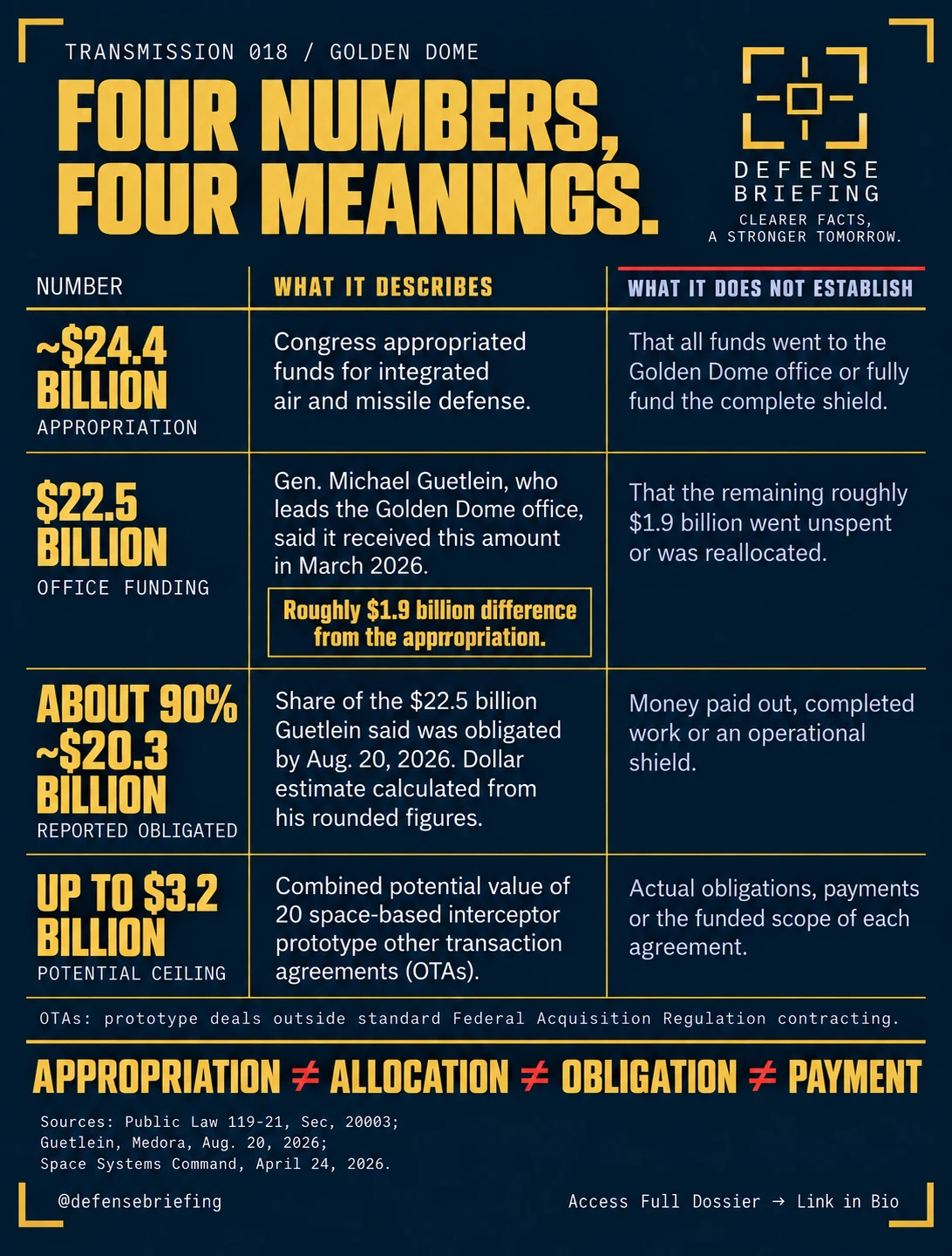
The money is real. The name, Golden Dome, does not appear in the statute. But the work is underway. What the public record still does not show is the funded scope of that work, agreement by agreement.
On 04-JUL-2025 President Donald Trump signed Public Law 119-21. Section 20003 appropriated $24.413 billion to the Secretary of Defense for "enhancement of Department of Defense resources for integrated air and missile defense," available through 30-SEP-2029.1, 2 Joint committee materials described that money as going toward Golden Dome for America. The enacted text does not use the name.2
That omission is interesting. It is not the accountability problem. A capability-based appropriation can finance an initiative without adopting its public branding. The harder questions sit one layer down: which office received which dollars, what those dollars are legally committed to buy, which milestones are already funded and which future activities need new budget authority.
Golden Dome Funding in 30 Seconds
- • Section 20003 appropriated $18.500 billion for next-generation missile-defense technologies and $5.913 billion for layered homeland defense, a combined $24.413 billion, available through 30-SEP-2029.
- • The enacted law does not name Golden Dome. Readers cannot treat every dollar in the section as work controlled by the Golden Dome program office.
- • Gen. Michael Guetlein said his office received $22.5 billion in March 2026 and had obligated about 90 percent of that sum by August. A Pentagon official said the balance was directed to the military services. Defense Briefing has not independently reconciled the residual by service or account.
- • Space Systems Command announced 20 other-transaction agreements, worth up to $3.2 billion, for space-based interceptor prototypes. That is a potential award ceiling, not an obligation. Its funding connection to Section 20003 remains unverified.
- • The fiscal year 2027 request is reported at about $17.5 billion, with roughly $400 million in the base budget and the rest tied to a second reconciliation measure. Those figures have not yet been reconciled against the justification books in this reporting.
What the law actually bought
Section 20003 is not a single lump sum labeled "Golden Dome." It is two subsections and twelve line items.
Subsection (a), $18.500 billion, funds next-generation missile-defense technologies. The largest lines are $7.200 billion for the development, procurement and integration of military space-based sensors and $5.600 billion for development of space-based and boost-phase intercept capabilities. The same subsection also funds directed-energy testing, national-security space-launch infrastructure, air moving-target-indicator satellites, a hypersonic test bed and $2.550 billion for the development, procurement and integration of military missile-defense capabilities.1
Subsection (b), $5.913 billion, funds layered homeland defense: hypersonic-defense acceleration, next-generation intercontinental ballistic missile defense, Indo-Pacific test-range infrastructure, improved ground-based missile-defense radars and a Missile Defense Agency range-safety ship.1
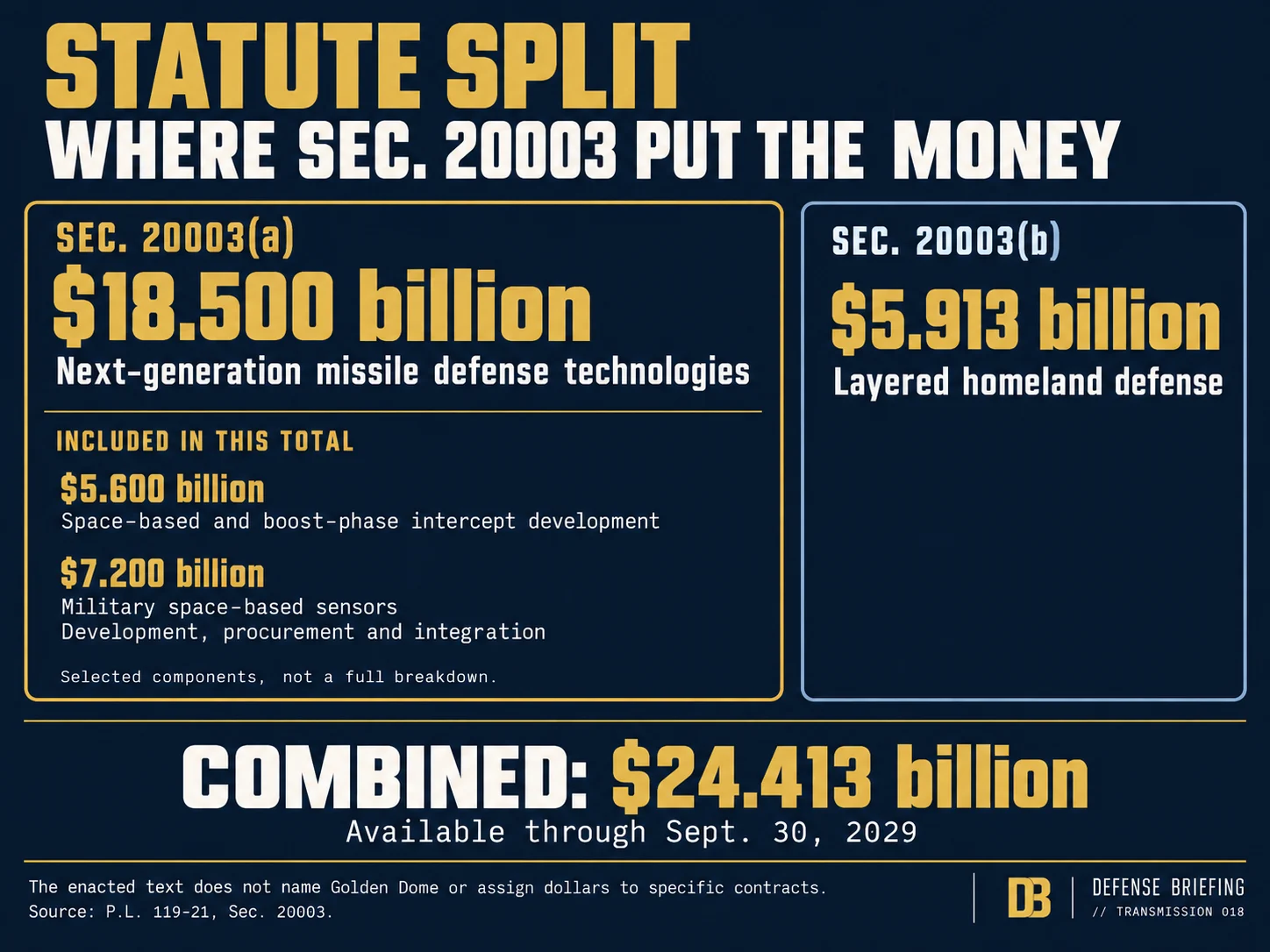
The verbs matter. The section funds development. It also funds procurement, integration, deployment, design and construction. Treating the entire appropriation as a research deposit, or as money that purchased only prototypes, misreads the statute. The sounder conclusion is narrower. The appropriation does not, by itself, establish a fully funded path to the complete operational architecture officials describe for the 2030s.1, 3
The Congressional Research Service notes a second gap. The enacted law does not specify how much of the money is for existing programs and how much is for new lines of effort. The House-passed bill would have required a spending plan within 45 days of enactment. That particular requirement is not in the enacted text.2 Absence of that clause does not prove the department supplied nothing through other channels. It also does not prove a complete public allocation exists. Those are separate facts. This reporting has not reconstructed either one from primary documents.
Four numbers that are not the same ledger
Public discussion of Golden Dome funding now runs four figures together. They answer different questions.
The first is the appropriation: $24.413 billion in Section 20003.1
The second is what the program office says it received. On 20-AUG-2026, speaking in Medora, North Dakota, Gen. Michael Guetlein said his office received $22.5 billion in March 2026 and had "obligated about 90 percent" of that amount. He added that the office "did not receive any funding to get after this [initiative] until March of this year." A Pentagon official later told Aerospace America that the legislation directed some funding to the services directly rather than to the program office.4 That explanation accounts for a gap. It is not an independently reconciled allocation by service and account.
The third and fourth figures are obligation and commitment percentages, and they do not land on one date or one denominator. On 11-AUG-2026 in Huntsville, Alabama, Guetlein said 90 percent of the funding his office was negotiating had been obligated and 95 percent was committed.5, 6 Nine days later he described "about 90 percent" of the $22.5 billion as obligated.4 Obligation and commitment are distinct accounting states. A commitment that is not yet an obligation is not the same thing as money already legally bound. This reporting has not seen a public table that states both amounts in dollars, with as-of dates and a defined denominator.
"We have radars on contract; we have space-based interceptors on contract; we have interceptors on contract; we have sites on contract."
That is Guetlein on 20-AUG-2026.4 It is a category list, not a contract file. He also referenced a recent live-fire event and said he could not discuss further test details. The same remarks used "sites," not specifically launch sites.4
The appropriation is public. The funded scope is the part that still has to be reconstructed.
Get Orbital Intel FreeThe 20 agreements are the readable slice
The cleanest public window into Golden Dome execution is not the full $24.413 billion. It is the space-based interceptor (SBI) prototype competition.
On 24-APR-2026 Space Systems Command (SSC) said it had awarded 20 Other Transaction Authority (OTA) agreements to 12 companies in late 2025 and early 2026, with a potential combined value of up to $3.2 billion. The stated task is a proliferated low-Earth-orbit constellation of interceptors capable of boost, midcourse and glide-phase engagements, with an initial capability demonstrated and integrated into the Golden Dome architecture by 2028.7, 8
Company lists circulating from that announcement have not been identical. Trade reporting and several official writeups name Anduril Industries, Booz Allen Hamilton, General Dynamics Mission Systems, GITAI USA, Lockheed Martin, Northrop Grumman, Quindar, Raytheon, Sci-Tec, SpaceX, True Anomaly and Turion Space.8, 9 At least one SSC-originated account of the same award set omits SpaceX.7 That stands as a roster discrepancy, rather than proof of a hidden award. The discrepancy remains unresolved in the documents reviewed for this article.
Even a clean roster would not finish the accounting. An OTA ceiling is not an obligation. Twenty agreements cannot explain sensors, radars, test ranges, ships and the other lines in Section 20003. The useful questions for each agreement are narrower:
Who holds it? On what date was it awarded? Which funding source supports it? How much has the government obligated so far? What are the maximum potential value and options? What funded scope and milestones does the current obligation purchase? When would the next required federal obligation fall? What nonfederal contribution, if any, is actually part of the arrangement?
"Next payment date" is useful but ultimately the wrong center of gravity. A payment can discharge an existing obligation without requiring new budget authority. The next unfunded milestone is the more relevant point.
Chronology cuts the same way. SSC says the prototype agreements were awarded in late 2025 and early 2026. Guetlein says his office received its allocation in March 2026.4, 7 Those statements can both be true. They make the original funding source, and any later transfer, a reporting question rather than a settled fact. We cannot assume the agreements were first funded from the March allocation.
What an OTA can eventually turn into
The prototype vehicle matters because of what it can legally become.
Title 10, Section 4022 authorizes prototype other-transaction agreements (OTAs). Follow-on production can proceed without another competition when specified conditions are met. Separate language addresses determinations and congressional notification for certain follow-on awards exceeding $100 million.10 Some prototype efforts also require that nonfederal sources provide at least one-third of total project cost. That is a share of total cost, not a casual "match" against the federal line alone.10
Those provisions create a concrete question. What production pathway do the SBI agreements contemplate, and what technical, funding and approval conditions must be met before it can be used? They do not establish that any production award has occurred.
The Government Accountability Office has documented the same transition problem across other prototype OTAs: award data is often listed as incomplete and the path from prototype to production is unevenly recorded.11 That is context for Golden Dome, not a finding that any specific Golden Dome recommendation has been ignored. Where GAO recommendations remain open, the accurate statement is that they remain open.
October is not a universal cliff
Fiscal year 2027 (FY2027) begins on 01-OCT-2026. Guetlein has warned that without continued funding "Golden Dome will stop with everything we've already built and delivered," and that if lawmakers "don't figure it out, there is no Golden Dome because there is no funding."5
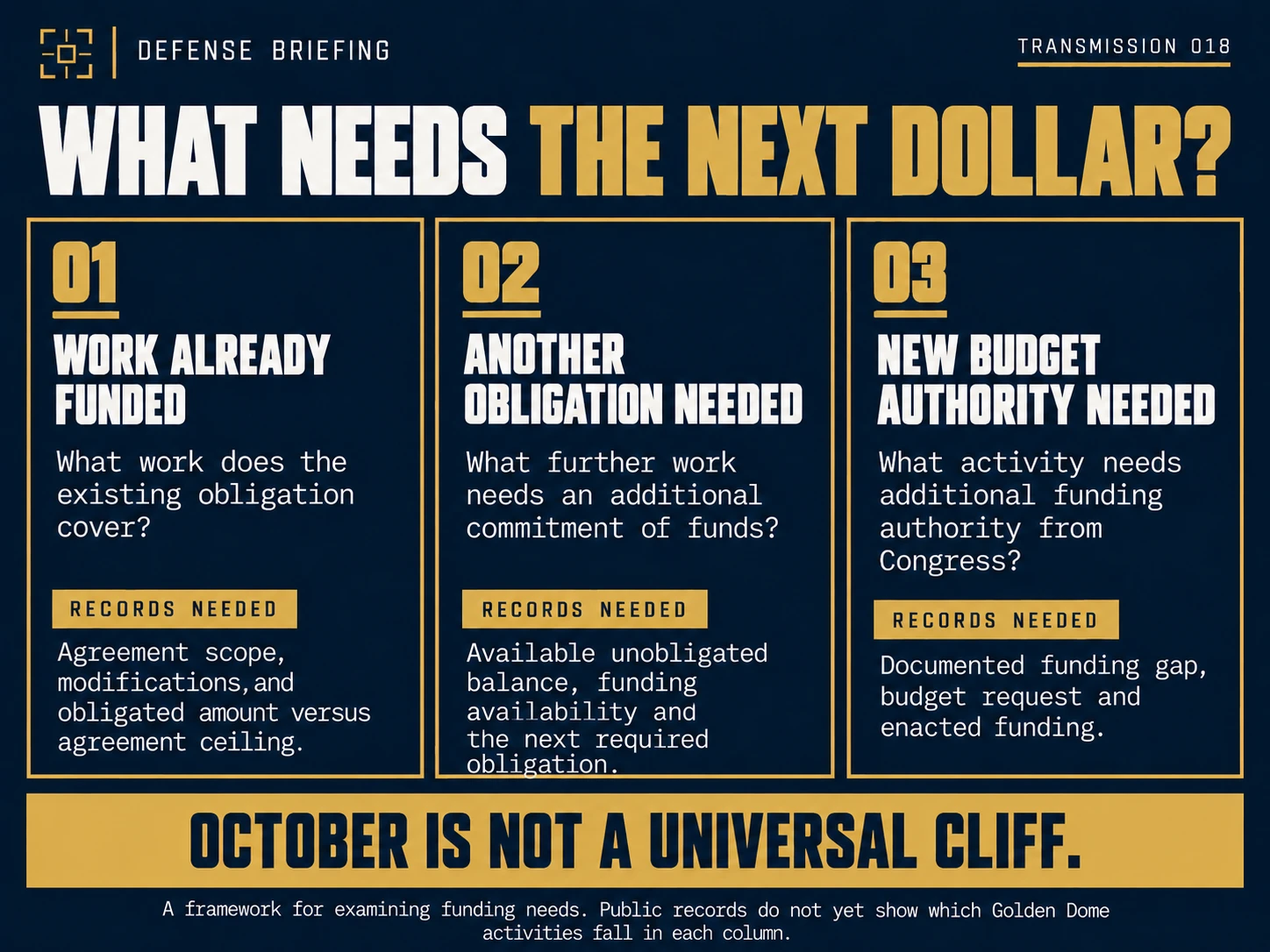
Further funding could support new activities or continued development beyond the funded scope of existing agreements. The warning does not establish an automatic funding cutoff on 01-OCT-2026. Unobligated Section 20003 balances remain available for lawful obligations within their permitted purposes through 30-SEP-2029.1 Work already covered by valid obligations can generally continue against those obligations, whether or not the money has been paid out. Separately, remaining unobligated balances may support additional lawful obligations. The availability date does not establish how much money remains or whether it is sufficient for planned work. A continuing resolution does not automatically freeze every Golden Dome activity on 01-OCT-2026. A production decision is not automatically a request for new statutory authority. A new obligation is not automatically dependent on a new appropriation.
What a continuing resolution would affect depends on the activity, the funding source, the agreement and the enacted restrictions. Activities that need a new start, a new site or a production decision may need new authority. Others may not. The public record does not yet identify which fiscal year 2027 milestones fall into which column.
Reporting on the request itself puts the fiscal year 2027 Golden Dome total at about $17.5 billion, with roughly $400 million in the base budget and about $17.1 billion tied to a proposed reconciliation measure.12, 13 Defense Briefing has not yet reconciled those figures against the justification books. Until that check is complete, treat $17.5 billion, $17.1 billion and $400 million as reported request figures, not as audited account lines.
Send this to the person who has to explain the difference between an appropriation and an operational shield.
Subscribe FreeA $1.2 trillion model is not a bill
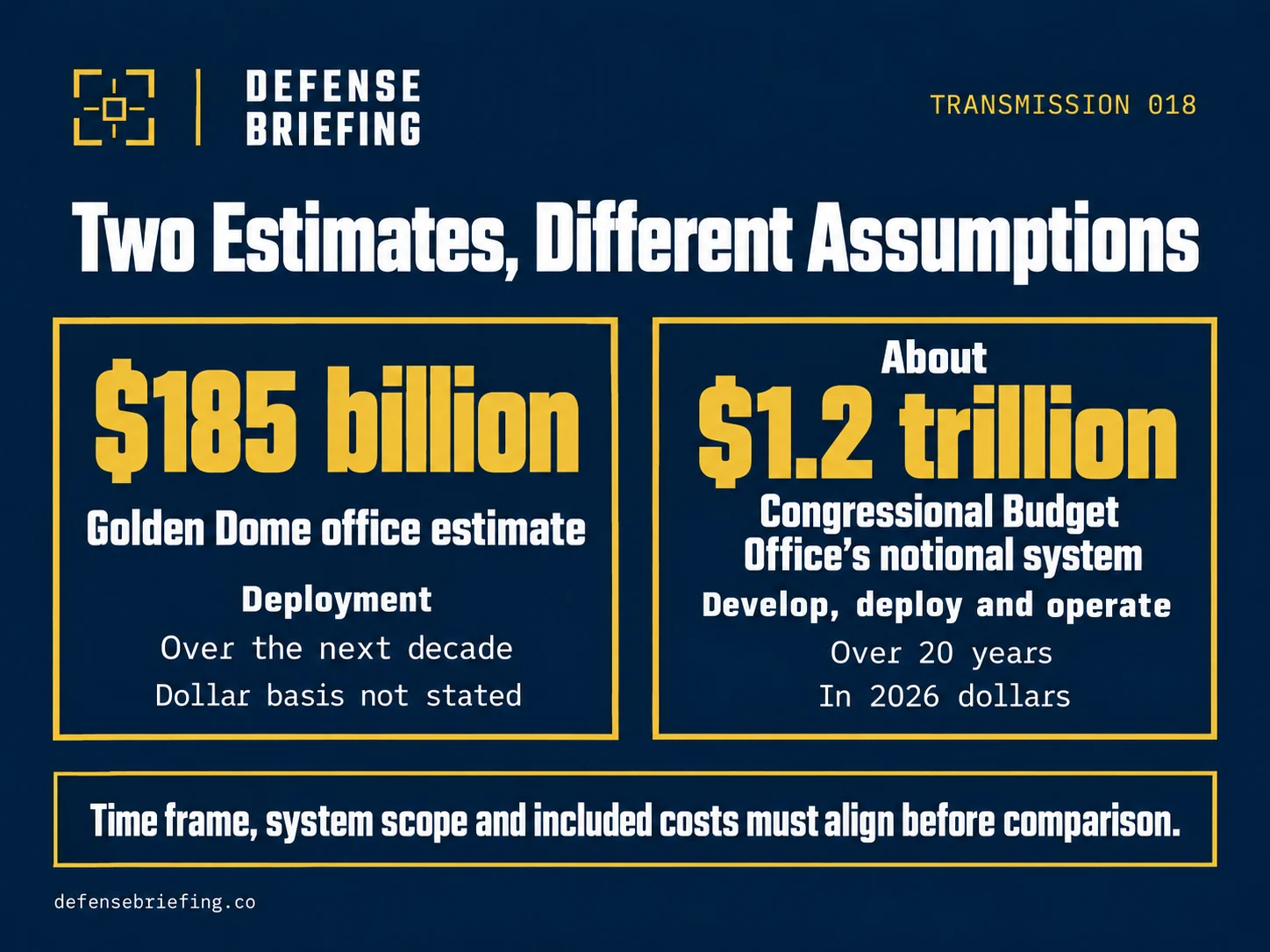
In May 2026 the Congressional Budget Office (CBO) estimated that a national missile-defense system consistent with the January 2025 executive order would cost about $1.2 trillion to develop, deploy and operate for 20 years, in 2026 dollars. Acquisition would account for more than $1 trillion. A space-based interceptor layer would dominate the total.3
CBO stated the limitation in the open. Details about the planned "objective architecture" had not been released, "making it impossible to estimate the long-term cost of the GDA system being contemplated by DoD." The $1.2 trillion figure models a notional architecture built from the executive order, not the classified or unreleased design the program office is actually buying.3
Guetlein has put the objective architecture at $185 billion for deployment over the next decade. CBO says that figure appears to cover a shorter period than its 20-year estimate and may cover different activities and budget categories. The gap suggests a more limited architecture, significant funding from other accounts or both. CBO offers those as possible explanations, not a reconciliation of the two estimates.3 That is conditional analysis. It is not an appropriation and it is not a guaranteed supplier market.
Schedule language has tightened in September. Guetlein has described a first increment in 2028 that leans on existing systems, with a fuller architecture later, including a 2035 mark in recent public remarks.14, 15 Those dates describe intent. They do not convert Section 20003 into a fully funded path from prototype to the complete shield.
What private capital can and cannot do
Companies cannot appropriate federal money. That point is true and quickly exhausted. The more useful question is what private financing can actually cover while the government decides what to buy next.
It can pay for testing, demonstrations and manufacturing preparation before a government award. It can keep work moving between development stages at company risk. It can finance infrastructure as a service if a customer later pays for access. It cannot supply missing government purchasing authority.
Northrop Grumman said in June 2026 that it would self-fund a 2027 on-orbit SBI demonstration with Apex and described that effort as building on a $1 billion company-led investment in missile-defense technology.16 Apex had earlier described Project Shadow, a separately announced demonstration, as a $15 million private investment focused on proving enabling technology rather than executing a live intercept.17 As these details originate from separate disclosures, the figures are not cumulative and do not define the extent of financial overlap or the total private financing across both efforts.
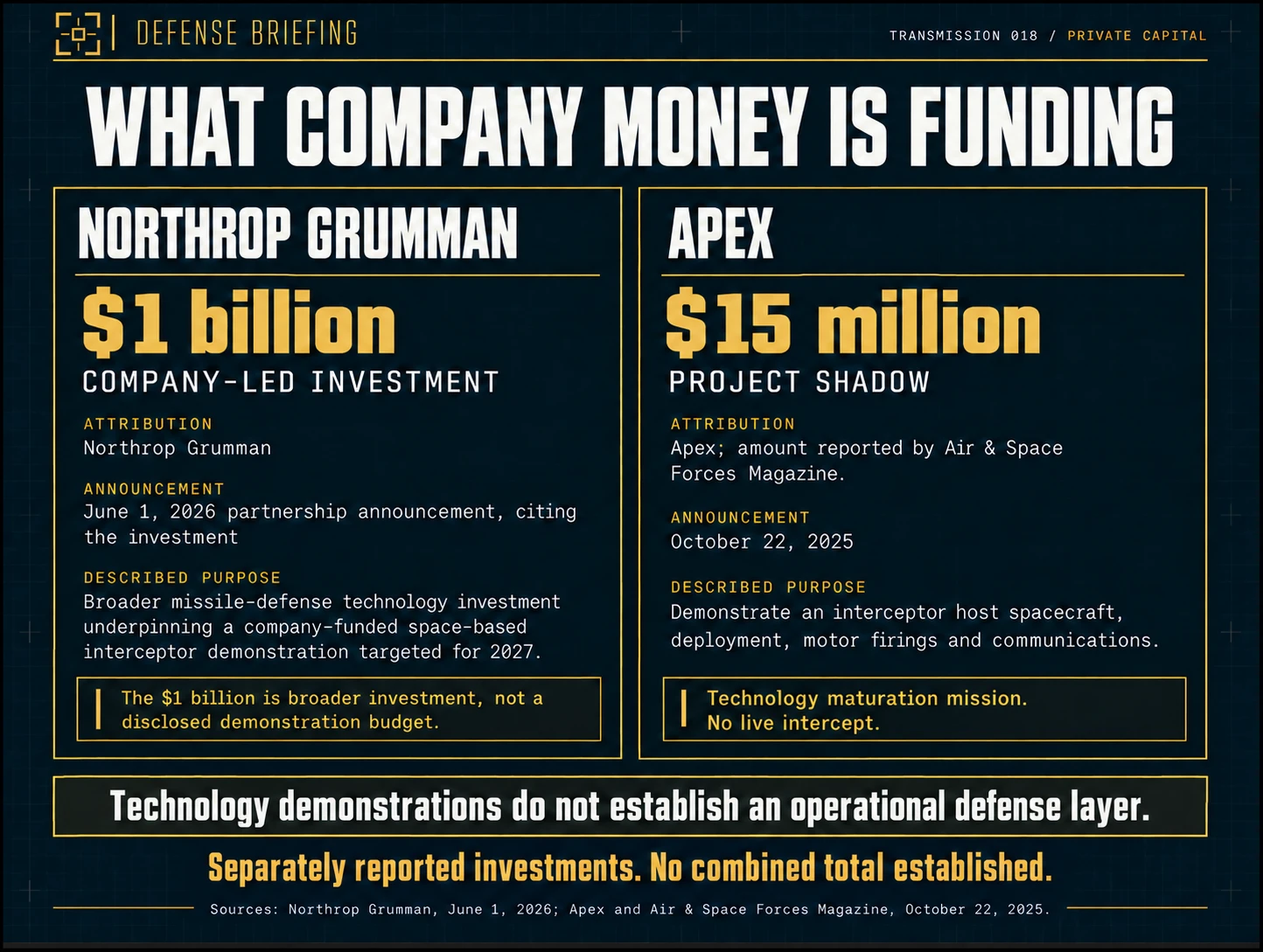
Company-funded research, capital expenditure and venture investment are distinct categories. Combining all of them into "corporate venture cash" collapses the distinction and limits accountability.
The same caution applies to earlier market chatter about a SpaceX-led subscription pitch. In April 2025 Reuters reported that SpaceX, Anduril and Palantir had emerged as frontrunners on a sensing-and-tracking constellation structured as a government subscription. Elon Musk replied that the report was "not true" and said SpaceX had not tried to bid.18 The episode is useful only as a reminder: a financing concept is not an award, and a denied report is not a contract file.
The Angle
Golden Dome now has a statutory down payment, a program office, prototype agreements, public obligation percentages and a 2028 increment on the calendar. What it still lacks in the open is a reconcilable map of funded scope.
That is not a finding of concealment. It is a finding about the public record. The records reviewed for this transmission show the appropriation, the office's claimed allocation, a $3.2 billion interceptor ceiling and a set of official statements about radars, interceptors and sites. They do not yet show, in one place, what current obligations purchase, which next milestones require new money and which FY2027 activities can proceed on balances that remain available through 2029.
The Senate Armed Services Committee's Strategic Forces Subcommittee is scheduled to receive an update on Golden Dome on Tuesday, 29-SEP-2026, at 4 p.m. Eastern in SR-222.19 That hearing is an opportunity to put dollars, agreements and next required obligations on the same table. Until those fields are public, the honest sentence is the plain one. Congress funded a large integrated air-and-missile-defense account. It has not yet become possible, from public documents alone, to say what complete operational architecture that account has secured.
Forward this to the staffer who intends to brief the $24.413 billion number and the $3.2 billion number as if they were part of the same story.
Sources: Public Law 119-21, §20003; Congressional Research Service Insight IN12576; Congressional Budget Office, Potential Costs of a National Missile Defense System, May 2026; Space Systems Command and DVIDS award materials, 24-APR-2026; Gen. Michael Guetlein remarks as reported 11-AUG-2026 and 20-AUG-2026; 10 U.S.C. §4022; GAO-25-107546 on other-transaction data; fiscal year 2027 request coverage; company releases on the Northrop-Apex demonstration. No classified information was used and all material is publicly accessible.