
The Physical Layer: Who Owns the Power, Water and Land Under the AI Boom
A data center is not a cloud. It is a large electrical load whose useful work is computation and whose input energy ultimately has to leave as heat. The 2026 fight over it is a fight over three physical constraints: power on a wire, cooling capacity and land that can host both. Nuclear, ocean and orbital compute are the bets placed on what happens when those three stop lining up.
Dismiss whatever concepts you have in your head of the digital cloud: a data center is not a warehouse of flashing lights, a quiet digital library or a benign piece of software running in the background. Thermodynamically, it operates on the scale of a heavy industrial power load. While electricity drives the required computational mission, nearly 100 percent of that electrical energy degrades into heat. Failing to aggressively dissipate this thermal signature will result in immediate silicon failure. Ultimately, a modern data center must be engineered and operated as a high-capacity thermal-management platform just to sustain its computing capabilities.
The United States is the world's largest data-center market, and it has one of the sharpest collisions between new demand and old infrastructure. A 100 megawatt hall in a dry county can pull on the same two public systems as the houses next door: the electric grid and, where water-based cooling is used, the water system. And it can pull hard on both. US electricity demand is starting to rise again after more than a decade of near stagnation, and the Energy Information Administration (EIA) says electricity use by data centers is driving that renewed growth.1 Many of the easiest places to build, meaning sites that offered cheap power, available cooling resources and fast zoning all at once, are already constrained or spoken for.
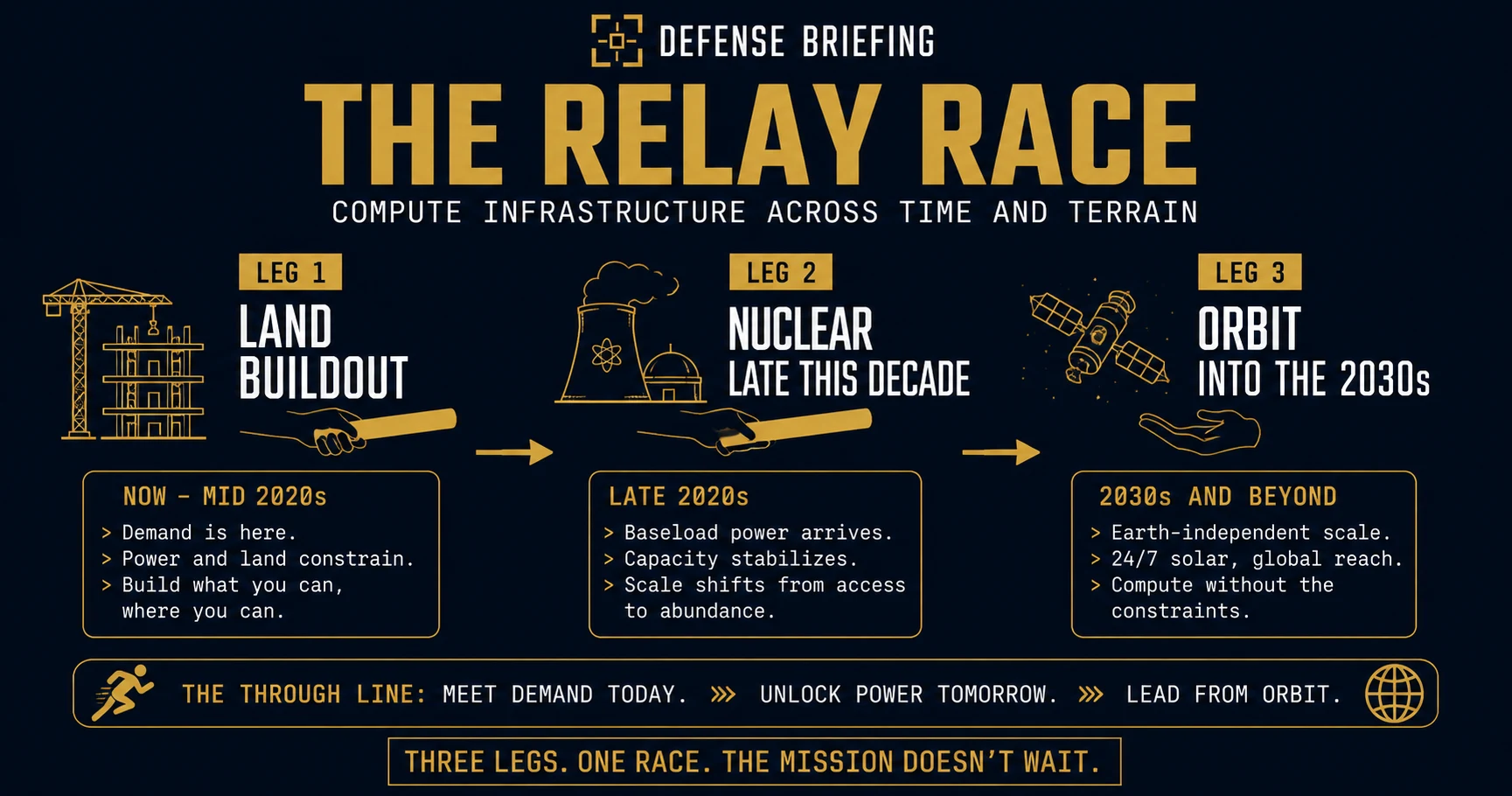
Because conventional expansion has hit a wall, the buildout is now a search for firm power that does not have to wait years for new transmission lines. On land, the newest answer is nuclear in blocks small enough to sit next to the chips. Off land, ocean platforms drop the freshwater problem, and orbital centers drop the freshwater problem and the grid at the same time. None of those alternatives is an equivalent replacement in 2026. The working assumption here is simpler: the land buildout carries the load now, and nuclear and orbit are the bets on what carries it later.
THE PHYSICAL LAYER IN 30 SECONDS
- • A data center needs three things at once: firm power, a heat sink and permitted land with fiber. Missing any one disqualifies the site.
- • US on-site data center water use was roughly 17.4 billion gallons in 2023. The water embedded in the electricity those facilities consumed added roughly 211 billion gallons more.2
- • A hall can be built in about 18 months. A high-voltage transmission line takes closer to a decade. That gap is the whole controversy.
- • Higher residential bills are driven by how regulators allocate grid and capacity costs, not by the servers themselves.
- • Advanced nuclear is moving faster than it was a year ago, but widespread commercial small modular reactor deployment remains a 2030s story.26
- • Exactly one data-center-class AI processor has operated in orbit to date.11
How a Data Center Works
At its core the plant runs a continuous four-step cycle. It draws power from the grid or a local source. It routes that electricity to processors, meaning central processing units (CPUs), graphics processing units (GPUs) and memory. It executes workloads across those chips. Then it dissipates the heat that results.
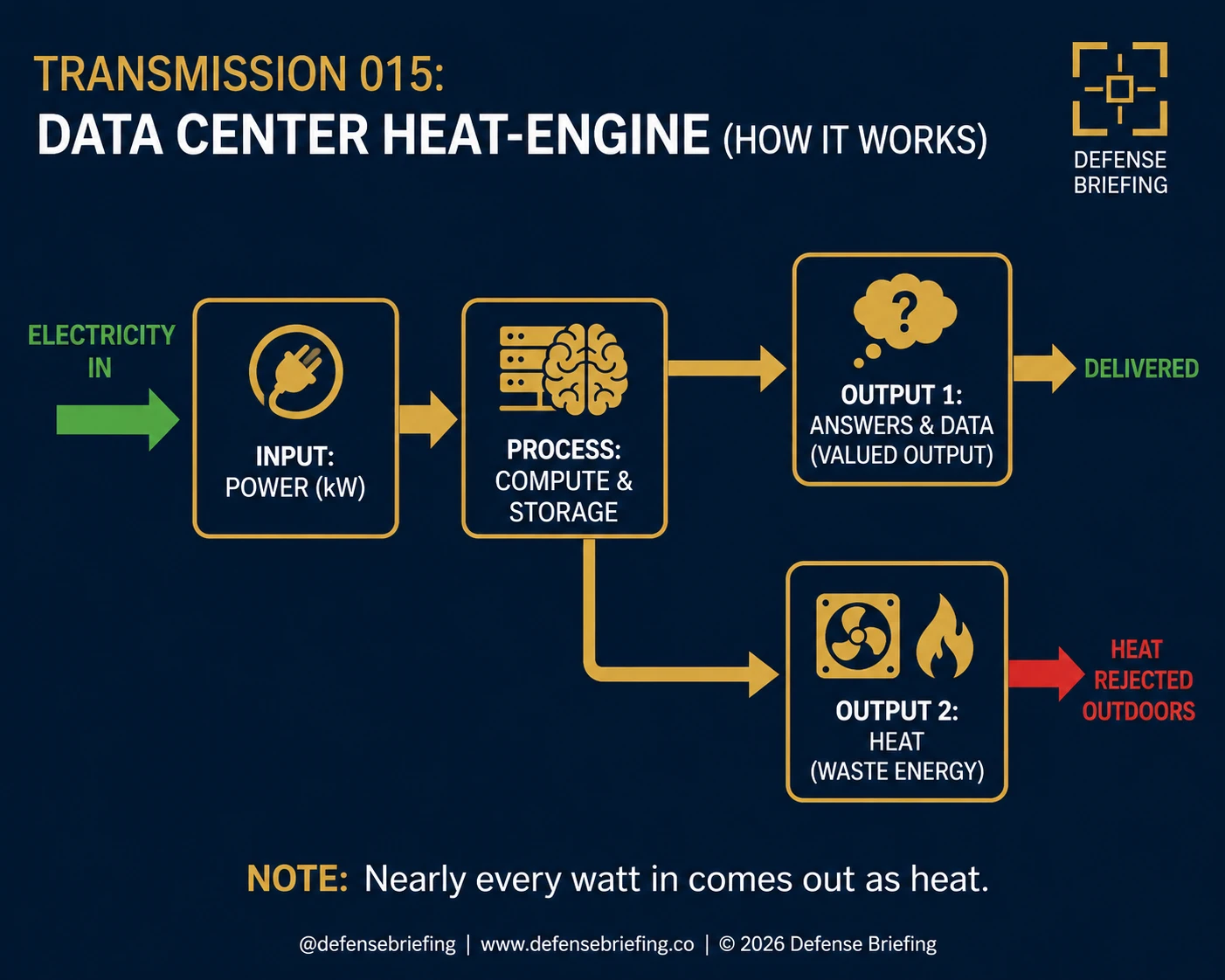
Managing that heat is not an afterthought. It is most of the engineering. A rack of AI chips drawing 100 kilowatts is, for cooling purposes, a 100 kilowatt space heater that cannot be switched off. Put thousands of those racks in one building and the plant has to move the heat of a small industrial furnace out the door every second of every day, without letting the silicon get hot enough to throttle itself and turn an expensive machine into a slow one.
That is why a data center is measured by its power rather than its floor space. The industry scorecard for overhead is power usage effectiveness. A score of 1.5 means that for every watt reaching the chips, another half watt goes to cooling, lights and losses. A score near 1.1 means almost everything is going to compute. Lower is better, and the new AI halls are chasing the low numbers because at this scale the overhead is a fortune.
Three inputs are the whole plot. Firm electricity, meaning power that is there every hour rather than only when the wind blows. A heat sink, meaning something cold enough to dump heat into. And land with a permit and a data line. A site missing any one of the three cannot host the plant no matter how much of the other two it has.
Why Data Centers Exist
These buildings stop being mysterious once you see them as factory floors. They carry the everyday digital economy, meaning cloud storage, banking, logistics, health records, mapping and streaming. They also carry mission-critical national security work: command and control, intelligence analysis, missile-warning integration and satellite communications, alongside the training and deployment of enterprise AI models. Without them, neither modern cloud computing nor scalable artificial intelligence functions.
Capital expenditure by Amazon, Microsoft, Alphabet and Meta was projected at roughly 320 billion dollars in 2025 as the companies accelerated spending on data centers, chips and related AI infrastructure.23 The scale is extraordinary, but the useful comparison is physical rather than rhetorical: these companies are becoming much more capital-intensive because AI requires buildings, power systems, networking and silicon at industrial scale.
Why Electricity Demand Is Surging
For nearly two decades US electricity consumption stayed close to flat, as efficient appliances and lighting offset growth. That era is over. EIA confirms national power demand is climbing again, while the International Energy Agency (IEA) projects data centers will account for nearly half of US electricity-demand growth through 2030.1, 24
Three figures set the scale.
- Global expansion. Global data center electricity consumption was about 460 terawatt-hours in 2024. The IEA projects it to roughly double to about 945 terawatt-hours by 2030.24
- US grid impact. Data centers accounted for roughly 4 to 4.4 percent of total US electricity use in 2023. Lawrence Berkeley National Laboratory's June 2026 update now puts the 2030 reference case at 11.8 percent, with sensitivity scenarios ranging from 9.5 to 15.3 percent.2, 22
- Upper-bound projection. The Electric Power Research Institute's 2026 scenarios put data centers at 10 to 20 percent of US electricity demand by 2035. The 20 percent figure is the top of a modeled range, not a baseline forecast.25
One terawatt-hour equals one billion kilowatt-hours, which puts these numbers on the scale of entire nation-states. The direction matters more than the decimal. Two structural dynamics drive it. Chips get more efficient every year, but the industry is adding them faster than efficiency can compensate. And the grid was never designed for a customer with the energy footprint of a city that wants to be connected inside eighteen months.
The infrastructure story behind the AI trade, every Wednesday, in plain language.
Get Orbital Intel FreeWhy They Are Controversial
A data center arrives with the power footprint of a major city and asks for grid and water infrastructure originally sized for small towns. The friction reduces to two resources.
On power, the bottleneck is not generating electricity but connecting it. By late 2025, US interconnection queues held well over 1,000 gigawatts of proposed generation, most of it wind and solar, stalled behind a shortage of high-voltage transmission.21 A hall goes up in 18 months. A transmission line takes closer to a decade. Demand spikes immediately while supply stays trapped behind the delay.
On water, the conflict is immediate and local. A 100 megawatt evaporative-cooled facility consumes roughly 1.5 to 3.0 million cubic meters of water a year.10 In Phoenix, West Texas or Imperial County that is a serious hydrological event in an already stressed basin. In wetter regions such as the Columbia River basin or the Nordics, the same volume can be much smaller relative to total water availability, though local permits, ecosystems and competing uses still matter. Same machine, entirely different political outcome.
Why Data Centers Need Water at All
It is a fair question. A desktop cools itself with a small fan. The answer is scale and thermodynamics. Air cooling works well at lower rack densities. As density climbs toward 40, 80 or 120 kilowatts per rack, conventional room-air cooling becomes increasingly difficult and inefficient. Moving that much air can require large fans and substantial overhead power.
Water absorbs roughly four times as much heat per degree by weight as air, and thousands of times as much by volume. A pipe the width of a wrist can carry heat that would otherwise need an air duct the size of a hallway. Liquid loops in gaming PCs work on the same principle, but they only relocate heat into the room. That is fine for 200 watts and useless for 100 megawatts.
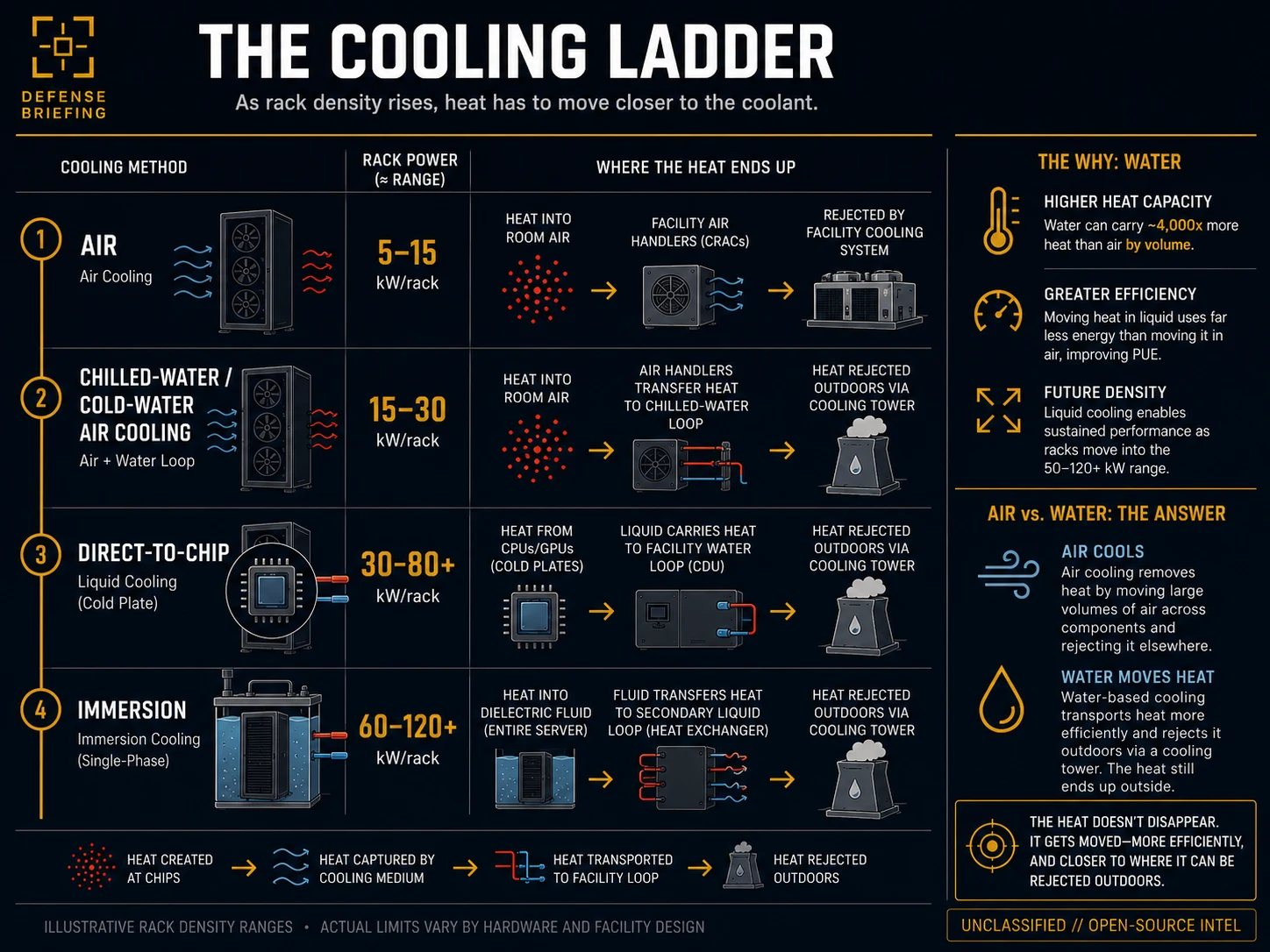
High-density sites use three main approaches. Cooling towers with chilled-water loops shed heat by evaporating water. Direct-to-chip cooling runs closed coolant loops against the processors, which need only small top-ups but still have to hand the heat off to a central system. Immersion cooling submerges entire servers in non-conductive dielectric fluid. Whichever method is used, the heat ends up in the surrounding air or water. In hot, dry climates, evaporative cooling can reject heat more efficiently than dry air systems during peak conditions. Water is not physically indispensable, however: dry cooling can avoid most direct water use at the cost of larger equipment, higher capital expense or higher power consumption in difficult weather.
Building underground does not solve it. Norwegian mines and hardened bunkers offer stable temperatures around 13 degrees Celsius, but soil is a poor thermal conductor. At data-center scale, the surrounding ground alone cannot absorb hundreds of megawatts indefinitely without an engineered heat-rejection system. Underground sites can gain security and cooler intake air, but they still need a sustained path for heat to leave the facility.
Reusing the waste heat is real but geographically limited. Stockholm, Helsinki and Odense already pipe data center heat into district heating networks. Four things block that model in most of North America. Server cooling water often leaves the facility in roughly the 30 to 45 degree Celsius range, which is generally too low-grade for many district-heating systems without heat pumps. District heating pipe networks mostly do not exist here. Hot water loses energy over distance, and data centers are deliberately built far from dense housing. And heating demand disappears in summer while the heat keeps coming 24 hours a day.
The Water Footprint, In Context
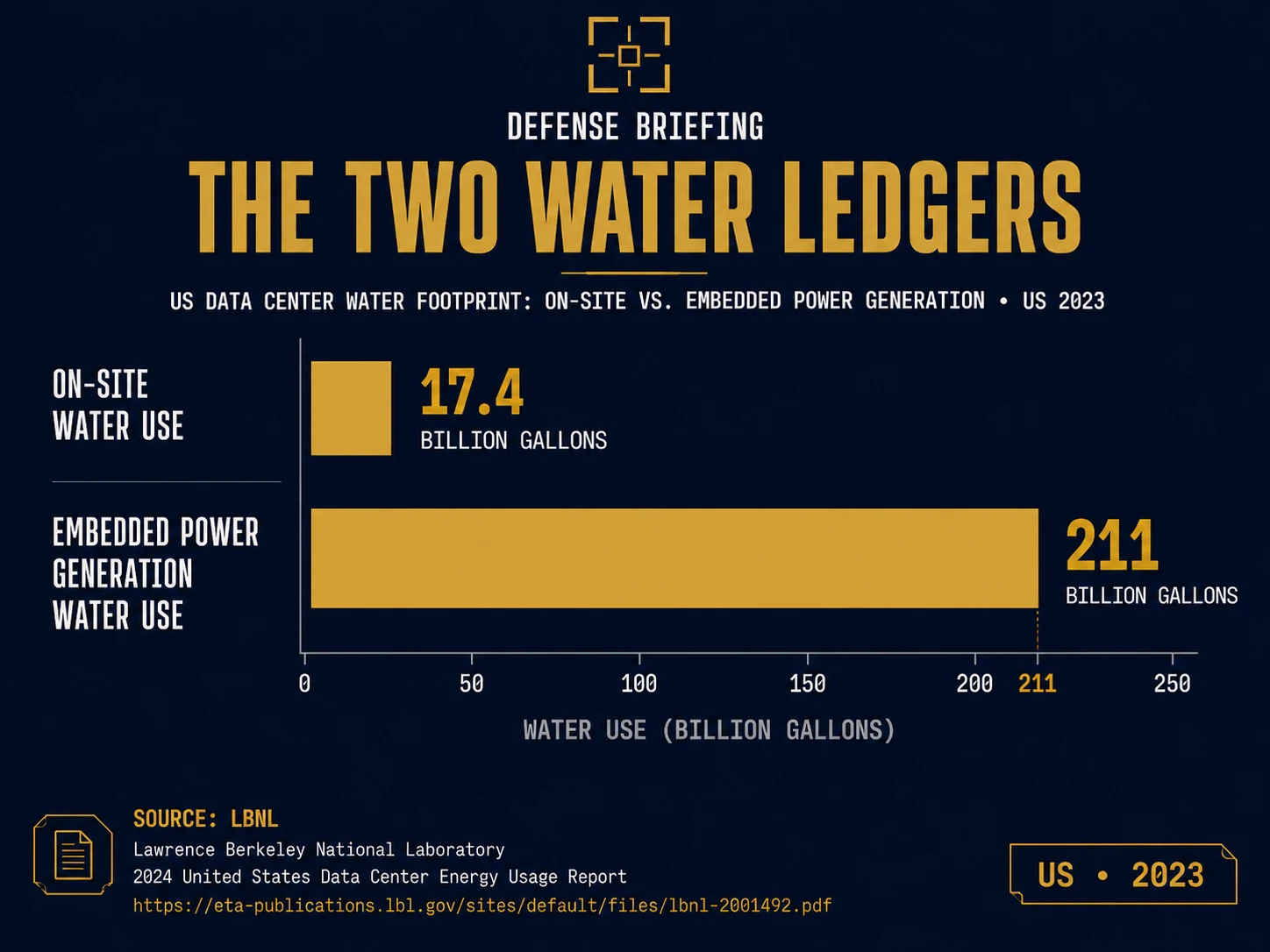
Figures associated with Lawrence Berkeley National Laboratory put US data center on-site water consumption at roughly 17.4 billion gallons in 2023. Indirect or embedded water use, meaning the water needed to generate the electricity those facilities consumed, added roughly 211 billion gallons, for a total near 228 billion.2 The embedded half is rarely publicized, because much of the US grid runs on thermal plants that use water for steam and cooling. An August 2026 Ceres study estimated that data center electricity across seven major host states was tied to roughly 3.4 trillion gallons of freshwater withdrawals a year, with nearly 78 percent of that power coming from water-dependent plants.9
Headlines routinely confuse withdrawal with consumption. Most power plant cooling water is withdrawn and returned to its source, warmer. Only the evaporated portion is consumed and temporarily lost from that watershed. A December 2025 peer-reviewed study in Nature Sustainability modeled US AI server expansion through 2030 and projected an additional annual water footprint of 731 to 1,125 million cubic meters, with a midpoint near 860 million. The authors concluded that best management practices could cut water consumption by up to 86 percent, but that the industry cannot hit net-zero water and carbon by 2030 without heavy reliance on unproven offsets.3
The public argument usually collapses into two claims, that none of the water can be reused or that all of it is recycled. Neither is true. It depends which part of the cooling process the water is serving. Closed loops, whether direct-to-chip or chilled-water, circulate the same fluid for months or years and need only minimal top-ups. Evaporative cooling towers work by turning liquid water into vapor, and once that moisture exhausts to the atmosphere it is gone from the facility. The global hydrological cycle conserves it. The local watershed does not. An aquifer in Phoenix gains nothing when that water falls as rain over Montana three weeks later.
"Deploying evaporative cooling towers in an arid, water-stressed basin is a planning failure, not a technological necessity."
There is also a minerals problem. As pure water evaporates, dissolved minerals stay behind and concentrate into scale that clogs pipes. Facilities have to purge a share of that mineral-heavy water, known as blowdown, and replace it with fresh. Blowdown can be treated and recycled on site, but building the treatment plant and obtaining discharge permits often costs more than buying municipal water. Some operators use reclaimed municipal wastewater for top-ups. That conserves potable supply but does not create new water. It redirects treated effluent away from agriculture or river ecosystems, which puts data centers into direct competition with existing users in stressed basins.
Finally, no amount of on-site efficiency by itself erases the embedded footprint. A facility using zero water for direct cooling can still inherit water use from the generation supplying its electricity. That footprint can be reduced through lower-water generation such as wind and solar, dry-cooled thermal generation, reclaimed or non-freshwater supplies and other changes in the power mix.
What a Data Center Costs the People Next Door
This is the question a county actually has to answer, and it is the one most often answered badly in public. Hyperscalers pay for the power they consume. Neighboring residents can still see bills rise, because an electric bill reflects far more than generation cost. A large new industrial customer reshapes the infrastructure and regulatory cost structure of the whole grid.
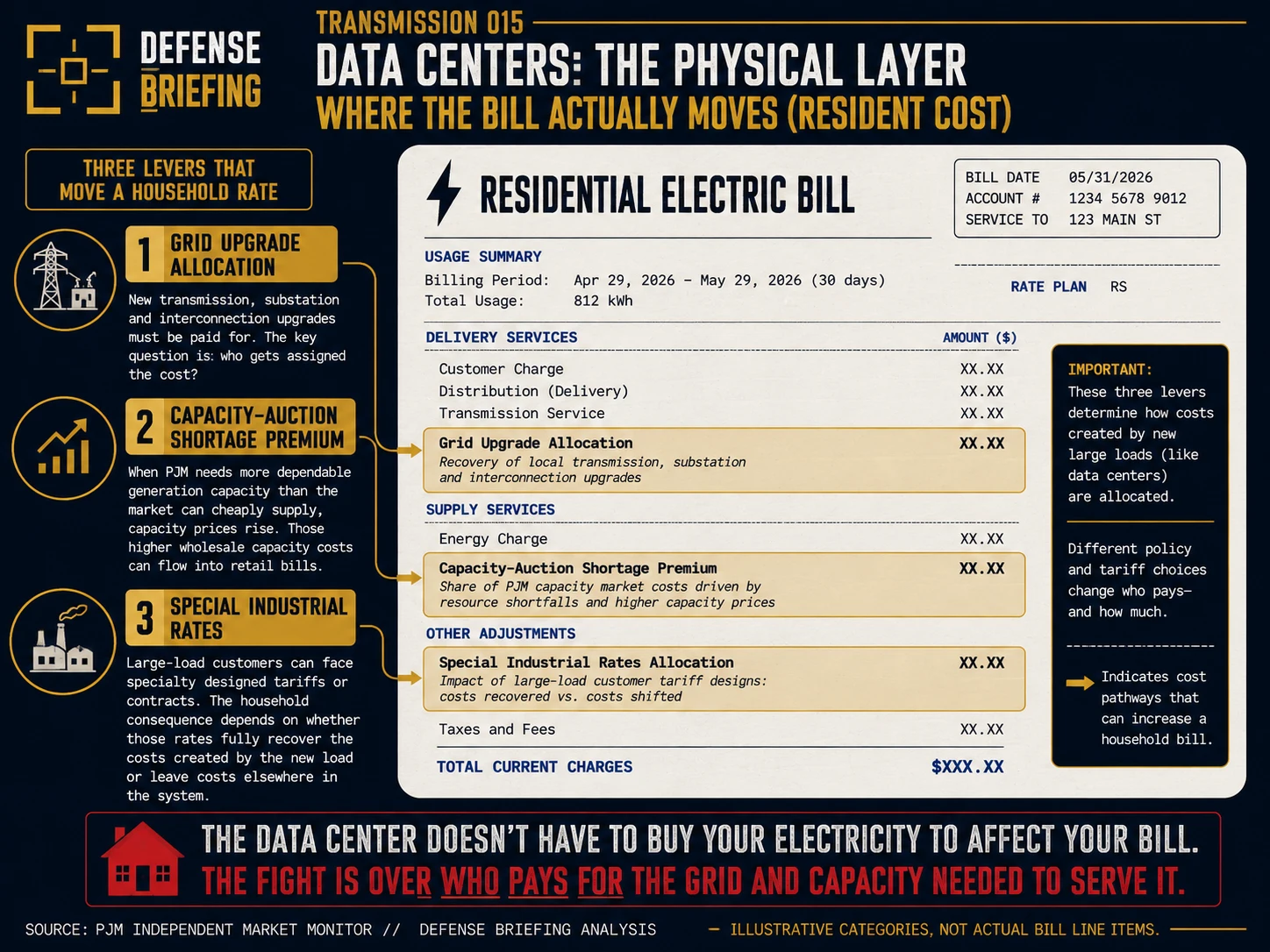
The first lever is grid infrastructure. When a utility builds a substation and high-voltage lines to connect a 300 megawatt campus, someone finances it. If regulators require the data center to cover its dedicated infrastructure, residential rates are unaffected. If regulators spread those capital costs across all ratepayers, a common feature of older economic-development incentives, households end up subsidizing the connection for a facility that may employ a few dozen permanent staff.
The second is capacity. Many regional markets run forward auctions to secure enough generation for peak years, and that cost passes to retail customers. In the PJM Interconnection, the regional grid serving Virginia and 12 other states, capacity prices jumped to record or capped levels for the 2025/2026, 2026/2027 and 2027/2028 delivery years as forecast demand outran new supply. PJM and its independent market monitor have identified data-center growth as a primary driver of the tightening balance.7, 8 Residents in those markets are not paying a data center's electricity bill. They are paying for a regional capacity shortfall caused by demand growth outrunning plant construction.
The third is rate structure. Large data centers often negotiate bulk, off-peak or interruptible rates below standard residential tariffs. Even when those rates are economically justified by a steady and predictable load, the optics of paying more per kilowatt-hour than an industrial neighbor drive real political backlash.
The economics are not uniform. A 2026 analysis noted that some of the sharpest residential increases occurred in states with stagnant demand growth rather than in high-density markets like Texas. Where operators build their own generation or fully fund their interconnection, residential rates tend to hold. Rate hikes show up when large unhedged demand lands on a constrained grid under rules that socialize expansion costs. Higher bills are not caused by the servers. They are caused by grid capacity failing to keep pace and by regulators allocating the shortfall to residential meters.
Primary sources. No hype. The briefing smart people forward.
Subscribe FreeThe Scarcity of Ideal Sites
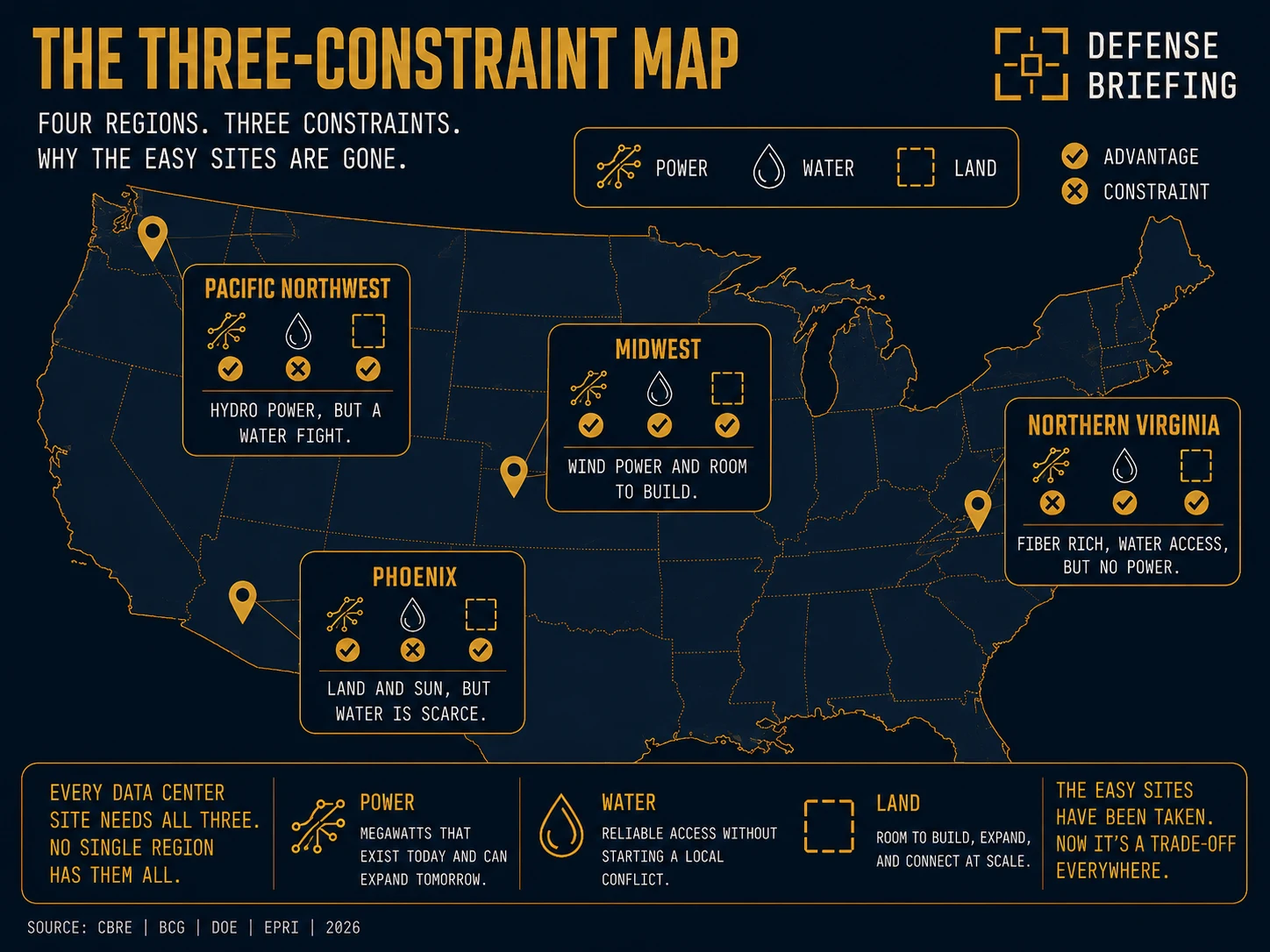
Map cheap power, abundant water and fiber-connected land near a short interconnection queue and the mismatch is obvious. Northern Virginia has world-class fiber and a mature market but severe power constraints. Phoenix has land and sun and a water problem. The Pacific Northwest has low-cost hydroelectric power and intense competition for grid access. The Nordics have cold air, hydro and nuclear, and are one of the few places able to cool large facilities without draining local water, though regulatory scrutiny there is tightening too.
Because no single location satisfies all three cleanly, capital is chasing two assets: firm power that skips multi-year transmission delays, and heat sinks that do not tap municipal drinking water. In the near term operators are leaning on closed-loop liquid cooling and dry-cooling systems that reject heat to ambient air with negligible water use, and on geographic realignment toward wind-rich and water-rich states. The Nature Sustainability modeling flagged Texas, Montana, Nebraska and South Dakota as strategic places to absorb future load.3 Those moves buy time. They do not change the trajectory, because the power demands of next-generation training clusters keep outpacing firm power on local grids.
The Nuclear Bet for Firm Power
Nuclear is the land-based answer to a specific problem: continuous power next to the chips without waiting years for public transmission. The distinction between what exists commercially today and what is promised matters, because headlines routinely blur the two.
The fastest nuclear deals use existing gigawatt-scale plants rather than new reactor technology. Microsoft contracted for power from the planned restart of the undamaged Unit 1 reactor at Three Mile Island, renamed the Crane Clean Energy Center, in Pennsylvania.18, 19 Amazon and Meta have also signed arrangements tied to operating nuclear plants while backing future reactor projects. Google's nuclear strategy is centered on new Kairos Power reactors, with the first 50 megawatts scheduled for 2030. 27
The novel approach is small modular reactors (SMRs) and microreactors. Instead of a 1,000 megawatt plant built on site over a decade, these are designed to be factory-built and assembled in modules. Microreactors can run behind the meter on a campus, bypassing grid congestion entirely. Paired with dry cooling, they can generate power without draining municipal water. Capacity can be added incrementally as compute demand grows. Oklo, Kairos Power, X-energy, TerraPower and Nano Nuclear are among the companies developing advanced reactors. Some, including Kairos Power, X-energy, Oklo and TerraPower, now have direct hyperscaler agreements or investment support.
None of that solves the mid-2020s grid crunch. Experimental microreactors are moving faster than they were a year ago: Department of Energy programs now have projects targeting electricity production in 2027 and full-power demonstrations in 2028. But DOE still describes new Gen III+ small modular reactor generation as a 2030s deployment story, and Google's first Kairos Power electricity is scheduled for 2030. Licensing, fuel supply and first-of-a-kind construction remain constraints.26, 27 Nuclear is therefore a credible long-term land-based answer for firm power, but not a blanket near-term fix.
Ocean-Based Cooling: The Intermediate Hedge
Seawater is a massive heat sink that does not touch municipal drinking water. That single advantage is what drives barge-mounted and submerged designs.
Keppel Data Centres began construction in 2026 on its roughly 25 megawatt floating data center in Loyang, Singapore. The seawater-cooled project is committed to a global hyperscaler and targeted for completion in 2028. Driven by Singapore's land and freshwater limits, it is one of the most mature near-term floating projects.17 Shanghai Hailanyun Technology, operating as HiCloud, runs a 24 megawatt underwater facility off Shanghai that reached full commercial operation in May 2026 and is directly paired with offshore wind power.17 China's broader push into capital markets for space and infrastructure ventures is covered in our earlier briefing on Chinese space companies on the STAR Market.
Panthalassa, backed by a 140 million dollar round led by Peter Thiel at a valuation near 1 billion dollars, is developing wave-powered free-floating nodes that rely on seawater cooling and satellite data transmission, with Pacific sea trials slated for 2026 and commercial deployment targeted for 2027. Power costs look attractive. The business model depends on hardware surviving open ocean.16 DeepGreen Western Passage is much earlier-stage. In August 2026, the Federal Energy Regulatory Commission accepted its amended preliminary-permit application for study. The federal notice describes 34 subsea compute pods and up to sixteen 300 kilowatt tidal turbine-generators, or 4.8 megawatts of nameplate generation, and explicitly states that a preliminary permit would not authorize construction. The Town of Eastport had enacted a temporary data-center moratorium shortly before the notice.6 Microsoft's Project Natick showed that servers sealed in a nitrogen-filled capsule fail less often underwater, but it ended without becoming a commercial offering. The last update on the project site dates to July 2020.20
Ocean cooling is commercially operational at HiCloud's Shanghai facility, while Keppel's floating project is under construction. Integrating open-ocean compute with wave or tidal generation remains at the pilot, prototype or study stage. Marine deployments bypass freshwater conflicts and land constraints, and take on higher latency for inland users, difficult maintenance logistics and coastal permitting.
Space-Based Data Centers
Orbital compute is the only architecture that can move all three terrestrial constraints off site at once. Heat is rejected by radiation to space, so the compute load does not need a local aquifer. Solar arrays generate power on the spacecraft, so the compute load does not need a terrestrial interconnection queue. Siting becomes a question of launch capacity, spectrum, orbital safety and spacecraft geometry rather than a county zoning board. What it trades for that is a harder engineering problem: launch cost, radiation and thermal management.
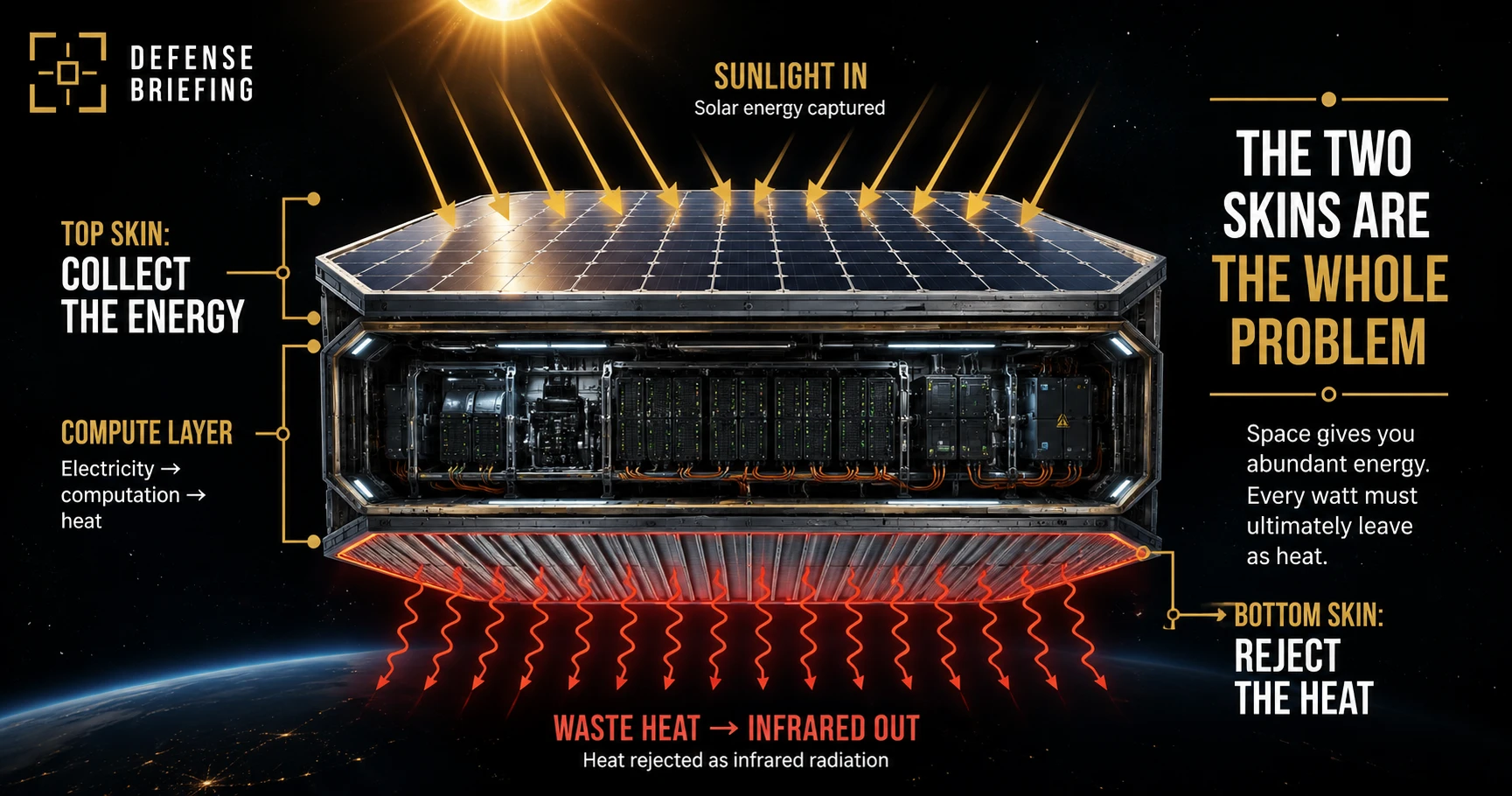
In orbit the plant is a three-layer system in vacuum: solar panels on one side, high-density processors in the center, radiative panels on the other. In low Earth orbit (LEO) solar radiation reaches roughly 1,361 watts per square meter with no atmosphere or weather in the way. In a Sun-synchronous dawn-dusk orbit along the terminator line, arrays receive near-continuous sunlight, which sharply reduces eclipse time and battery demand and can make each panel several times more productive than an equivalent ground installation.4
WHAT IS THE TERMINATOR LINE?
The terminator is the moving boundary between Earth's sunlit and dark hemispheres. A dawn-dusk Sun-synchronous orbit stays close to that boundary, keeping a spacecraft in sunlight for most of each orbit. For orbital compute, that means more continuous solar generation and less battery mass, though seasonal geometry can still produce eclipses.28
The barrier is on the other skin. A vacuum has no air to carry heat away by conduction or convection, so waste heat has to leave by thermal radiation and radiator panels become large structural elements. High-bandwidth memory (HBM) is also a concern: Google's radiation tests found HBM to be the most sensitive subsystem in its TPU hardware.4 An IEEE Spectrum first-principles estimate puts a 700 watt H100 at about 1.4 square meters of radiator at 60 degrees Celsius, rising toward 3 square meters if held near 20 degrees. The same model puts a roughly 40 kilowatt AI rack at about 80 square meters of radiator. Scaling that illustrative rack to 100 megawatts implies about 200,000 square meters of radiator before degradation, spacing and structural margin.29 For a real-world benchmark, NASA's current International Space Station radiator system uses six deployable ammonia radiator arrays. A recent NASA state-of-the-art comparison lists the full ISS radiator area at roughly 1,300 square meters for about 125 kilowatts of heat rejection.30
Because both power generation and heat rejection demand enormous surface area, an orbital data center is defined by its geometry: two large wings connected to a small compute core. The spacecraft structure is the product.
What Has Actually Flown
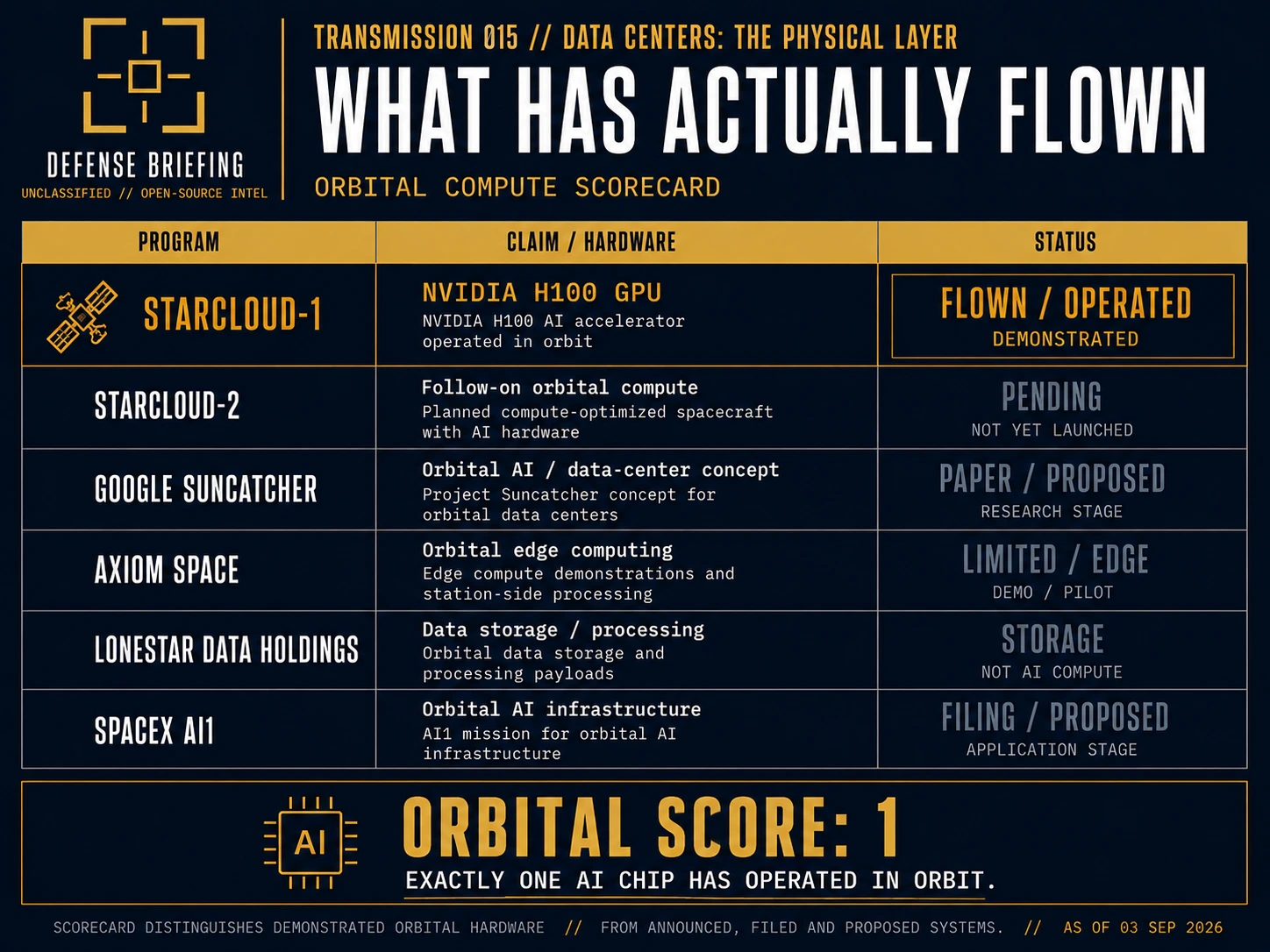
Starcloud, based in Redmond, has gone furthest. On 02-NOV-2025 it launched Starcloud-1 carrying a single Nvidia H100, the first data-center-class AI chip to operate in orbit, running small inference and training tasks.11 That was a short-duration demonstration, not a working data center. Starcloud-2 is the company's follow-on GPU-cluster spacecraft, which Starcloud says is expected to be fully operational in a Sun-synchronous orbit in 2027. The company no longer describes the current mission simply as the earlier 8 kilowatt concept. In August 2026 Starcloud announced a 250 million dollar Series A extension that brought total capital raised to 450 million dollars at a 2.3 billion dollar post-money valuation, with Nvidia and Cisco among the participants.12
Axiom Space has operated commercial edge-compute hardware on the International Space Station since 2022, deployed its AxDCU-1 data-processing prototype to the station in 2025 and says its first two free-flying orbital data-center nodes launched to LEO on 11-JAN-2026. These are edge and cloud-compute demonstrations, not terrestrial-scale AI training clusters.31 Lonestar Data Holdings has demonstrated storage and edge processing in cislunar space and on the Moon through Intuitive Machines missions. That validates off-world data services. It is not an AI training cluster.32
Google's Project Suncatcher proposes a cluster of 81 satellites carrying tensor processing units, flying 100 to 200 meters apart in a dawn-dusk orbit and linked by optical laser. Prototype launches developed with Planet Labs are planned for early 2027. Google's proton-beam tests found HBM to be the most radiation-sensitive subsystem, with irregularities beginning only after a cumulative dose nearly three times the expected shielded five-year mission dose. Google's economic model says space-based compute could become competitive if launch prices fall below roughly 200 dollars per kilogram, and its own learning-curve projection reaches that level in the mid-2030s. That is a model, not a launch-provider price commitment.4, 15 Launch access is already tightening well before that point, as detailed in our Transmission 014 reporting on SpaceX rideshare capacity.
SpaceX has proposed AI1, marketed as Starmind, an orbital data center constellation integrated directly with the Starlink network architecture. SpaceX's current AI1 page describes a vendor-agnostic compute architecture with a payload rated at up to 250 kilowatts peak and 175 kilowatts average. The company says its planned Gigasat Factory is intended to enable production and deployment of thousands of AI satellites starting as soon as late 2027.13 14 Separately, SpaceX applied for Federal Communications Commission authority for an orbital data-center system of up to one million satellites. The FCC accepted that application for filing on 04-FEB-2026, which opened it for public comment but did not constitute authorization.5 Whether the million-satellite ceiling becomes a manufacturing blueprint or remains a regulatory envelope is unresolved. The capital structure behind that ambition is the subject of our earlier briefing on the SpaceX public offering.
Despite the mega-constellation filings and the multi-gigawatt roadmaps, exactly one data-center-class AI processor has operated in orbit. Everything else is a prototype, a regulatory filing or a projection.
The Four Core Challenges Facing Orbital Compute
Turning a single-satellite demonstration into an industry means solving four problems that no one has solved yet.
Thermal management and weight. Rejecting a megawatt of heat in vacuum is physically achievable and economically punishing, because every kilogram of radiator, coolant plumbing and structure has to be launched. Running chips hotter shrinks the radiator and degrades processing efficiency, and that trade-off dictates the entire spacecraft design. Conceptual designs propose integrated tiles combining solar collection, compute and radiative surface in one lightweight panel. No rack-scale version has been built.
Radiation with no repair crew. LEO is more forgiving than deep space, but energetic particles can still flip bits, trigger latch-ups and degrade electronics. With no technicians on a free-flying satellite, operators have to build in shielding, redundancy, spare capacity and replacement plans at launch. That resilience adds mass and cost whether or not the backup hardware is ever used.29 Station-hosted systems are a partial exception because crewed missions can support some maintenance and replacement.
Latency between chips. Inside a terrestrial rack, chips a meter apart exchange data in nanoseconds. Satellites a kilometer apart incur microsecond delays, and that penalty scales badly across tens of kilometers. Distributed AI training requires near-instantaneous synchronization, so inter-satellite latency leaves expensive processors idle waiting for updates. That is a geometric constraint, and faster lasers do not remove it.
Networking and downlink. Mitigating latency means flying in tight formation, which is why Google's design calls for 100 to 200 meter spacing. Holding that precision at orbital velocity near 17,500 miles per hour over multi-year missions, while keeping terabit-class laser targeting aligned, is unproven. Operators are avoiding custom networks where they can: Starcloud uses Starlink laser terminals for relay and SpaceX's compute nodes integrate directly into Starlink. Getting processed data back to the ground is still constrained. Text outputs need little bandwidth. Dense media generation and large training checkpoints hit hard downlink limits set by spectrum availability and by weather over optical ground stations.
The Next Terrestrial Buildout: Zero-Water Cooling and On-Site Turbines
Orbital and ocean compute are bets on the 2030s. The nearer answer is less exotic and already moving: architectures that decouple a campus from the municipal water main and the interconnection queue without leaving the ground. Water tables and regional transmission get treated in most siting debates as fixed constraints. Two lines of engineering are working to make them negotiable.
On the thermal side, the shift is away from evaporative cooling toward dry cooling loops and phase-change systems that move heat at the chip. Two-phase dielectric immersion and liquid-to-air closed microchannel heat exchangers let racks drawing well over 100 kilowatts reject heat into ambient air rather than into evaporated water, and the Department of Energy funds that class of hardware directly through the ARPA-E COOLERCHIPS program.34 Microsoft has committed to the approach at the design level. Beginning August 2024 it adopted a datacenter reference design that consumes zero water for cooling, circulating a fixed charge of water in a closed loop between servers and chillers after construction, and estimates the change avoids more than 125 million liters a year per facility. The first pilots are Phoenix and Mount Pleasant, Wisconsin in 2026, with new sites coming online from late 2027.33 Nvidia's AI factory reference architecture takes the same route, running a recirculated water and glycol loop warm enough that outdoor dry coolers can reject the heat to ambient air without a tower.35 The distinction that matters is where the heat finally leaves the building. A closed loop at the chip is not by itself a water saving, because the facility can still hand that heat to an evaporative tower. Pairing the closed loop with dry heat rejection is what removes the withdrawal, and Phoenix is the test case: it is the basin where the alternative is competing with residents for the same aquifer.
Dry cooling is not free. It trades water for power and for capital, and its penalty is worst on exactly the hottest days, when both the grid and the facility are already strained. In a temperate basin that penalty is a rounding error. In a desert at 45 degrees Celsius it is a design constraint, and it is the reason evaporative towers persist in the places that can least afford them.
On the power side, the transmission lag has pushed operators toward generating on their own side of the fence. Gas turbines, from aeroderivative units to modular combined-cycle sets, can run a campus in island mode or behind the meter, delivering firm power at the property line without waiting on a queue. GE Vernova markets exactly that configuration for data centers, including hybrid microgrids that run islanded or grid connected.36 Siemens Energy positions its SGT lines for the same behind-the-meter role.38 The hydrogen path is further along than the skeptics assume. GE Vernova reports fleet experience on fuels ranging from 5 percent hydrogen by volume up to 100 percent, across more than 120 units and over 10 million operating hours.37
The binding constraint is not the turbine. It is the fuel. Green hydrogen at the volume a 300 megawatt campus would burn continuously, and the pipeline or on-site electrolysis to deliver it, largely does not exist, so a turbine installed today runs on natural gas whatever it is rated to burn later. That is firm power with a carbon bill attached. It answers the interconnection queue. It does not answer emissions.
The efficiency play behind those turbines sits at an earlier stage still. Supercritical carbon dioxide power cycles run a dense working fluid through a sealed loop instead of boiling water into steam, which removes the condenser water a steam Rankine cycle requires. Southwest Research Institute puts the potential efficiency gain at as much as 10 percent over steam, with turbomachinery roughly one-tenth the size of conventional plant components, and the Department of Energy-sponsored STEP Demo facility is a 10 megawatt-electric pilot.39 Ten megawatts is a pilot, not a product, and nothing at that scale is running behind a commercial data center yet. Closed-loop rejection plus on-site generation can shorten the interconnection problem now. The emissions position improves later, on a schedule set by hydrogen supply and by whether the demonstration units scale.
Track the buildout before the balance sheet does.
Get Orbital Intel FreeThe Angle
Terrestrial growth can stay sustainable by prioritizing sites that already have the power and the water: hydroelectric basins, existing nuclear plants, the wind-rich Midwest and cool-climate regions that mirror the Nordic model. Policy can require closed-loop and dry cooling where basins are stressed, and can require large campuses to supply or fully fund their own generation so the surrounding community does not absorb the cost of grid upgrades and capacity shortfalls. Those moves buy time without changing the trajectory. Demand keeps climbing, desert basins keep running dry and interconnection still takes years that model release cycles do not have.
For national security, the relevant point is that compute is now infrastructure in the same sense a refinery is. Command and control, intelligence analysis and missile-warning integration all sit on top of the same power and water constraints as commercial AI, and they compete for the same interconnection slots. A national compute base concentrated in a handful of stressed basins is a resilience question, not just a utility-bill question. Ocean and orbital architectures are interesting to defense planners for exactly that reason: they move the physical layer somewhere an adversary, a drought or a county zoning board cannot reach in the same way.
For capital, the analytical discipline is the same one this publication applies to contract ceilings. Announced campus megawatts and satellite counts are permit and filing ceilings, not delivered capacity. Until a first phase is actually delivering power and compute, an eleven-gigawatt land project and a million-satellite spectrum filing are functionally identical: options on infrastructure that does not exist yet. The signals worth tracking run in sequence. First, interconnection queues and county zoning decisions. Next, Starcloud-2 and Project Suncatcher, which will show whether hardware handles vacuum, radiation and sustained thermal loads. Finally, launch cost per kilogram, which determines whether orbital economics ever close.
The physical layer of AI will end up wherever power can be generated and heat can be rejected. On Earth that pairing is getting scarce in places that also have dense fiber and stable regulation. In the right orbit, solar power can be nearly continuous and cold space provides a radiative sink for waste heat. That is not a metaphor. It is the next site-selection memorandum.
Forward this to the person on your county planning commission, and to the analyst who keeps calling it a cloud.
Sources: Primary and peer-reviewed material includes the US Energy Information Administration, Lawrence Berkeley National Laboratory's 2024 United States Data Center Energy Usage Report and June 2026 update, the International Energy Agency, the Electric Power Research Institute, a December 2025 Nature Sustainability study, Google Research's published Project Suncatcher design, NASA technical material, Department of Energy reactor updates and Federal Communications Commission and Federal Energy Regulatory Commission filings. Reporting and analysis from Utility Dive, IEEFA, Ceres, The Wall Street Journal, IEEE Spectrum, SpaceNews, DatacenterDynamics, Ars Technica, Reuters and company releases fill in market and program detail. Announced campus megawatts and satellite counts are permit and filing ceilings, not delivered capacity. Company water-efficiency figures are self-reported and not audited to a common standard. Launch dates for Starcloud-2 and SpaceX AI1 are targets that have moved and may move again. Orbital thermal figures are order-of-magnitude estimates drawn from independent engineering studies, not vendor specifications. The numbered list below is authoritative. No classified information was used and all material is publicly accessible.