
Golden Dome Survived the Deadline. Its Funding Didn't Grow.
Golden Dome's director warned that without fiscal 2027 money, the program would stop with what it had already built. A Defense Briefing review of nearly three weeks of Pentagon contract notices shows the 2025 money still working, no new money arriving and a real cliff further out than the warning implied.
Last updated 22-OCT-2026: adds Lockheed Martin's third-quarter results, reported 22-OCT-2026.
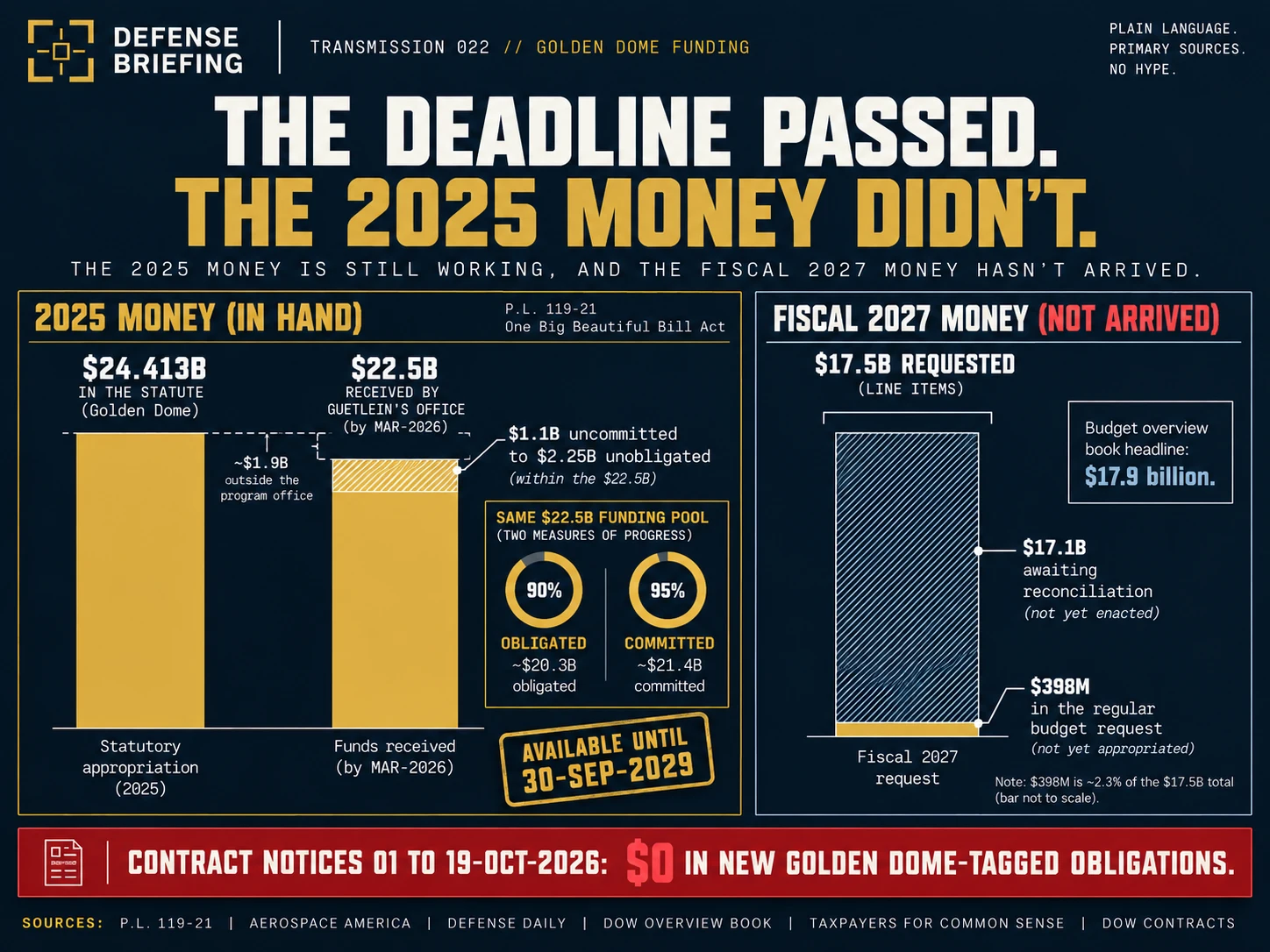
Golden Dome's money so far has come through reconciliation, not the regular budget. Graphic: Defense Briefing; data from P.L. 119-21, the Department of War FY2027 budget request and Aerospace America.
Guetlein, the Space Force general who runs Golden Dome, spoke at the Space and Missile Defense Symposium in Huntsville, Alabama, on 11-AUG-2026. His warning was blunt: if lawmakers did not find fiscal 2027 money, "there is no Golden Dome because there is no funding."1 To reporters he added: "Without continued funding, Golden Dome will stop with everything we've already built and delivered."2
That gives us a test the program set for itself. We are not measuring Golden Dome against its critics. We are measuring it against its director's own deadline. The legal point, that the 2025 money lasts until 2029, is already on the record. What no one had measured is what the Pentagon actually did once the deadline arrived. So we checked the contract notices.
Golden Dome's Deadline in 30 Seconds
- • The deadline: On 11-AUG-2026, Gen. Michael Guetlein warned that if Congress did not find fiscal 2027 money, "there is no Golden Dome because there is no funding." Fiscal 2027 began 01-OCT without it.
- • The finding: A Defense Briefing review of Pentagon contract announcements from 01-OCT through 19-OCT found no new obligations tagged to Golden Dome. The one real missile defense obligation was $454 million in fiscal 2026 money for SM-3 Block IB interceptors, paid through the Missile Defense Agency's regular budget.
- • The reason: Golden Dome hasn't stopped because its 2025 money doesn't expire until 30-SEP-2029. It hasn't grown because nothing new can start under the stopgap.
- • The clock: The stopgap expires 11-DEC-2026, during the lame-duck session after the 03-NOV midterms.
- • The cliff: The real deadline is the day the last of the 2025 money is committed with no regular budget line behind it.
Defense Briefing has followed the money from the start: the interceptor competition in The Prize Fight, the reconciliation squeeze in Golden Dome Funding Faces a $60B Reconciliation Squeeze and what the first round of money bought in Golden Dome Has Billions. What Has That Money Secured? This transmission asks the obvious follow-up: what happened when the deadline arrived?
What a stopgap can and can't pay for
Congress passed a continuing resolution (CR), signed 02-SEP-2026 as Public Law 119-103. It funds the government through 11-DEC-2026, a 72-day period, generally at fiscal 2026 levels.3
Think of a CR as a photocopy of last year's budget. Section 102 of this one bars three things: production of items "not funded for production in fiscal year 2026 or prior years," production rates above fiscal 2026 levels and multiyear purchases that use advance funding for bulk buys "unless specifically appropriated later."3 Congress can carve out exceptions, called anomalies. The Congressional Research Service (CRS) summary of this CR lists none for missile defense, the Space Force or Golden Dome.3
That is the problem Guetlein described. Golden Dome received no regular fiscal 2026 appropriation, so the photocopy has nothing on it to copy.4 Its money came through reconciliation, a budget process that passes the Senate with a simple majority and sits outside the annual spending bills.
For fiscal 2027, the Pentagon's budget overview book lists "$17.9 billion for Golden Dome for America."5 The line items in the request add up to about $17.5 billion: roughly $17.1 billion through a new reconciliation bill and $398 million in a discretionary "Golden Dome for America Fund."6 The Pentagon has not publicly explained the roughly $400 million difference. Either way, at least 95% of next year's money depends on a bill Congress has not passed.
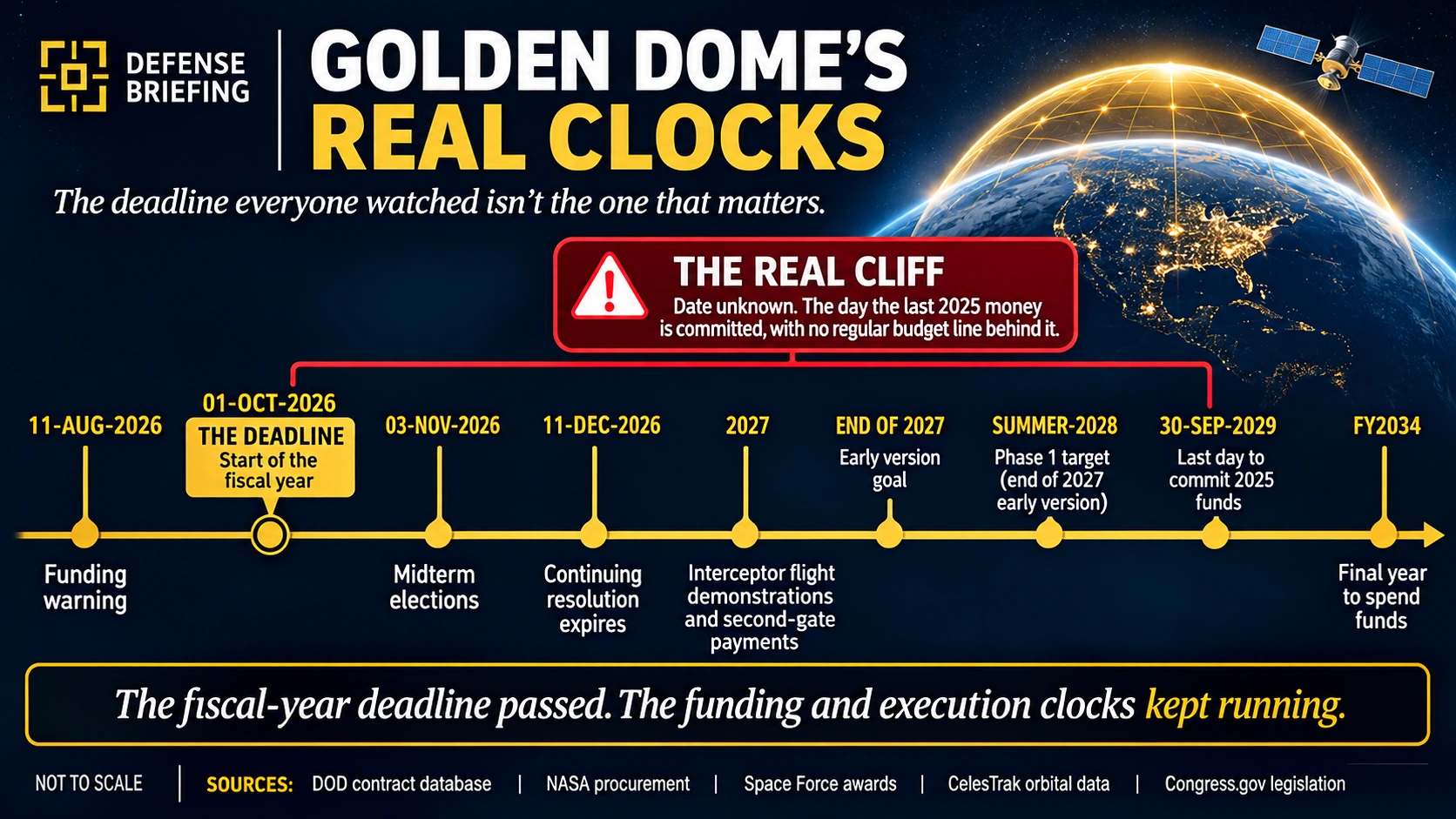
The deadline that passed and the one that matters: Golden Dome's 2025 money can be committed until 30-SEP-2029. Graphic: Defense Briefing; data from P.L. 119-21 and P.L. 119-103.
Primary-source briefings on where defense money actually goes, every Wednesday.
Get Orbital Intel FreeThe money that doesn't expire
Here is why "no Golden Dome" did not happen on 01-OCT.
The One Big Beautiful Bill Act, signed 04-JUL-2025 as Public Law 119-21, appropriated $24.413 billion in Section 20003 for integrated air and missile defense, "to remain available until September 30, 2029."7 The law never uses the words "Golden Dome," CRS notes; the name was attached by congressional committees and the Pentagon.8 CRS describes the money as mandatory budget authority, the kind the annual appropriations process does not touch.8 Northrop Grumman's latest quarterly filing describes the wider $150 billion defense package the same way: available to be committed until 30-SEP-2029 and spent through fiscal 2034.9
So the CR did not freeze this money. It was never part of the CR's math.
How much is left? In August, Guetlein said, "we're 90 percent obligated, 95 percent committed."10 He put the base at the $22.5 billion his office had received, adding that it "did not receive any funding to get after this [initiative] until March of this year."11 That leaves roughly $1.1 billion uncommitted to $2.25 billion unobligated, depending on the measure.
The statute's $24.413 billion and Guetlein's $22.5 billion differ by about $1.9 billion. The law gives the money to the Secretary of Defense, not to a Golden Dome office, and several line items name other organizations, including $408 million for Army test range infrastructure in the Pacific and $530 million for a Missile Defense Agency range safety ship.8 No public document we reviewed maps which line went where.
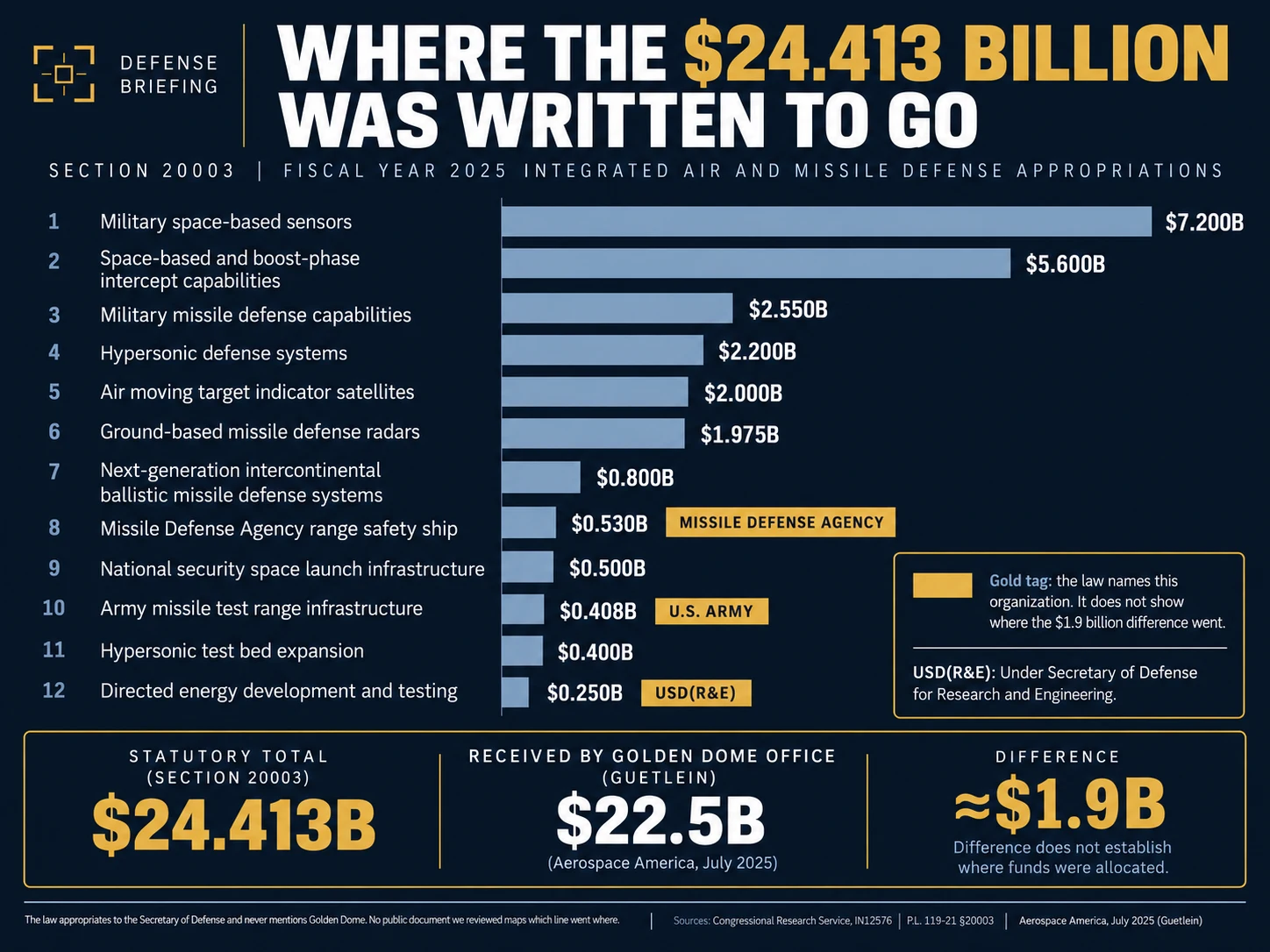
The law funds the Secretary of Defense, not a Golden Dome office. Graphic: Defense Briefing; data from P.L. 119-21 and CRS Insight IN12576.
Money being available is not the same as money being spent quickly. The pace depends on how fast the program office can write contracts, and most of this money is already under contract.
The statute, the budget book and the contract notices, read line by line. Free every Wednesday.
Subscribe FreeNineteen days of contract notices
Defense Briefing reviewed Pentagon daily contract announcements from 01-OCT through 19-OCT-2026.12
New money tagged to Golden Dome: none.
The one real missile defense obligation: $454 million in fiscal 2026 procurement funds on the Missile Defense Agency (MDA) SM-3 Block IB contract with Raytheon, a unit of RTX.12 The contract carries a ceiling of up to $6.3 billion over five years plus two option years.13 The money comes from the regular budget. The announcement does not mention Golden Dome.
Ceilings without money:
- The Navy's multiyear agreement with Raytheon for SM-6 interceptors, awarded 01-OCT, the first day of the CR, with a ceiling of up to $24.4 billion. Congress has not appropriated money for it.12, 14
- MDA's $151 billion Scalable Homeland Innovative Enterprise Layered Defense (SHIELD) contract, an indefinite-delivery, indefinite-quantity (IDIQ) vehicle. A ceiling is the most the government may spend; nothing is spent until a task order is issued. None has been.12
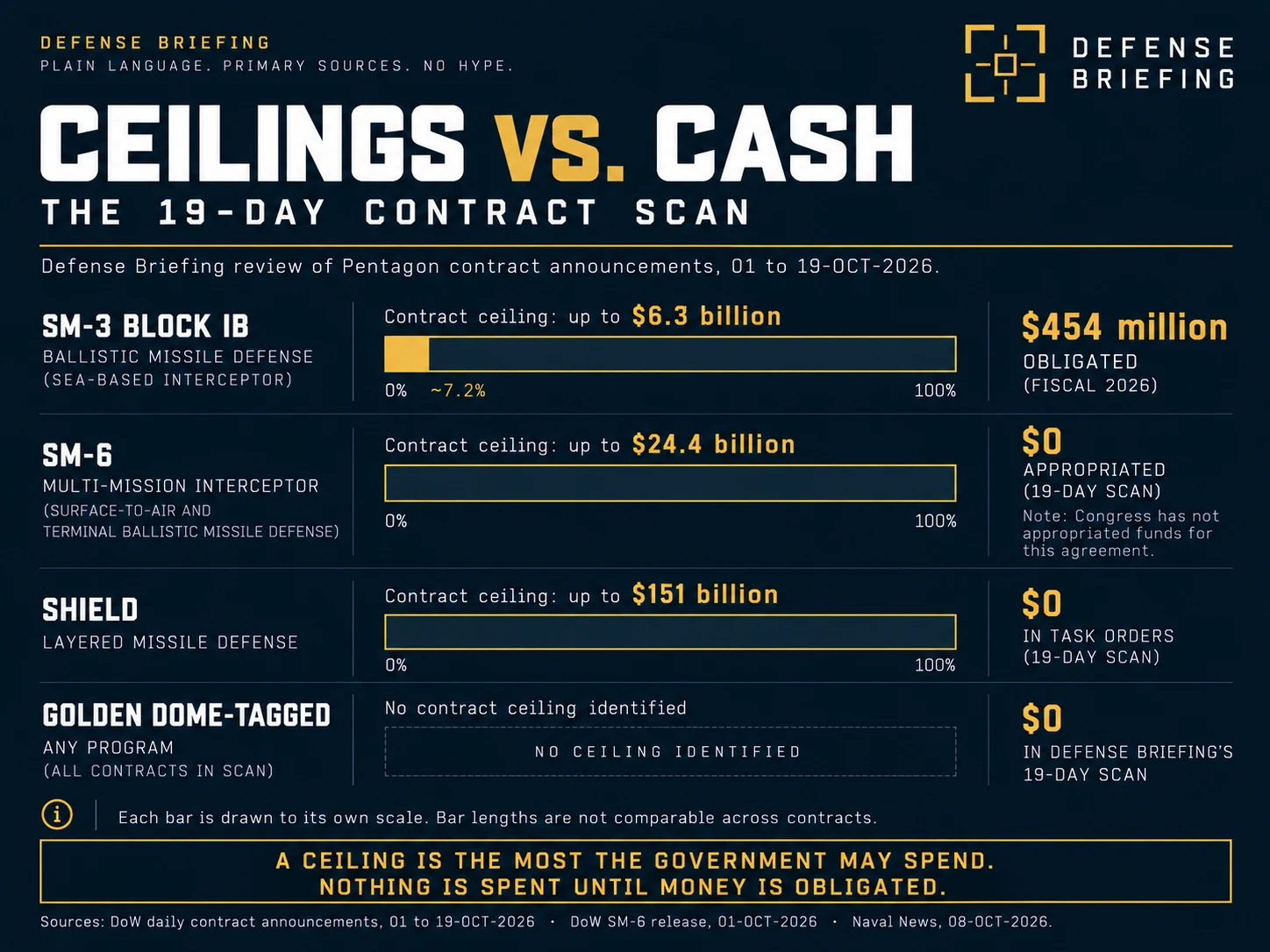
A ceiling is the most the government may spend, not money spent. Graphic: Defense Briefing; data from Department of War contract announcements, 01 to 19-OCT-2026.
The timing of the SM-6 and SM-3 multiyear deals raises a question neither public announcement answers. The CR bars multiyear purchases that rely on advance bulk-buy funding unless Congress appropriates it later.3 Northrop Grumman's filing describes the clause more broadly, as requiring prior congressional approval for new multiyear equipment contracts.9 Neither award notice we reviewed says which authority the multiyear structure rests on.
The organization keeps moving. Joint Task Force Gold (JTF-Gold), the roughly 100-person U.S. Northern Command (NORTHCOM) unit set up in January to coordinate Golden Dome, took on a defensive cyber mission this month and holds its next planning session at the end of October.15, 16 The Army has set aside an air defense unit for the mission, said Lt. Gen. John Rafferty, commander of U.S. Army Space and Missile Defense Command.15 Site work continues at Joint Expeditionary Base Fort Story, Virginia, which held its first public event on 23-APR-2026.
None of that needs new money. It is the 2025 money doing its job.
The interceptor competition is between paydays. Twelve companies hold 20 agreements worth up to $3.2 billion to develop space-based interceptors (SBI), satellites meant to destroy missiles from orbit.17 All 12 cleared the first gate on 11-AUG.18 The next payment, reported by Bloomberg at $126 million per team, is tied to a flight test.18 Initial testing is planned before 31-DEC-2026, with orbital flight demonstrations in 2027, Bloomberg reported.19 No milestone payment was due in October, so the CR has not yet been tested here.
Every figure sourced. Every contract notice read. Get the next one in your inbox.
Subscribe FreeWhat the contractors said, and didn't
Northrop Grumman and RTX both hold space-based interceptor agreements. Both reported third-quarter results on 20-OCT-2026. Neither said "Golden Dome" on its earnings call, based on a full read of both transcripts.20, 21 Neither company's filings use the term.9, 22, 23 Lockheed Martin, another interceptor team, reported on 22-OCT-2026, and its results filing does not use the term either. It credits $480 million in higher third-quarter sales to production ramps for the Patriot Advanced Capability-3 (PAC-3) and Terminal High Altitude Area Defense (THAAD) interceptors, and reports a record $292 billion backlog that includes $52.5 billion for a multiyear PAC-3 production award.24
Northrop and RTX both talked about the CR on their calls.
Northrop CEO Kathy Warden: "We are operating under a continuing resolution, and we're hopeful that an agreement for appropriations will be reached in the coming months." On next year: "The amount of time we stay in a continuing resolution certainly could impact 2027."21 She described her growth drivers as "firmly anchored in the U.S. base budget request."21
RTX CEO Chris Calio said the company "signed multi-year contracts for SM6 and SM3.1B" earlier this month and that its critical munitions "will be prioritized" however the budget turns out.20 RTX reported a record $340 billion backlog.22
The filings show where missile defense revenue is actually landing. Northrop's year-to-date Space Systems sales include "$107 million of higher GPI sales," the Glide Phase Interceptor that MDA is developing against hypersonic weapons.9 That is homeland missile defense revenue. It is not labeled Golden Dome.
In August, Warden was more direct. At a Bloomberg News event on 25-AUG, she said Northrop expects a "decent share" of Golden Dome.25 Absence from a quarterly filing proves little; companies rarely name individual programs there. The shift in vocabulary between August and October is still worth noting.
Golden Dome-era money has already reached some balance sheets. Bloomberg Government reported that SpaceX defense obligations reached $5.9 billion in the first three quarters of fiscal 2026, up from $1.8 billion in all of fiscal 2025, driven by space-based missile defense awards.26 Those include Space Systems Command (SSC) awards in May for the Space-Based Air Moving Target Indicator (SB-AMTI), a satellite layer that tracks aircraft and cruise missiles, and SpaceX's portion of the Space Data Network (SDN) Backbone.27
Earnings calls, filings and contract notices, read so you don't have to.
Get Orbital Intel FreeThe calendar
A bipartisan way out exists. At a 29-SEP Senate Armed Services strategic forces subcommittee hearing, Sen. Mike Rounds (R-South Dakota) urged colleagues to "include it in the underlying appropriations bill."4 Sen. Angus King (I-Maine) objected to the program bypassing the normal budget process. Sen. Deb Fischer (R-Nebraska) noted the idea began in the committee's own defense bill: "So, it came from us."4
The party-line route is delayed, not dead. Senate Majority Leader John Thune has acknowledged the Senate won't act on a budget resolution before the 03-NOV midterms, leaving reconciliation as possibly the only option in November.28 Even then, the House-passed budget resolution carried $60 billion for defense against a $350 billion request.29 That is the squeeze we described in T009.
The cost fight is unresolved too. The Congressional Budget Office (CBO) estimated in May that a system matching the original executive order30 could cost up to $1.2 trillion over 20 years.31 Guetlein says $185 billion over 10 years.11 The two figures cover different scopes and time spans. CBO received its first briefing from the program office on 25-SEP, four days before the hearing.32
Guetlein has set his own test for the most expensive layer. "If boost-phase intercept from space is not affordable and scalable, we will not produce it," he told Congress on 15-APR.17 Boost-phase means hitting a missile in its first few minutes of flight, while the engine still burns. Physicists have questioned whether that can be done affordably from orbit, including the National Research Council in 2012 and the American Physical Society (APS) in February 2025.33, 34
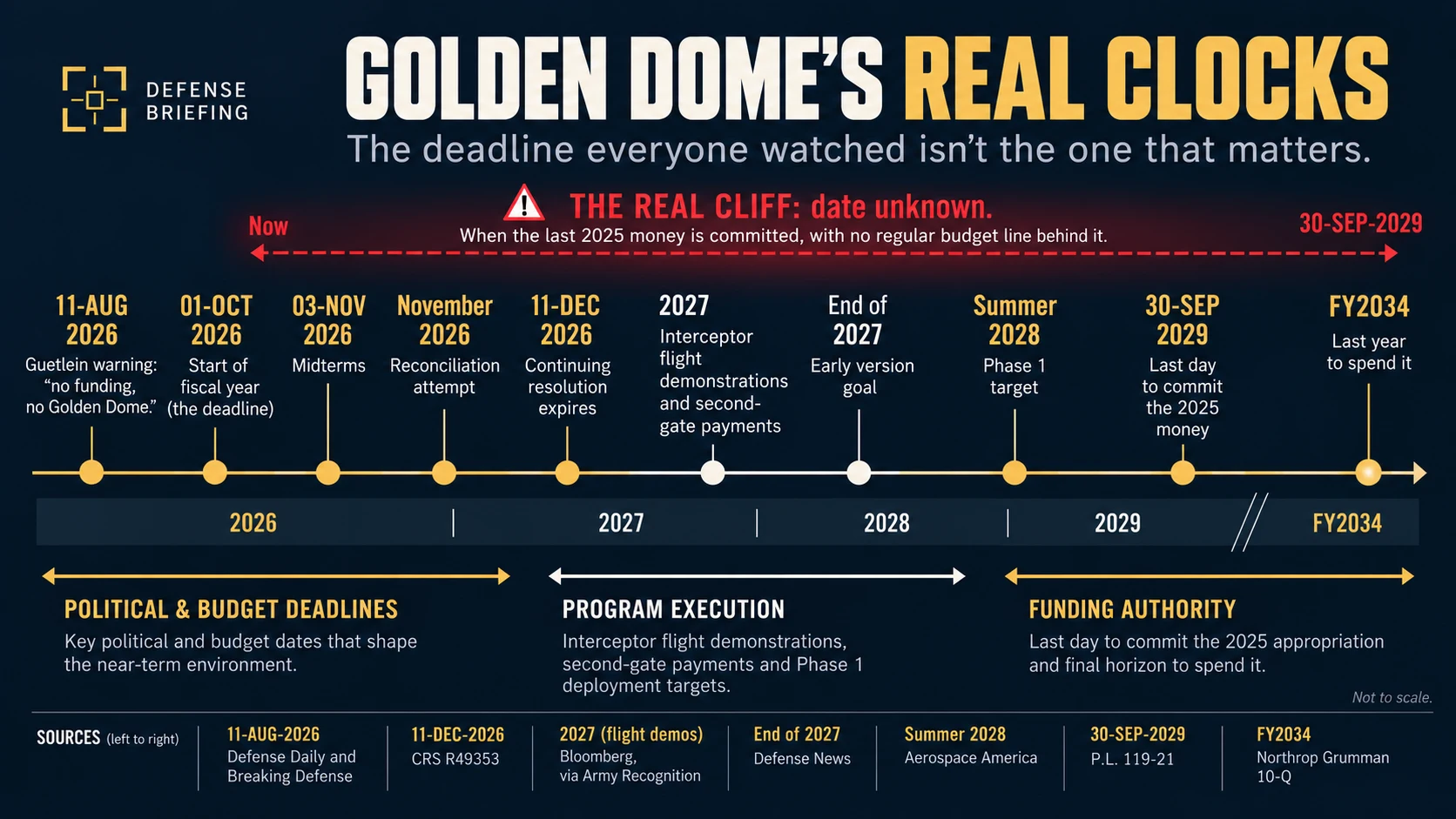
The interceptor schedule runs ahead of the funding fix. Graphic: Defense Briefing; data from Bloomberg, Aerospace America and P.L. 119-21.
The CR expires 11-DEC, during the lame-duck session after the election.
Then: Brilliant Pebbles
Space-based interceptors have been here before. Brilliant Pebbles was the space interceptor program of the Strategic Defense Initiative (SDI) in the late 1980s and early 1990s. No vote killed it. The Department of Defense Inspector General (DoD IG) later concluded its termination "resulted primarily from Congress reducing… budget authority… from $640 million to $35 million in FY 1994."35
The lesson is not that Golden Dome will meet the same end. It is that a program without a stable budget line can be stopped without anyone voting to stop it. Brilliant Pebbles had a line that Congress cut. Golden Dome does not have one yet.
"Brilliant Pebbles had a line that Congress cut. Golden Dome does not have one yet."
Built for the people who price defense budgets before the headlines catch up.
Get Orbital Intel FreeWhat it means
National security. Guetlein says the first operational phase arrives in summer 2028, "as we promised."11 Pentagon officials aim for an early version by the end of 2027, Defense News reported.15 Both depend on interceptors that already exist, such as Patriot and the Standard Missile family. Those stocks are strained. The DoD IG report on Operation Epic Fury cites "strategic inventory shortfalls."36 CBO estimates the United States has probably used between one-half and two-thirds of its interceptor inventory since JUN-2025, and that rebuilding will take "at least five years."37 Adm. Brad Cooper says he is "not concerned at all."38 A funding pause on the new layers becomes a real schedule risk only if the old layers are short too. On the evidence, they are.
Capital. Missile defense revenue is flowing, but through MDA and Navy regular budgets and multiyear munitions deals, not a Golden Dome line. RTX says its munitions agreements, worth about $70 billion combined, give it "almost a decade of demand visibility."20 Pure Golden Dome exposure sits with the 12 interceptor teams and the space sensor builders. Their next real test is the second-gate payment in 2027, not October.
What to watch next
- End of October: JTF-Gold planning session
- 03-NOV: midterm elections
- November: reconciliation attempt
- 11-DEC: CR expires
- 2027: interceptor flight demonstrations and second-gate payments
The Angle
Guetlein's warning was accurate about fiscal 2027 and overstated about the program. Golden Dome did not stop on 01-OCT. It is frozen at its 2025 size, running on contracts signed with money that lasts until 2029. The real cliff is the day the last of that money is committed with no regular budget line behind it. Whether that day comes before summer 2028 decides whether the first phase holds its date.
Companies in this story
- • Space-based interceptor agreements (SSC, 24-APR-2026):17 Anduril, Booz Allen Hamilton, General Dynamics Mission Systems (General Dynamics), GITAI USA, Lockheed Martin, Northrop Grumman, Quindar, Raytheon (RTX), Sci-Tec, SpaceX, True Anomaly, Turion Space
- • Missile warning and tracking satellites (JUL-2026):39 L3Harris, Sierra Space
- • SB-AMTI and SDN Backbone (MAY-2026):27 SpaceX
- • Space-based AMTI follow-on awards (AUG-2026):40 Rocket Lab, Systems and Technologies Research
- • SM-3 Block IB and SM-6: Raytheon (RTX)
- • Glide Phase Interceptor: Northrop Grumman
Links go to Defense Briefing company profiles where one exists.
Forward this to the person on your team who tracks missile defense spending.
Sources: public law and Congressional Research Service reports; Department of War contract announcements, budget documents and releases; Space Systems Command releases; Congressional Budget Office reports; Department of Defense Inspector General reports; SEC filings from Northrop Grumman, RTX and Lockheed Martin and earnings calls from Northrop Grumman and RTX, supplemented by reporting from Defense Daily, Breaking Defense, Defense News, Air & Space Forces Magazine, Aerospace America, Bloomberg and others. The numbered list below is authoritative. No classified information was used and all material is publicly accessible.