
China Could Put Directed-Energy Weapons Into Orbit by the Late 2020s, According to a U.S. Report
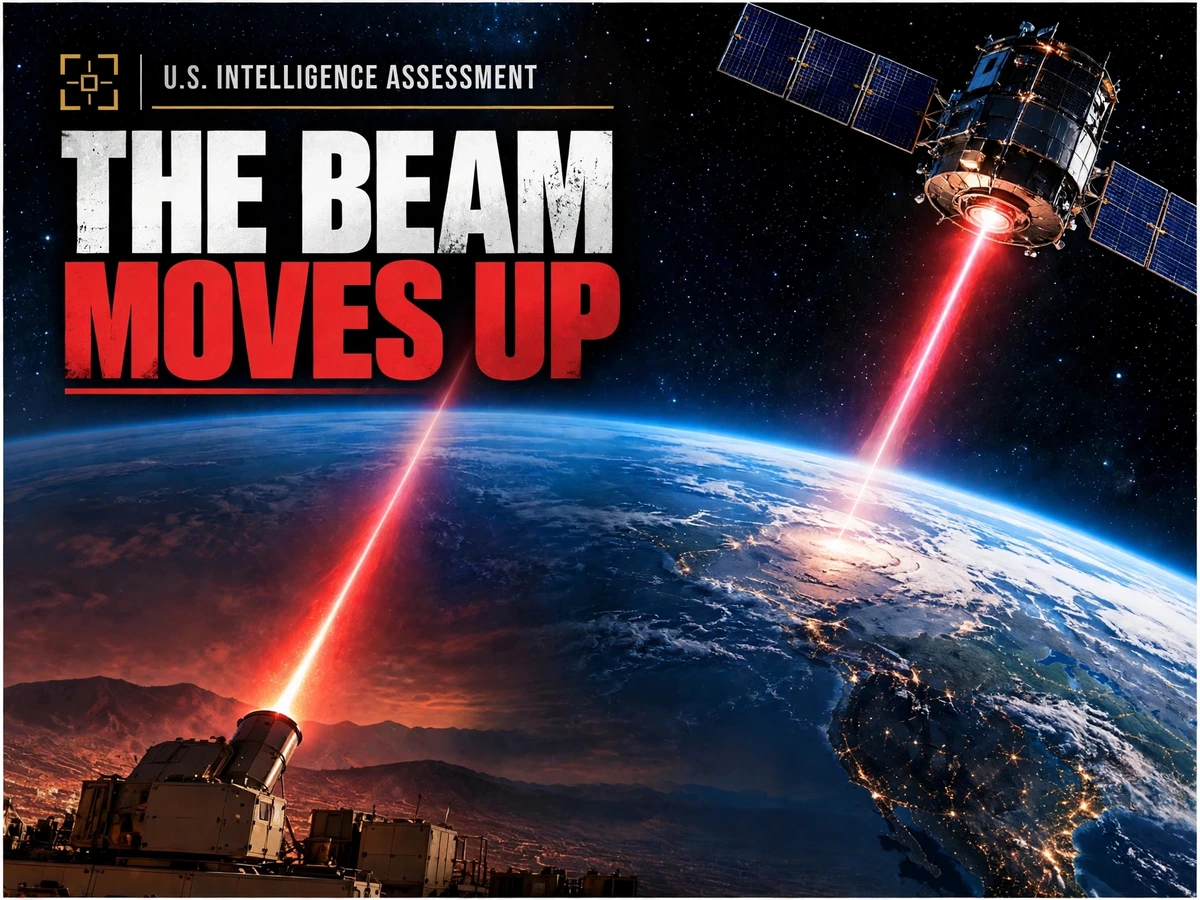
A new Defense Intelligence Agency assessment builds on a forecast it began tracking in 2019, introducing a key qualifier: space-based. As in, not just weapons, but space-based weapons. Russia is advancing toward high-altitude dominance, while the West's public strategy emphasizes orbital resilience and legal frameworks rather than deploying matching directed-energy weapons.
"Truth is stranger than fiction, but it is because Fiction is obliged to stick to possibilities; Truth isn't."1
Mark Twain (Following the Equator, 1897)
"Everything is becoming science fiction. From the margins of an almost invisible literature has sprung the intact reality of the 20th century. What the writers of modern science fiction invent today, you and I will do tomorrow…"2
J.G. Ballard
A good deal of what once lived only in books, films and television has quickly become reality. Jules Verne had a gifted knack for it more than most.
Between the 1860s and the 1880s, Verne wrote of a submarine that stayed under the sea for months, of flying machines and of three men fired around the Moon. He wrote these fantasies as if they were the next logical thing a competent engineer might build once he put his mind to it.
Ray Bradbury put little radios called "seashells" in people's ears and called it our dystopian future; we called them earbuds, bought millions, and never looked back.
Edward Bellamy imagined the credit card in 1888. Arthur C. Clarke, Neal Stephenson, Douglas Adams and George Lucas each in turn sketched some piece of the world we now walk around in without comment. Flying cars never arrived the way Back to the Future Part II portrayed them, though a few electrical half-car, half-plane machines now exist. Elon Musk has introduced the Roadster which seems to fit more of what Robert Zemeckis had in mind. And you would be hard-pressed to find anyone in 2026 without a credit card and a pocket telephone.
But it is George Lucas that we will focus on for this article.
Star Wars, it turns out, was less of a forecast but rather, more like a schedule. Critics even utilized the name of the blockbuster film on President Reagan's 1983 missile defense plan, which was a little too ahead of its time, as well as being quite expensive. And now with the Golden Dome's construction, the same could be said about President Trump's project.
With satellites thickening overhead and a new race for the high ground under way, the future has stopped being a destination and become the place we already live in. Which brings us to the business at hand: weapons that operate above the atmosphere. Recently the United States said, in plain language, that it has such weapons in orbit. Today we look at what the other side has been building.
The assessment lands
On 26-OCT-2026, the Defense Intelligence Agency (DIA) released the 2026 edition of Challenges to Security in Space.3 It is the third in the series, after Part 1's release in 2019 and the sequel released in 2022. A trilogy, so to speak. SpaceNews reported on the Challenges to Security in Space release the same day under the headline "China could field directed-energy weapons in orbit by late 2020s, U.S. intelligence says."4 The load-bearing sentence sits on page 26: "China has multiple ground-based laser weapons with varying power levels to disrupt, degrade or damage satellites in LEO; by the late-2020s, China may field space-based directed energy systems and higher-powered ground-based directed energy systems capable of threatening satellites in higher orbits."3 It is an intelligence assessment. It is not a confirmed deployment, a test or a program announcement. And of course, China does not confirm this out loud either. The key wording is "may field." DIA names no weapon type, no orbit and no Chinese program.
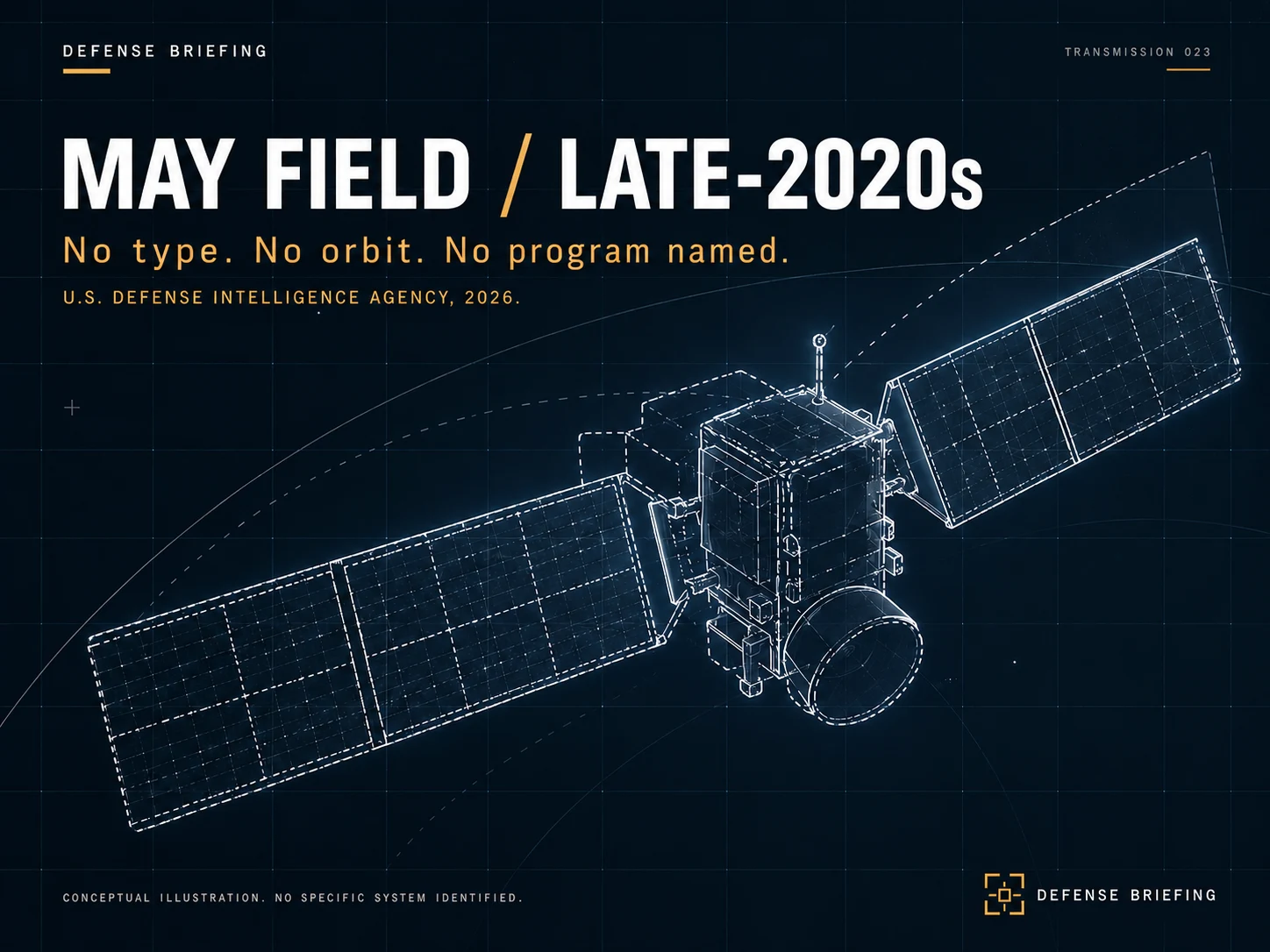
Furthermore, the first half of the sentence is not new. DIA used nearly the same words in 2022: multiple ground-based laser weapons "of varying power levels."5 What is new is one idea: space-based.
Every earlier edition described Chinese directed energy as something fired from the ground. The 2026 edition is the first to put that capability in orbit, as a possibility. Why it matters comes down to what satellites do. They carry the Global Positioning System (GPS) signal that times bank transactions and steers ships, trucks and munitions. They provide missile warning, military communications, weather data and reconnaissance. They provide you directions when you are driving. Many people simply do not realize how key space is to the ease of our everyday lives.
Capt. Amy Padilla of Space Systems Command (SSC) put it simply: "Space is the backbone of the American way of life, whether you're using GPS to navigate to work, for financial transactions, or even shipping your cousin's birthday present."6 SSC also cites a study estimating that a GPS outage would cost about $1 billion a day, and about $45 billion if it lasted 30 days during planting season.6 Those are study estimates, not observed losses. Directed energy changes the calculation in two ways. First, DIA describes its effects as ranging "from temporary to permanent."3 The same class of weapon can dazzle a sensor today and damage it at higher power tomorrow. Second, DIA says it "can be difficult to attribute the origin of a DEW attack, depending on the type."3 A blinded sensor can look like a malfunction. While that does not make a beam attack untraceable, it makes it harder to prove outright, which is a different problem and, in some ways, a much harder one to navigate.
Primary-source briefings on the new arms race, every Wednesday.
Get Orbital Intel FreeThe ladder: how counterspace got here
The 2026 assessment is the next rung in a visible sequence. Each step below is dated and sourced to DIA unless noted.
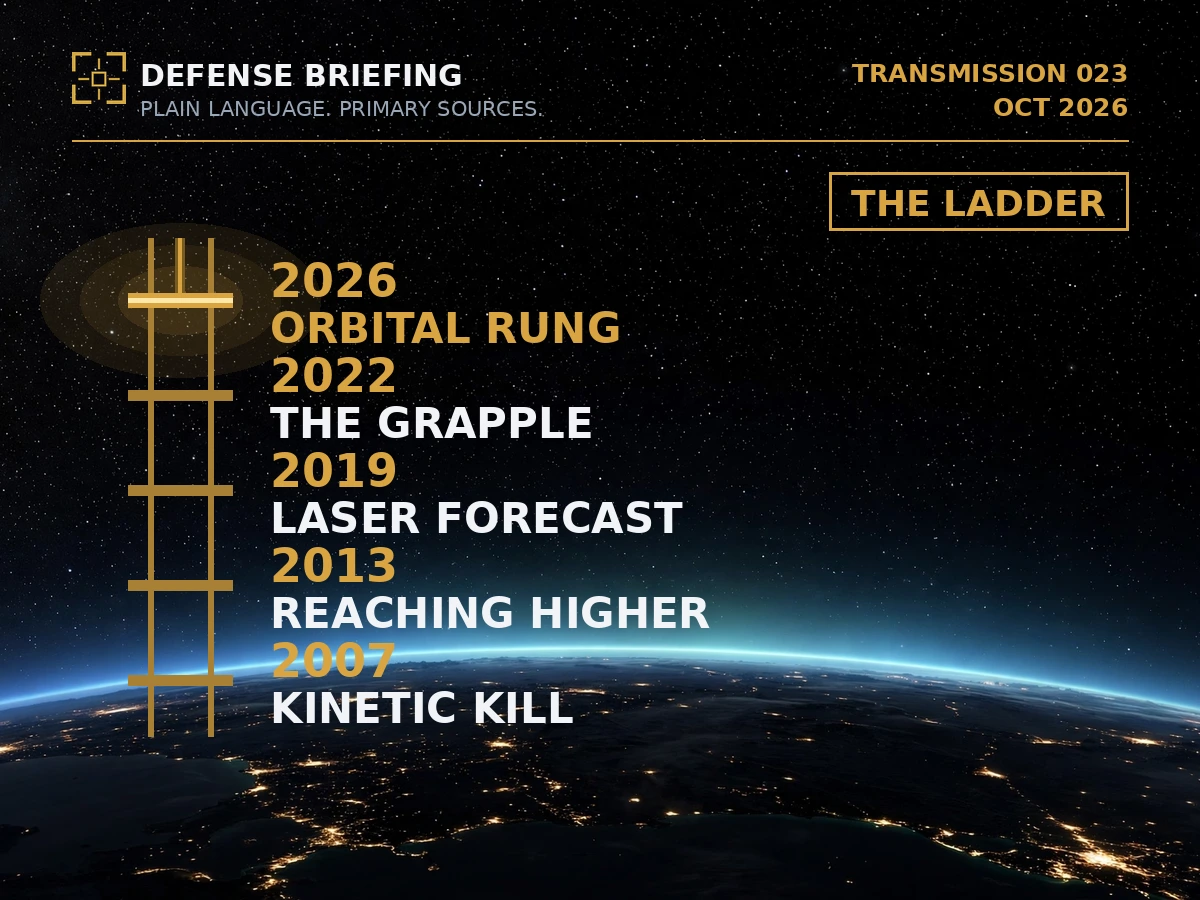
2007: the kinetic rung. China destroyed its own defunct weather satellite more than 800 kilometers up with a ground-launched anti-satellite (ASAT) missile. DIA's 2026 edition says the test created more than 3,500 pieces of trackable debris, and more than 2,400 are still in orbit posing a collision threat in low Earth orbit (LEO).3 That debris is also why kinetic kills limit themselves: the wreckage threatens the attacker's satellites too. (Our inference, not a DIA finding.)
2013: reaching higher. China launched an object on a ballistic trajectory to 30,000 kilometers. DIA says this suggests China may have a missile able to destroy satellites not just in LEO but also in geosynchronous orbit (GEO), which is about 36,000 kilometers up. The launch profile fit no ordinary rocket, missile or research flight.3
2019: the laser forecast begins. The first edition said China "likely is pursuing" laser weapons and "possibly already has a limited capability" against satellite sensors. It forecast a ground-based laser against low-orbit sensors by 2020. It also said that "by the mid-to-late 2020s, it may field higher power systems that extend the threat to the structures of non-optical satellites."7
2021: the doctrine language. In January 2021, People's Liberation Army (PLA) media said laser weapons were entering a "golden age." They named dazzling, meaning temporarily blinding a sensor, as one operational use (DIA 2026).3
2022: the ground lasers are in place. The second edition said China "has multiple ground-based laser weapons of varying power levels," with "a current limited capability" against satellite sensors. The mid-to-late 2020s forecast for higher-power systems stayed. In the same edition, DIA reported that China's Shijian-21 moved a derelict BeiDou navigation satellite to a high graveyard orbit above GEO (January 2022). DIA also notes that Shijian-17 carries a robotic arm that can grapple other satellites.5 The move is a confirmed event. Reading it as weapon practice is a U.S. assessment of dual-use capability, not a confirmed attack.
2023 to 2025: the close approaches. Several times in 2023, the TJS-3 satellite came within 10 kilometers of other nations' spacecraft in GEO. China launched TJS-10 in November 2023 and had launched 27 TJS-series satellites as of July 2026. Shijian-25 went up in January 2025, which China says will test refueling and servicing. DIA calls the TJS close approaches "largely inconsistent" with their stated missions, "suggesting China may have obfuscated their true mission."3 Shocking.
2026: the orbital rung. The "limited capability" qualifier is gone. "Mid-to-late 2020s" has become "late-2020s." Space-based systems have joined the forecast.3, 5 These are wording changes in an assessment. They signal DIA's view hardening, not a confirmed jump in Chinese capability. The pattern matters more than any single rung. DIA forecast higher-power Chinese lasers for the mid-to-late 2020s seven years ago.7 The forecast has held its shape, and the window is now open.
The assessment, the editions before it and what changed, read line by line. Free every Wednesday.
Subscribe FreeAnd then there was the 2023 weather balloon that captured the imagination of the American media. The balloon, which was eventually shot down off South Carolina in February 2023, was an airspace surveillance incident, not a counterspace one; Beijing called it a civilian weather airship blown off course. It earns a mention for its satellite link. According to Newsweek's reporting on a U.S. military technical analysis of the debris: a 75-page National Air and Space Intelligence Center analysis that Newsweek did not itself review, stated it carried an Iridium 9602 module for short-burst satellite messaging. Its payload stored imagery on hard drives packed in a foam cooler.8
China: the directed-energy assessment in full
The assessment has two parts: what DIA says China has now, and what it says China may field by the late 2020s. A third part is missing: Beijing's own account. As of 27-OCT-2026, the country had not responded.
What exists now. DIA says China has multiple ground-based laser weapons of varying power, able to disrupt, degrade or damage satellites in LEO. Directed-energy weapons (DEWs) are DIA's umbrella term for lasers, high-power microwaves and other radiofrequency weapons. The 2026 edition says they can temporarily or permanently blind imagery satellites and affect overhead persistent infrared (OPIR) and weather sensors.3 OPIR is the infrared sensing behind U.S. missile warning. That detail is easy to skim past but it should not be glossed over.
What is assessed for the late 2020s. Two tracks share one timeline:
- Space-based directed energy systems.
- Higher-powered ground-based directed energy systems able to threaten satellites in higher orbits.
DIA does not say whether either track means lasers or microwaves. It does not say which orbit a space-based system would occupy, or which "higher orbits" are at risk.3
For context only: GPS satellites sit in medium Earth orbit (MEO), while many communications and missile-warning satellites sit in GEO. The assessment does not tie the threat to any of them specifically.
Why the PLA likes the weapon. DIA says the PLA "probably considers DEWs ideal counterspace systems" because they can cause both reversible and nonreversible effects.3 Note the framing: this is DIA's reading of PLA thinking, not DIA endorsing the weapon. The logic is plain enough. One system can send a signal in a crisis by dazzling a sensor, and then if required, escalate the effect to damage the satellite permanently if the crisis turns into a war.
The attribution problem. DIA draws a sharp contrast. ASAT missile attacks "are more easily attributable" because launches are detectable and they leave debris (DIA 2026).3 A beam leaves no debris cloud and may leave ambiguous evidence by design. Proving who blinded a satellite, and when, could take time a crisis does not allow.
The scale behind it. The laser assessment sits inside a much larger orbital buildup. DIA counts 510 Chinese intelligence, surveillance and reconnaissance (ISR) satellites, more than triple the 2018 figure, as of July 2026 (DIA 2026, p. 20).3 SSC puts China's on-orbit presence up 667% in a decade, to more than 1,300 satellites. It also counts 70 Chinese launches carrying 319 payloads from January through November 2025, and about 300 LEO satellites launched in a year as China competes with Western mega-constellations. SSC says China operates at least 10 satellites for space domain awareness.6
The asymmetry with Russia. DIA says "there is no indication that China plans to actively test or develop a nuclear ASAT weapon for use in space." China is party to the Outer Space Treaty (OST). DIA assesses that Chinese leaders "probably calculate" that a nuclear detonation in space would run against Beijing's economic interests and risk uncontrolled escalation, not to mention violating the treaty itself.3 That makes sense for a country with a fast-growing fleet in the same orbits a nuclear blast would poison. On the evidence, Defense Briefing assesses the situation as China appearing to be betting on precise, deniable and scalable tools. Russia, as the next section shows, is building toward the opposite.
Every figure sourced. Every assessment attributed. Get the next one in your inbox.
Subscribe FreeRussia: the parallel arsenal, a different top rung
Russia has mostly climbed the same ladder as China, but its top rung is different: DIA says Russia is developing a satellite designed to carry a nuclear weapon.3
The kinetic rung. In November 2021, a live-fire test of Russia's Nudol missile destroyed a defunct Russian satellite at 470 kilometers. DIA's 2026 edition says it created more than 1,700 pieces of trackable debris, plus tens of thousands of lethal pieces too small to track.3 (DIA's 2022 edition put the trackable count above 1,500.)5 Crew aboard the International Space Station (ISS) took shelter as a precaution, according to Space Systems Command.6
The co-orbital pattern. Russia keeps parking satellites near American ones:3
- 2019: Cosmos 2542 and 2543 shadowed a U.S. satellite.
- In 2020, Cosmos 2543 fired a projectile into orbit in what DIA calls a space-based ASAT weapons test.
- 2022: Cosmos 2558 approached a U.S. government satellite.
- May 2024: Cosmos 2576 went into the same orbit as another U.S. national security satellite and began moving toward it, per Russian media.
- February 2025: Cosmos 2581, 2582 and 2583 maneuvered in close proximity. On 18-MAR-2025, Cosmos 2583 released a subsatellite.
- May 2025: Cosmos 2588 maneuvered within about 93 kilometers of a U.S. government satellite.
The laser rung. Russia's Peresvet is a ground-based laser designed to dazzle the optical systems of enemy satellites to hide the movement of Russia's strategic missiles. Deliveries began by July 2018. As of 2019 it was deployed with five strategic missile divisions, "where they remain today" (DIA 2026).3 A second laser, Kalina, sits at the Krona space surveillance complex in southwest Russia. In 2022, DIA forecast more capable Russian lasers in the mid-to-late 2020s and, by 2030, possibly systems threatening "the structures of all satellites."5 That 2030 date belongs to Russia's forecast. It does not apply to China. Regardless of the date, it is definitely to Russia's benefit if they can dazzle any satellites it perceives as helping Ukraine.
Burevestnik. DIA describes Burevestnik as "a developmental, co-orbital air-launched ASAT weapon" for killing spacecraft in LEO. A modified MiG-31 fighter launches a rocket that puts the weapon in orbit "with little or no warning."3 This is not new in 2026. The 2022 edition said Russia was "reportedly developing" it.5 What changed is that DIA now states it flatly – the weapon has been developed.
The nuclear rung. On page 42, DIA says: "Russia is developing a satellite designed to carry a nuclear weapon despite its obligation to comply with the 1967 Outer Space Treaty." It says such a weapon could cause the loss or degradation of thousands of satellites at a bare minimum. It would also leave radiation belts that "could persist for years," damaging satellites that were only temporarily disrupted at first.3 And we don't know what further damage a nuclear blast in space could have to not only planet Earth, but to the Solar System as a whole. If there are extraterrestrials, they may not be pleased with such an event.
DIA links the program to Cosmos 2553, launched in February 2022 into "an unusual and isolated orbit not used by any other spacecraft."3 Moscow said at the time that it was testing the effects of space radiation on electronics.
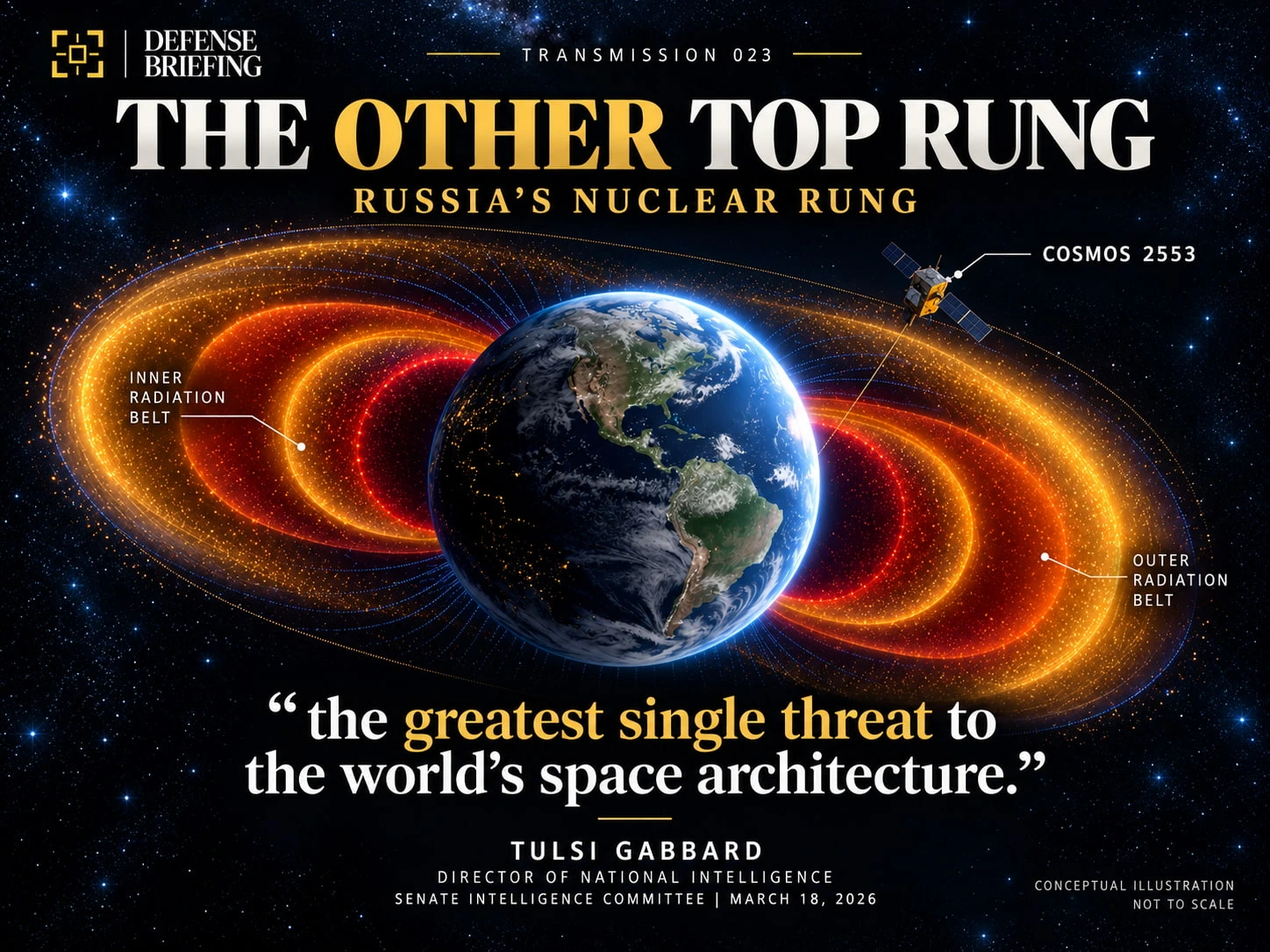
Presenting the 2026 Annual Threat Assessment on 18-MAR-2026, Director of National Intelligence Tulsi Gabbard went further. Her prepared remarks said Russia's "development of a nuclear counterspace weapon poses the greatest single threat to the world's space architecture."9 That line is Gabbard's, not DIA's.
Built for the people who track the threat before the headlines catch up.
Get Orbital Intel FreeWhy Russia would want it. A Royal United Services Institute (RUSI) study by Sidharth Kaushal, published 08-OCT-2026, offers a rationale. Proliferated U.S. constellations make killing satellites one at a time impractical. Research by RAND that the study cites estimates a single 110-kiloton detonation could affect about 20% of satellites. Suppressing U.S. space-based surveillance would be central to any Russian nuclear operation.10 That is analysis, not a deployment finding. It does not establish deployment or a procurement decision. The Russia Strategic Initiative under U.S. European Command funded the study, and Putin has denied any intent to deploy nuclear weapons in space. Defense Briefing believes the logic fits a pattern: a shrinking space industry that can no longer match U.S. numbers can still threaten them cheaply in the same way multiple cheap drones can counteract expensive weapon systems.
SSC describes Russia's launch rate and funding declining under international isolation, while counterspace work continues, albeit slower.6
Where the world stands. In December 2024, the United Nations (UN) General Assembly adopted the non-binding Weapons of Mass Destruction (WMD) in Outer Space resolution 167 to 4, with six abstentions. The resolution urged all member states not to develop nuclear or mass destruction weapons designed for outer space. The Outer Space Treaty already outlines this. Interestingly, the four votes against were Iran, Russia, North Korea and Syria, while Belarus, Bolivia, China, Cuba, Lebanon and Nicaragua all abstained.
The West: what the U.S. and allies actually have
The public record shows the United States has deployed space weapons of an undisclosed type. It shows no Western space-based directed-energy weapon. Three categories need to stay separate here:
- Ground-based lasers built for air and missile defense.
- Systems that can act against satellites.
- Weapons actually in orbit.
Britain's DragonFire and Israel's Iron Beam are lasers built to shoot down drones, rockets and missiles. They are not counterspace weapons, and nothing in our sources says otherwise. The same goes for China's road-mobile air-defense lasers. Mixing these categories is the fastest way to overstate any country's space arsenal, including our own.
The U.S. disclosure. Air Force Secretary Troy Meink recently confirmed that the United States has deployed "on-orbit space control weapons capable of defending the Joint Force against hostile adversary action," according to the Associated Press (AP), as published by PBS NewsHour on 06-OCT-2026.11 He did not disclose type, mechanism or targets.
Victoria Samson of the Secure World Foundation (SWF) told AP the weapons could be non-kinetic, such as jammers, which avoids creating debris.11 That is her informed reading and opinion, not a disclosure. SSC used nearly the same sentence in its own statement: the United States "has on-orbit space control weapons capable of defending the Joint Force against hostile adversary actions." SSC says the United States "has space superiority," while Russia and China "have been fielding terrestrial and orbital counterspace capabilities for years." It calls China the "pacing threat" and Russia the "acute threat."6
Capt. Amy Padilla put it bluntly: counterspace weapons "are not a future threat... They are a here-and-now threat." The other half of the answer is resilience. SSC describes spreading capability across large constellations in LEO so no single loss is decisive. It adds anti-jamming and hardening into each new batch of satellites, faster launch to replace losses and partnerships with commercial and allied operators.6
The United States also leads the world in space situational awareness (SSA), the tracking of what is in orbit. SSC says China and Russia are building their own SSA networks to end reliance on U.S. data.6 Additionally, the US formally expanded its strategic horizon to include cislunar space (the vast region beyond GEO to the Moon).
Who has what in orbit, sorted by evidence, not by headline.
Subscribe FreeThe 13-country picture. SWF's 2026 Global Counterspace Capabilities report (editors Victoria Samson and Kathleen Brett, data through 28-FEB-2026) covers 13 countries. They are the United States, Russia, China, India, Australia, France, Germany, Iran, Israel, Japan, North Korea, South Korea and the United Kingdom. Germany is new to the list. The report covers five categories: co-orbital, direct-ascent, electronic warfare, directed energy and cyber. Its headline finding is that research and development is spreading, but only non-destructive capabilities are being used in active conflicts.12
- France and Germany: interest in lasers for non-destructive ASAT capabilities.
- United Kingdom and France: cooperative rendezvous and proximity operations with the United States.
- Japan: published space domain defense guidelines.
- North Korea: a policy change allowing military use of space.
- Iran: extensive jamming, with Starlink spoofing discussed.
- China: a likely on-orbit refueling experiment through much of the second half of 2025, and reports of a possible new direct-ascent interceptor.
- United States: heavy policy and doctrine output in 2025, with emphasis on "dynamic space operations."
SWF also notes growing interest in "bodyguard" satellites and spaceplanes.12 Both are dual-use by nature: the same craft that protects or inspects can interfere or attack.
Golden Dome. The planned U.S. missile defense system will rely on satellites for detection and tracking, and potentially for interception from space (as framed in the RUSI summary).10 We covered that topic in Transmission 022.
The point here is narrower. Space-based missile defense and space weapons share technology, orbits and arguments, which is why Moscow and Beijing cite it. What the West does not have is evidence. There is no publicly confirmed Western space-based directed-energy weapon. There is no confirmed Western co-orbital kill system in Burevestnik's class. The Western edge on the public evidence is resilience, partnerships, SSA leadership and non-destructive tools. It is not a matching orbital beam.

The law's gap
The 1967 Outer Space Treaty bans nuclear weapons and weapons of mass destruction in orbit. It says almost nothing about lasers which makes sense as they were more theoretical in 1967, while nuclear was fresh.
Article IV reads: "States Parties to the Treaty undertake not to place in orbit around the Earth any objects carrying nuclear weapons or any other kinds of weapons of mass destruction, install such weapons on celestial bodies, or station such weapons in outer space in any other manner."13 The same article bans weapons testing and military maneuvers on celestial bodies such as the Moon. It does not ban them in orbit. That creates a clean split. DIA says Russia's nuclear-carrying satellite is being developed "despite its obligation" under the treaty, so deploying it would breach Article IV.3 China's assessed directed-energy systems, as DIA describes them, are conventional weapons. The treaty does not technically reach them, although it is debatable and dependent on the strength of those weapons (whether they can produce mass destruction). Which leads us to the definition problem. There is no agreed definition of a "space weapon." A servicing satellite with a robotic arm, a refueling experiment, a "bodyguard" satellite and a grappling weapon can be the same hardware flown with different intent. Shijian-17's arm and Shijian-25's refueling test are exactly that kind of hardware.
The verification problem. DIA's own definition says directed-energy effects can be temporary and attribution can be difficult.3 A treaty against something you cannot reliably detect is hard to enforce.
The process problem. Russia and China have long promoted a treaty to ban weapons in space. DIA noted in 2019 that their proposals "do not address many space warfare capabilities" and "lack verification mechanisms," leaving room to keep building counterspace weapons.7 Western governments object, in particular that the proposals leave out ground-based ASAT missiles. Negotiations have since shifted toward norms of responsible behavior, such as avoiding debris-creating tests. The December 2024 UN vote, 167 to 4, is the latest marker, and Russia voted no.
The debris backdrop. The European Space Agency tracks about 46,950 objects in orbit, according to AP.11 That is a different count from DIA's figures for single tests.
Treaty text, intelligence assessments and the gaps between them. Free every Wednesday.
Get Orbital Intel FreeWhat to watch, and the angle
An intelligence assessment is merely a weather forecast, and wise men do not unfurl their umbrellas until the first drop hits the hat. A thing is not a fact until it happens in the open where it can be seen by man, woman or alien. That is to say, the yarn only turns into history when something actual turns up in the daylight.
What converts this "may field" into hard currency is simple enough: an official DIA sequel, a stray declassified memorandum or some tailored witness testifying under oath upon the matter of orbital death-rays. Failing that, we need tracks in the mud. A rocket launched from the Chinese coast under an alias as thin as tissue; an unnatural machine overhead drawing more power and casting off more heat than any satellite has right to; or an American sensor suddenly going blind with no solar flare around to blame.
Beijing has not breathed a word as of 27-OCT-2026. Come New Year's, we can tally their launches and count the constellation cages. Add in Meink's speeches, the SWF compendiums and whatever verdict falls on Golden Dome interceptors, and you will have your docket.
The long view is the entertaining part. For two whole decades, Washington filed space warfare under "matters to worry about later," while Moscow and Beijing went right on carpentering their ladder, peg by peg. The 2026 paper doesn't claim the weapon has landed. It merely observes that, in the Agency's cautious opinion, a ladder exists and that ladder is mighty close to reaching orbit. The Western retort, meanwhile, consists of treaties and toughened hulls with hardly a counter-beam to be found. The fog is the very marrow of the piece. The DIA whispers "may field" and hints at the "late-2020s," without pinning a single name to the animal. The doubt belongs in the story. Give the reader that truth, and leave the rest alone.
Forward this to the person on your team who tracks space threats.
Sources: Defense Intelligence Agency assessments, an Office of the Director of National Intelligence release, Space Systems Command and the Outer Space Treaty text, supplemented by reporting from SpaceNews, the Associated Press and Newsweek and analysis from the Secure World Foundation and RUSI. The numbered list below is authoritative. No classified information was used and all material is publicly accessible.
Sources
- Mark Twain, Following the Equator, 1897.
- J.G. Ballard, "Fictions of Every Kind," Books & Bookmen, FEB-1971, as reproduced at jgballard.ca. jgballard.ca
- Defense Intelligence Agency, Challenges to Security in Space 2026, released 26-OCT-2026 (information cutoff JUL-2026). dia.mil
- Sandra Erwin, "China could field directed-energy weapons in orbit by late 2020s, U.S. intelligence says," SpaceNews, 26-OCT-2026. spacenews.com
- Defense Intelligence Agency, Challenges to Security in Space 2022. dia.mil
- Space Systems Command, "Space Threats: Russia, China are United States' biggest competitors for space superiority," Article 4624257, 13-OCT-2026 (the article page carries no date line; date per contemporaneous coverage).
- Defense Intelligence Agency, Challenges to Security in Space, 2019 (information cutoff JAN-2019). dia.mil
- Newsweek, "Chinese Spy Balloon That Traversed US Airspace Was Packed With American Tech: Report," FEB-2025. Newsweek did not itself review the National Air and Space Intelligence Center analysis.
- Office of the Director of National Intelligence, News Release No. 03-26, 18-MAR-2026, remarks as prepared by Director of National Intelligence Tulsi Gabbard. dni.gov
- Sidharth Kaushal, "Russia's Nuclear Deterrent and Its Weapons Procurement," Royal United Services Institute, 08-OCT-2026, as summarized by SpaceNews.
- Associated Press, "Some nations have deployed space weapons. Here's what issues are worrying experts," PBS NewsHour, 06-OCT-2026.
- Secure World Foundation, Global Counterspace Capabilities 2026, eds. Victoria Samson and Kathleen Brett, data through 28-FEB-2026.
- Treaty on Principles Governing the Activities of States in the Exploration and Use of Outer Space, including the Moon and Other Celestial Bodies (Outer Space Treaty), 1967, Article IV, Department of Defense copy of the treaty text. acq.osd.mil
Related Reading
Enjoyed this transmission? Get the next one delivered free, every Wednesday.
Subscribe to Orbital Intel