
Red Flag in Orbit: What the Space Force's $981M NITE-STAR Contract Can Buy
Space Systems Command awarded 15 companies positions on a test and training vehicle on 31-JUL-2026. It disclosed no task orders, no initial obligation and no satellite purchase. Here is what the public record supports, and what it does not.
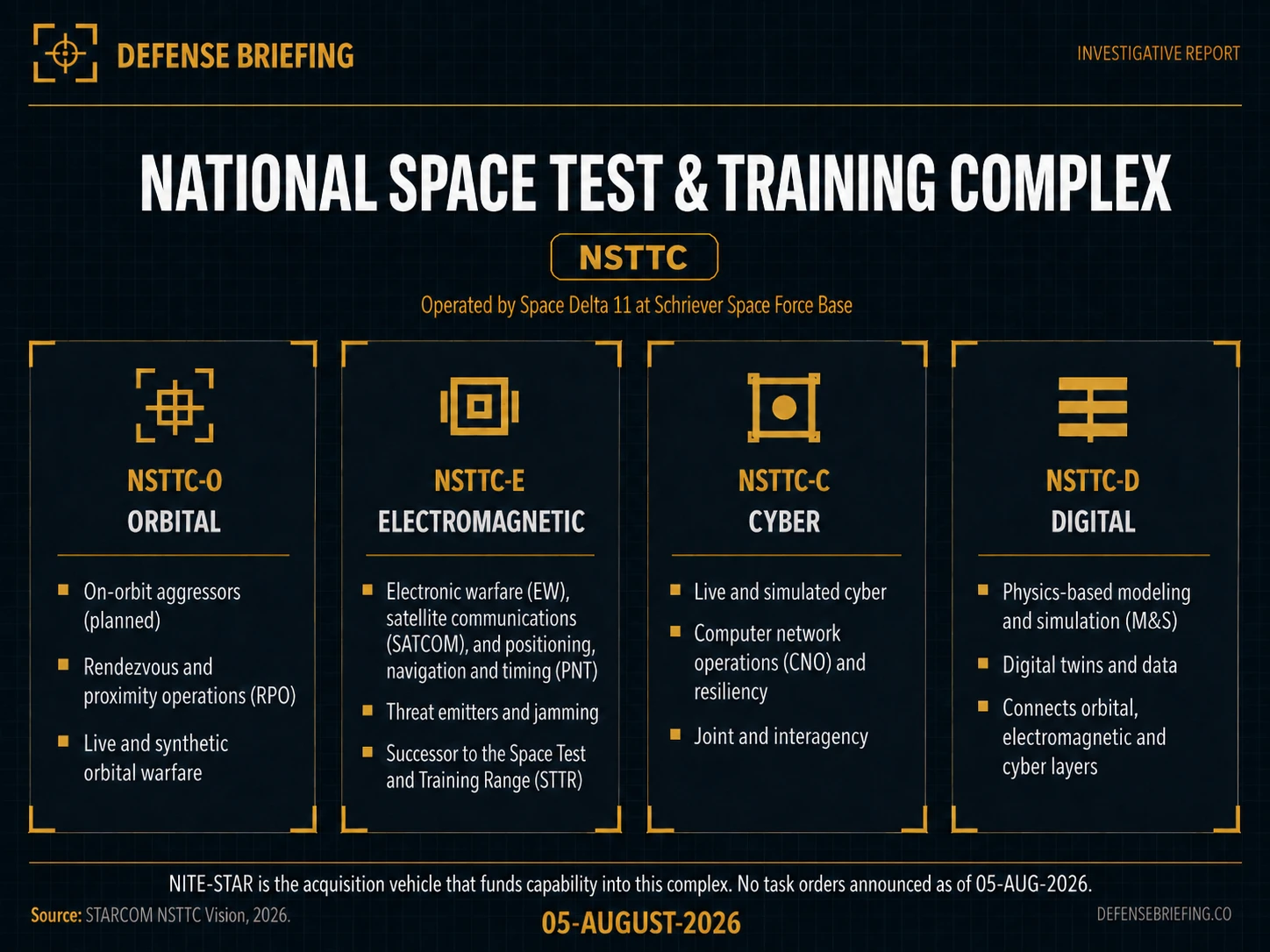
Space Systems Command did not buy $981 million of orbital weapons. It created a contracting mechanism through which the U.S. Space Force can order test ranges, digital simulations, ground systems and potentially live on-orbit training assets over multiple years. The distinction matters because the ceiling is the largest number in the announcement and the least useful measure of what has been delivered.
The public record shows 15 companies holding positions on the National Space Test and Training Complex Innovative Technology and Engineering, Space Test and Range program, better known as NITE-STAR. It does not show a public task order, an associated obligation or a hardware purchase. Future task orders will decide which capabilities are built, which companies receive revenue and whether the Space Force buys dedicated spacecraft or range services instead.1
Welcome to Orbital Intel, presented by Defense Briefing. Every Wednesday, you receive the week's defense, aerospace and space economy signal in plain language. Primary sources. No hype. Built for analysts, operators and the curious.
Today's headlines are rarely new. They're sequels. We deliver the prequels.
NITE-STAR IN 30 SECONDS
- • Space Systems Command awarded 15 companies positions on the vehicle.
- • $981 million is the total ceiling, not committed spending.
- • No public task order or hardware purchase has been announced.
- • The scope can cover ground systems, digital environments and on-orbit range capabilities.
- • Task orders will reveal who wins the work and what the Space Force actually buys.
What the Space Force NITE-STAR Contract Actually Awarded
On 31-JUL-2026, Space Systems Command's System Delta 81 announced contract awards to 15 companies under NITE-STAR. The official release describes a multiple-award, indefinite-delivery/indefinite-quantity vehicle with a ceiling of $981 million across two five-year periods.1
The ceiling is not committed spending. Each company received a position on the vehicle, not a share of $981 million. Under an indefinite-delivery/indefinite-quantity contract, the government qualifies a pool of vendors and then places individual orders as requirements emerge. The ceiling is the maximum aggregate value that may be ordered across the vehicle, subject to the contract terms and available funding.2
As of publication, Space Systems Command has announced no NITE-STAR task order, disclosed no associated obligation and identified no hardware purchase.
"This effort sets the foundation for rapidly advancing and integrating the test and training tools needed to effectively train Space Force Guardians," Col. Craig Hackbarth, the NITE-STAR program director within the service's Operational Test and Training Infrastructure enterprise, said in an SSC press release.
"As a centralized IDIQ, the NITE-STAR Capability Development will be available to the entire OTTI enterprise, accelerating the development of test and training capabilities across the architecture."1
"Foundation." "Available to." "Accelerating." That is procurement language for optionality, not for a fielded capability or a task order.
The Training Gap, Measured by the Man Who Owns It
NITE-STAR is not revealing a problem the Space Force has only now recognized. On 17-APR-2025 the service published its Space Warfighting framework, establishing a common lexicon for counterspace operations across three mission areas: orbital warfare, electromagnetic warfare and cyberspace warfare. 5 Doctrine came first. Acquisition is following.
The gap is also not that Guardians have been stuck at tabletops. SPACE FLAG has run contested-environment exercises for years. System Delta 81 has been building the Space Warfighter Operational Readiness Domain, or SWORD, as a distributed digital training environment.6
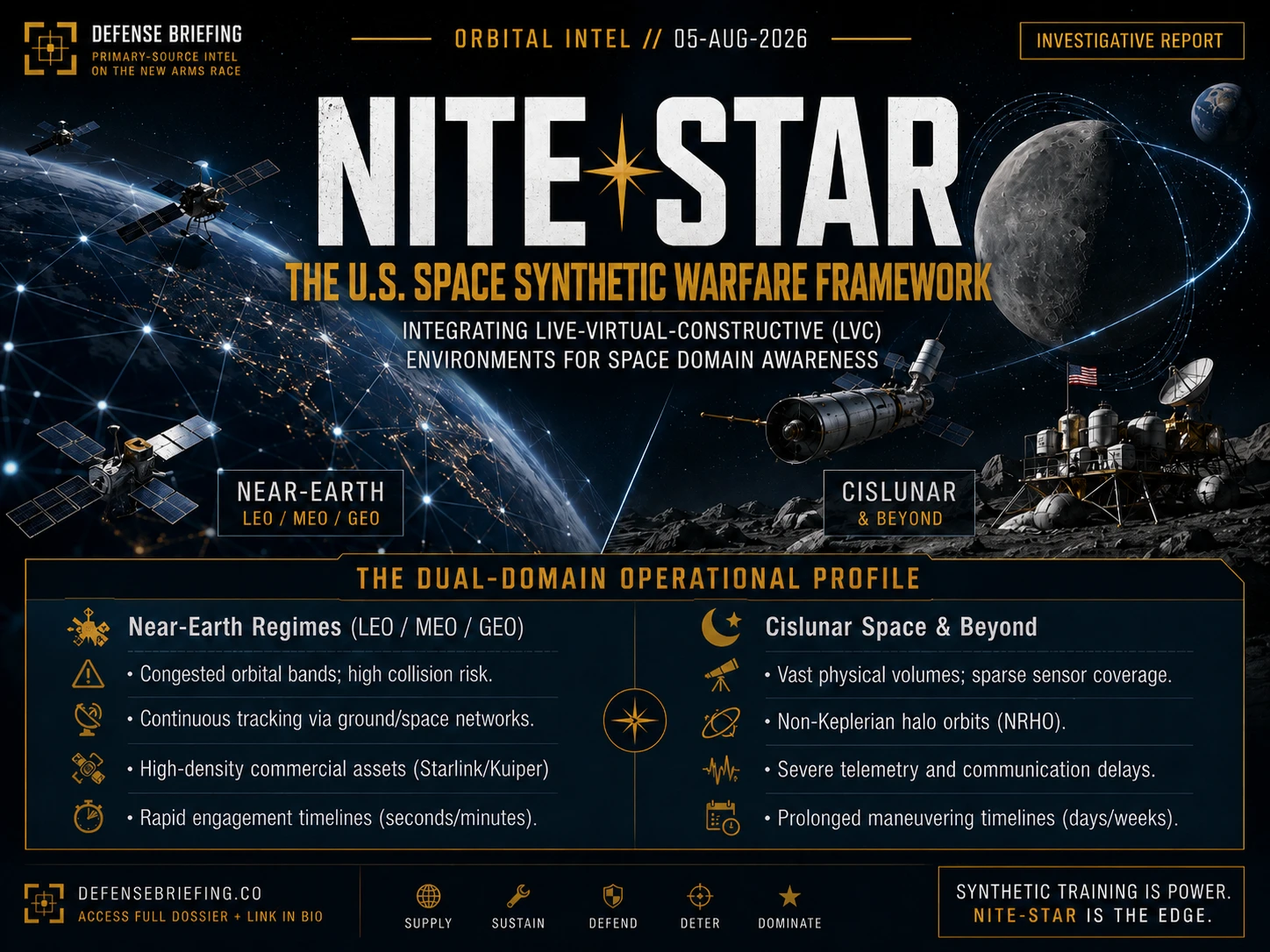
The real gap is uneven, and Lt. Gen. Gregory Gagnon, commander of Combat Forces Command, graded it himself the week of the award. Simulated training for missile warning and tracking, he said, rates "a green checkmark." Mission Delta 9, the orbital warfare unit, still works primarily with "real mission equipment," although its simulator requirement is resourced. Space domain awareness and intelligence are worse. "It's confluence of different unique systems that do precise things, and then we aggregate them," Gagnon said. "So, I'm still kind of red-Xed on those."7
That is the story. Not a service with no training, but a service whose training quality varies sharply by mission area and whose most contested mission areas score worst.
There is also a live-orbit precedent, and it predates NITE-STAR. On 12-FEB-2026, USSF-87 launched a Geosynchronous Space Situational Awareness Program spacecraft alongside additional research, development and training systems intended to help Guardians refine tactics, techniques and procedures for precision on-orbit maneuvers.8 Trade reporting identified one payload as a prototype maneuverable satellite for Mission Delta 9, which Space Systems Command has not confirmed. Gagnon described the upgrade at the AFA Warfare Symposium: "In the past, we've kind of had like a 737 and we practiced with that. Now, we're getting a military-grade aircraft to practice with."9
Dedicated live-range capability remains nascent. Gagnon said some current on-orbit training uses residual capability left on satellites after their primary missions end, giving operators additional repetitions before those systems exhaust their remaining energy.10
Confirmed: USSF-87 carried on-orbit research and training systems for precision maneuver work. Not confirmed: NITE-STAR has purchased an additional system.
The contract headline is easy. The task orders will tell the real story.
Get Orbital Intel FreeThe 15 Contractors and the Task Orders Ahead
The pool is Amentum Technology, BAE Systems, Boeing, CACI, Firefly Aerospace, L3Harris Technologies, Lockheed Martin Space, Northrop Grumman, Pacific Crest Alliance, Parsons Government Services, Redwire Space Missions, Rocket Lab USA, Sierra Space, Viasat and York Space Systems.1 Pacific Crest Alliance is an 8(a) joint venture between La Jolla Logic and Sierra Nevada Corporation.11
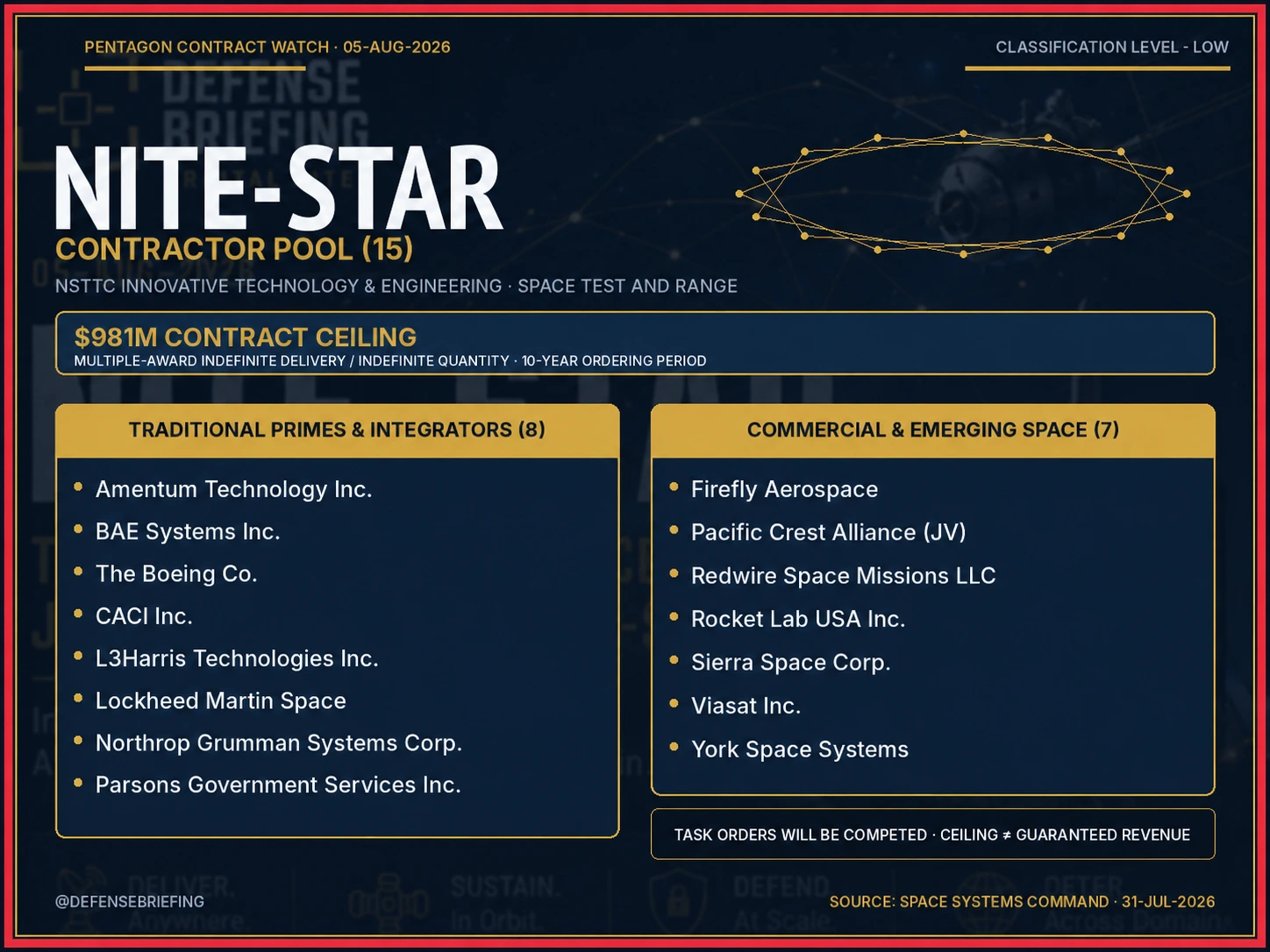
The pool splits roughly between large integrators and primes on one side and spacecraft, launch and space-infrastructure specialists on the other. The ratio does not reveal an acquisition strategy. Admission determines eligibility. Task orders determine revenue.
The published solicitation scope is where the substance sits. The vehicle can support development and integration of space-based systems such as satellites, payloads and sensors; ground systems such as command and control, radars and tracking infrastructure; digital environments including hardware- and software-in-the-loop simulation and digital twins; sustainment and life-cycle management; and enterprise work on interoperability, automation and cybersecurity.3, 4
Space-based systems being in scope is the load-bearing fact for anyone expecting aggressor satellites. Col. Corey Klopstein, who leads Space Systems Command's infrastructure acquisition portfolio, described a pool that could deliver a physical ground environment or supply satellites and instrumentation for on-orbit range capability, either as dedicated assets or as a service.4
Likely: live on-orbit training assets are eventually ordered under this vehicle. Not confirmed: any have been bought.
The question is not whether NITE-STAR is itself a weapon. It is which systems, behaviors and failure modes the resulting range must reproduce.
What Guardians May Need to Train Against
Orbital engagement is not aerial dogfighting. It is governed by orbital timing, relative velocity, propellant budget and electromagnetic access. A spacecraft cannot bank toward a target like an aircraft. To change its path, it must change its orbit, and every maneuver spends delta-v it normally cannot replenish during the mission.
Two corrections to the popular framing matter. A kinetic intercept needs no warhead, but closing speed depends on encounter geometry, not merely on being in low Earth orbit. For scale, NASA's Orbital Debris Program Office recorded a direct-ascent interceptor striking the roughly one-metric-ton Fengyun-1C satellite at about 9 kilometers per second near 850 kilometers altitude.12 Lasers also do not automatically perform better against orbital targets. A ground-based laser still crosses the atmosphere. A space-based emitter avoids atmospheric attenuation but inherits beam divergence, pointing accuracy, prime power and thermal rejection as limiting constraints.
Operational U.S. systems
| System | Confirmed mission | Status | Unresolved |
|---|---|---|---|
| Meadowlands L3Harris |
Ground-based counter-communications designed to detect, deny, disrupt and degrade adversary satellite communications. | Operationally accepted 08-JUN-2026 by Mission Delta 3.13 | Specific effects, targets and employment doctrine. |
| GSSAP Northrop Grumman |
Near-geosynchronous surveillance and characterization through rendezvous and proximity operations. | Operational. One spacecraft launched on USSF-87 alongside additional research, development and training systems.8, 15 | Any offensive payload or physical manipulation capability. |
Observed foreign behavior
| Event | What was observed | Unresolved |
|---|---|---|
| SJ-21 China |
Rendezvoused with and relocated the defunct Compass G2 satellite to a disposal orbit.16 | Whether the demonstrated capability is intended for a counterspace mission. |
The acquisition vehicle
| Program or vehicle | Confirmed | Unresolved |
|---|---|---|
| NITE-STAR | Test and training capability development, a $981 million ceiling and 15 contract positions. | Task-order scope, contractor, schedule, obligation and deliverables. |
The official Meadowlands description is broader than reversible jamming alone. The Space Force says the system advances "reversible and non-reversible capabilities."13 The fiscal 2027 request includes roughly $450 million for Meadowlands production and projects another $605 million in procurement from fiscal 2028 through fiscal 2031.14
WHAT NITE-STAR DOES NOT PROVE
The Joint Laser Weapon System does not establish that the United States has fielded a new counterspace laser. The Department of War announced two agreements on 09-JUL-2026 with nLIGHT Defense and Lockheed Martin Aculight, with an initial value of $86 million and a total program ceiling of $847 million, for cruise missile and unmanned aircraft defense tied to Golden Dome.17 Directed energy is adjacent technology. Adjacency is not a counterspace mission.
Space capability is easy to overstate when mission, payload and intent are classified.
Subscribe FreeTraining for these scenarios is partly an engineering problem. Governing them is a different problem, and international law remains far less specific than the technology.
What Space Law Prohibits and What It Leaves Open
There is no legal vacuum in orbit. The Outer Space Treaty, the United Nations Charter and the law of armed conflict all apply. What is missing is specificity.
Article IV of the Outer Space Treaty prohibits nuclear weapons and other weapons of mass destruction in orbit. It also bans military bases, fortifications and weapons testing on celestial bodies. It establishes no blanket prohibition on conventional weapons in Earth orbit. Other articles still matter: states bear international responsibility for their national activities, can bear liability for damage caused by their space objects and must act with due regard for the interests of other states.18 Those are real obligations, but not a detailed rulebook for counterspace conflict.
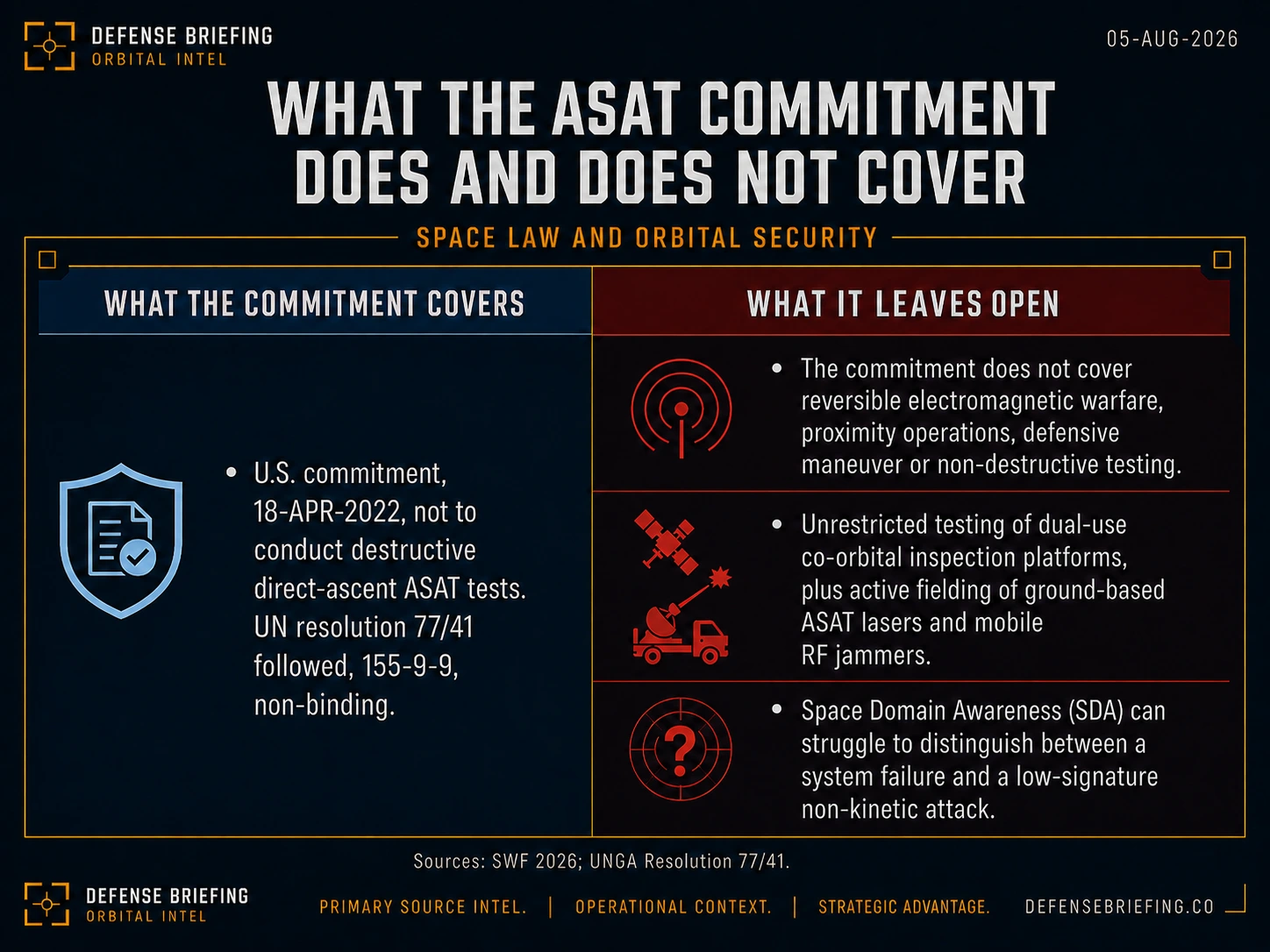
The asymmetry is more precise than "the United States self-handicaps," and it is countable. On 18-APR-2022, the United States committed not to conduct destructive direct-ascent anti-satellite missile tests.19 On 07-DEC-2022, the United Nations General Assembly adopted Resolution 77/41 calling on all states to make the same commitment, by 155 votes to 9 with 9 abstentions. China and Russia voted against it. India abstained.20 The resolution is nonbinding, and by October 2023 roughly 37 states had made national pledges.21
The commitment itself does not cover reversible electromagnetic warfare, proximity operations, defensive maneuver or non-destructive testing. Those uncovered categories are where the activity is. Secure World Foundation documents continued Chinese rendezvous and proximity operations alongside Russian ground-based electronic warfare systems.26
The debris record explains why the norm exists. NASA called the 11-JAN-2007 Fengyun-1C intercept the worst satellite breakup in history.12 Russia's 15-NOV-2021 test against Kosmos-1408 added more than 1,500 trackable pieces.22 Secure World Foundation's 2026 assessment puts the aggregate at 6,904 cataloged debris pieces from destructive counterspace testing by four countries, with 2,773 remaining in orbit.23
The same assessment found counterspace research spreading across 13 countries, while only non-destructive counterspace capabilities have been observed in active military conflicts. The capability base is expanding faster than the public record of wartime use.23
Attribution is the harder problem, although the popular version of this argument overstates the contrast with Earth. Terrestrial attribution is not routinely clean either, as cyber operations, electronic warfare and gray-zone maritime activity demonstrate. Orbital attribution can be particularly difficult because observations are sparse and benign failures can mimic hostile effects. When a satellite in geosynchronous orbit degrades, investigators may have to separate internal component failure, a micrometeoroid or untracked debris fragment, ground-based laser dazzling and a deliberate electromagnetic effect.
Such ambiguity could be exploited. Whether it is being exploited systematically in any given case is an intelligence judgment the open record does not settle.
What NITE-STAR Signals About Space Force Readiness
One indefinite-delivery/indefinite-quantity contract does not rewrite American military doctrine. It does show where acquisition is catching up to it.
The Department of the Air Force's fiscal 2027 request seeks $71.1 billion for the Space Force. Of that, $21.6 billion is identified for space control, which the department describes as a 158 percent increase from fiscal 2026.24 The public material does not reveal how much of the underlying capability portfolio sits in classified accounts. That opacity makes the unclassified NITE-STAR vehicle one of the few visible places to track how the service is building space-control readiness.
It is also a stated priority, not an inference. Asked by the House Appropriations defense subcommittee on 30-APR-2026 to name his must-fund programs, Chief of Space Operations Gen. Chance Saltzman listed space control capabilities, launch infrastructure and test and training support.25 NITE-STAR fits within the third.
These remain requests. Congress has not enacted them.
The Angle
Five things will show whether NITE-STAR grows into the live and simulated range enterprise Space Force officials envision:
- Which task orders get awarded, and when. A vehicle with no orders is a filing cabinet.
- How much is obligated against the $981 million ceiling during the first two fiscal years of the ordering period.
- Whether Space Systems Command procures dedicated on-orbit targets or buys on-orbit range capability as a service.
- Which vendors win. The distribution will show how Space Systems Command divides the work between integration and hardware.
- Whether the range extends beyond near-Earth orbit. Nothing in the public record puts cislunar requirements in NITE-STAR. Given the vehicle's multi-year ordering period, that is a question worth keeping open rather than an answer worth asserting.
NITE-STAR does not buy $981 million of orbital weapons. It creates the mechanism through which the Space Force may buy the ranges, simulations and live assets needed to train for counterspace operations, at a moment when its own operational commander says several mission areas still lack adequate simulators or integrated training environments.
That is a smaller claim than the headlines. It is also the one the documents support.
Forward this to the person who thinks a contract ceiling is the same thing as a funded program.
Sources: Space Systems Command award and mission releases, the NITE-STAR solicitation, the Space Force warfighting framework and program fact sheets, Department of the Air Force budget material, NASA orbital-debris assessments, United Nations treaty records and Secure World Foundation counterspace research. SSC describes NITE-STAR as covering two five-year periods. Some contract databases display an ordering end of 29-JUL-2032, a discrepancy Defense Briefing could not resolve without the signed award documents. No classified information was used and all material is publicly accessible.