
The War You Can Watch: How Drones Are Rewriting the Rules of Combat
Drones made the battlefield easier to see and cheaper to strike, but the real cost per hit is higher than the headline price, and every advantage expires faster than the last.
Revised 04-NOV-2026 // Reporting cutoff: 04-NOV-2026
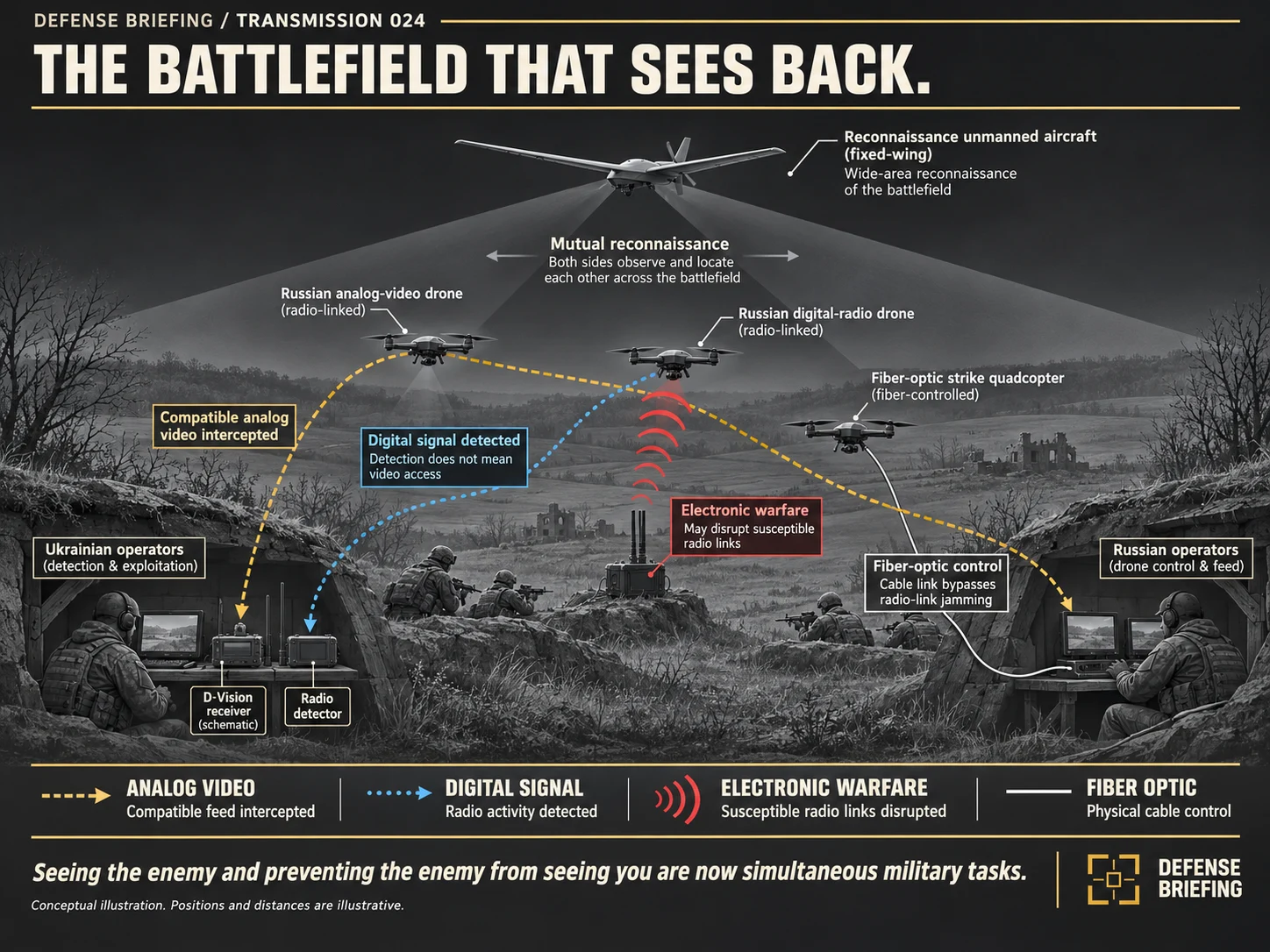
Conceptual illustration. Positions and distances are illustrative. Graphic: Defense Briefing.
Imagine a Ukrainian soldier moving through a Ukrainian-held frontline sector. This is a hypothetical scene, not a reconstructed encounter. Distant artillery is audible.
A warning comes over the radio: drones incoming.
The soldier reaches into a pocket and draws out a small black receiver. It weighs 290 grams, about the weight of a large apple. The device was built in Kyiv by a company called CODE380.1
The soldier is using it for one purpose. If the drone is sending its video back over an open analog link, the receiver can catch the signal and show the picture on its own small screen. For a few seconds, the pilot flying the drone and the soldier it is hunting may be looking at the same imagery.
The receiver is real. Called the D·Vision SDR, it uses software-defined radio (SDR) to scan from 500 megahertz to 8.7 gigahertz.1 CODE380 reports analog-video reception out to 10 kilometers between 540 megahertz and 6 gigahertz, falling to approximately 3.5–5 kilometers at higher frequencies.2 These are manufacturer specifications, not guaranteed combat ranges.
The limits matter as much as the reach. The manufacturer reports a scan of roughly nine seconds and the ability to view one analog feed at a time.3 That is not simultaneous imagery from every drone nearby. Compatible digital signals, including some DJI links, can trigger detection without producing a viewable picture.2 Detecting a transmission and decoding its video are separate capabilities. A fiber-optic drone sends its control signals and video through a cable, leaving no ordinary radio video link for this function to intercept. Any other onboard radio emissions are a separate detection question.
The box addresses a specific gap. In June 2026, Serhii "Flash" Beskrestnov warned that Russian Molniya drones were using the 4.3–4.5 gigahertz video band, within a broader 4.1–4.5 gigahertz range that many detectors covered poorly.4 Beskrestnov was then an adviser to Ukraine's defense minister. He became a presidential adviser in July.5 CODE380's developers say they update the receiver's software about twice a month.6
This is evidence of a transformation already underway. Observation is spreading, precision attack is becoming more affordable and technical advantages can disappear as opponents adapt.
Primary sources, plain language, every Wednesday. Get the next Transmission in your inbox.
Get Orbital Intel FreeI. Battlefield Transparency
Persistent surveillance did not begin with small drones. Aircraft, satellites, unmanned reconnaissance systems, patrols and electronic intelligence had long supplied battlefield information, sometimes continuously. What changed in Ukraine was the cost, density and distribution of observation, and how quickly small units could act on it.
Drones changed the rhythm. A platoon can launch its own camera, watch an approach and pass a target to a weapon while the target is still there. Coverage can be persistent in a particular sector, but weather, terrain, endurance, enemy action and available crews still interrupt the picture.
Jack Watling examined this environment in Emergent Approaches to Combined Arms Manoeuvre in Ukraine, published by the Royal United Services Institute (RUSI) on 23-OCT-2025. It draws on fieldwork from January through August 2025.7 In his account, drones work alongside other sensors and communications networks to shorten the interval between finding a target and attacking it. The practices described below concern the formations and operations in that study. They are not a universal Ukrainian operating procedure.
The result is that the sanctuary behind the front line has shrunk. Supply routes, vehicle parks, artillery positions, troop rotations and evacuation routes can all come under observation and attack. Watling reports that medical support is often delivered more than seven kilometers behind forward positions.7 The wounded are stabilized where they were injured and moved later at night, including by ground robots stationed two to five kilometers back. Resupply is planned by day and carried out by night. The drop-off point is set apart from the receiving position, so a robot tracked by a drone does not lead the enemy to the infantry it serves.
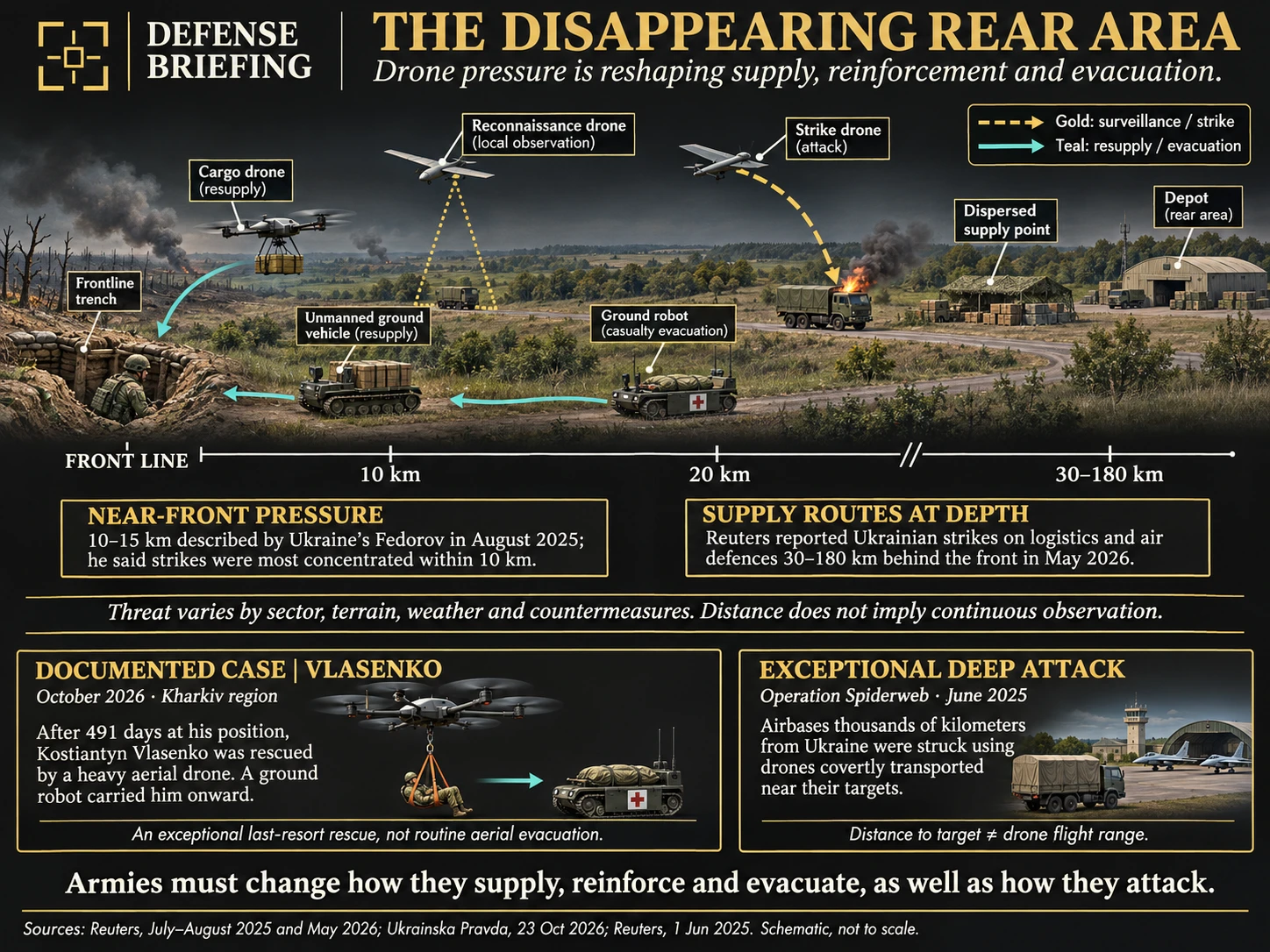
Schematic, not to scale. Distances come from separate reports on different sectors and dates and do not describe a continuous zone. Graphic: Defense Briefing; sources: Reuters (Jul–Aug 2025; May 2026; 01-JUN-2025), Ukrainska Pravda (23-OCT-2026).
Armies have changed how they behave to survive. Watling describes an optimized Ukrainian infantry section of seven: two fireteams and a commander.7 Soldiers dig two-person and three-person positions in tree lines with overhead cover, and one fireteam habitually watches the sky. Artillery hides to fire. Guns sit dug in under mesh screens, in closed positions that open only to shoot. Fire missions run to roughly ten rounds before the gun risks coming under observation. Ammunition is stored away from the gun. Resupply comes by ground robot. The gun moves when its crew believes the enemy has identified its position.
Watling also describes Russian adaptations. Small groups of two to five infiltrate under thermal sheeting, carrying days of supplies, guided by a command post watching them through a drone.7 Ukrainian assaults go in at thermal crossover, when heat cameras lose contrast, or in bad weather. Poor weather degrades small drones, but artillery can still strike positions it has already registered.
All of this points to a difficult question. If a large formation can be seen and hit before it concentrates, how does an army gather enough force to break through? Watling lays out three problems.
- Surprise is hard, because the sensor network sees preparations as they happen.
- Concentration invites destruction, because precision fire exists at every level and a concentration of force is met by a concentration of effect. Breaching vehicles are destroyed on the road in.
- Exploitation starves, because defenders find it easier to hit the trucks behind the fight than the troops in it. A force that pushes forward outruns its supplies, loses momentum and gives the enemy time to rebuild its defenses.
The new arms race, decoded weekly. Join the readers who get Orbital Intel first.
Subscribe FreeRussia faces the same problem in reverse. Its infiltration tactics kill Ukrainian soldiers, but Watling identifies failures to reinforce and resupply infiltrating troops as a constraint on turning local gains into larger advances.7
The Ukrainian method in Watling's study is not a massed breakthrough. It is a deliberate seven-phase effort to seize a sector: survey, isolate, degrade, fix, suppress, close and destroy, then consolidate. The process typically runs five to ten days. During isolation, Ukrainian forces do not try to seal the sector completely. They aim to make rotating and resupplying the defenders costly enough that holding the position becomes unsustainable.
None of this means concealment is dead. With discipline, Watling writes, artillery and mortars can be highly survivable.7 He reports a Ukrainian assessment that only about half of the Russian artillery pieces claimed destroyed in drone strikes were actually destroyed. The rest were damaged, recovered and eventually repaired. Detection is not destruction.
The sensor network also has gaps. Weather and deliberate interference open holes in coverage, and both sides use them. The battlefield is not transparent. It is contested, and how much each side can see changes by place and by hour.
Drones have not replaced combined arms either. Artillery still has advantages in responsiveness, payload and firing in weather that can ground small drones. Laser-guided ammunition does not depend on a drone's radio-control link, although laser designation has its own limitations. Senior Ukrainian drone officers told Watling that Ukraine uses its first-person-view drones in extremely inefficient ways because it has no alternative.7 Ukraine leaned on drones to cover shortages elsewhere, including manpower and other weapons, and that weakness is part of why Russian infiltration works. Seeing more did not solve the old problems. It moved them.
Battlefield analysis without the hype. One briefing, every Wednesday.
Subscribe FreeII. Cheap Killing
The most quoted number in this war can also be misleading. A first-person-view (FPV) drone sortie costs about $500 in materiel, according to one former team member's account.8 Put that next to a tank worth millions and the arithmetic looks one-sided.
But it is not the whole arithmetic.
The $500 does not buy the goggles, the controller, the ground station or the relay drone that carries the signal forward. It does not buy the reconnaissance drone that may locate the target first, or the operator's training. Shared equipment supports many missions rather than being bought anew for every launch. And the airframe price does not account for drones that never arrive, killed by jamming or by their own defects on the way.
The honest comparison is system to system. An analysis by The Pricer, dated 02-OCT-2026, reports bundled system prices from the U.S. Drone Dominance Phase II program:9
- $3,500 for close-quarters FPVs
- $4,500 for deep-strike systems
Both include supporting equipment, spares and training. Adding the payload price the analysis reports, $3,250, gives illustrative armed totals of $6,750–$7,750. The analysis also reconstructs the September order from Neros: 14,000 drones and payloads for more than $100 million. That reconstruction is consistent with those prices, but it is not an official line-item invoice. This is secondary pricing analysis, not a Pentagon price sheet. The totals are 13.5–15.5 times a $500 sortie, but the two purchases contain different things and face different sourcing requirements.
The Lancet shows what a different class of weapon costs. Russia's factory-built loitering munition has electro-optical guidance, with range and payload varying by version. In an account reported by Defence Blog, pro-Russian commentator Pavel Gubarev put its price at approximately $37,000–$67,000.10 That is the estimate used here, not a verified Russian procurement price. A longer-range loitering munition and a short-range quadcopter occupy different tactical and economic niches.
Then there is the question the price tag hides: how often does a cheap drone reach its target? Former Slovak officer Jakub Jajcay published an account in War on the Rocks on 26-JUN-2025, drawn from six months with one FPV team in the Donbas.8 His figures:
- 43 percent of flown sorties hit the intended target and detonated.
- 20–30 percent was the success share once missions canceled before launch were included.
- About one in four drones had a technical fault before takeoff.
- About one in ten hit the target but failed to detonate.
- 31 percent of sorties were downed by enemy jamming, and another 3 percent failed because of friendly jamming.
These measures have different denominators and should not be added together. They describe one team's experience, not a national audit.
Real numbers, traced to their sources. Orbital Intel lands every Wednesday.
Get Orbital Intel FreeThe arithmetic needs care. At $500 per expended drone and a 43 percent success rate, drone spending comes to about $1,160 per successful outcome. A 20–30 percent rate would imply about $1,670–$2,500, but only if every counted attempt also consumed a $500 drone. Missions canceled before launch do not necessarily do that, so dividing $500 by that rate is not a measured cost per hit. Payloads, training and support add costs. Reused equipment and recovered aircraft change them. And a hit is not necessarily a destruction. A tank may take several attacks, and many of the team's tasks overlapped with missions other weapons could perform.
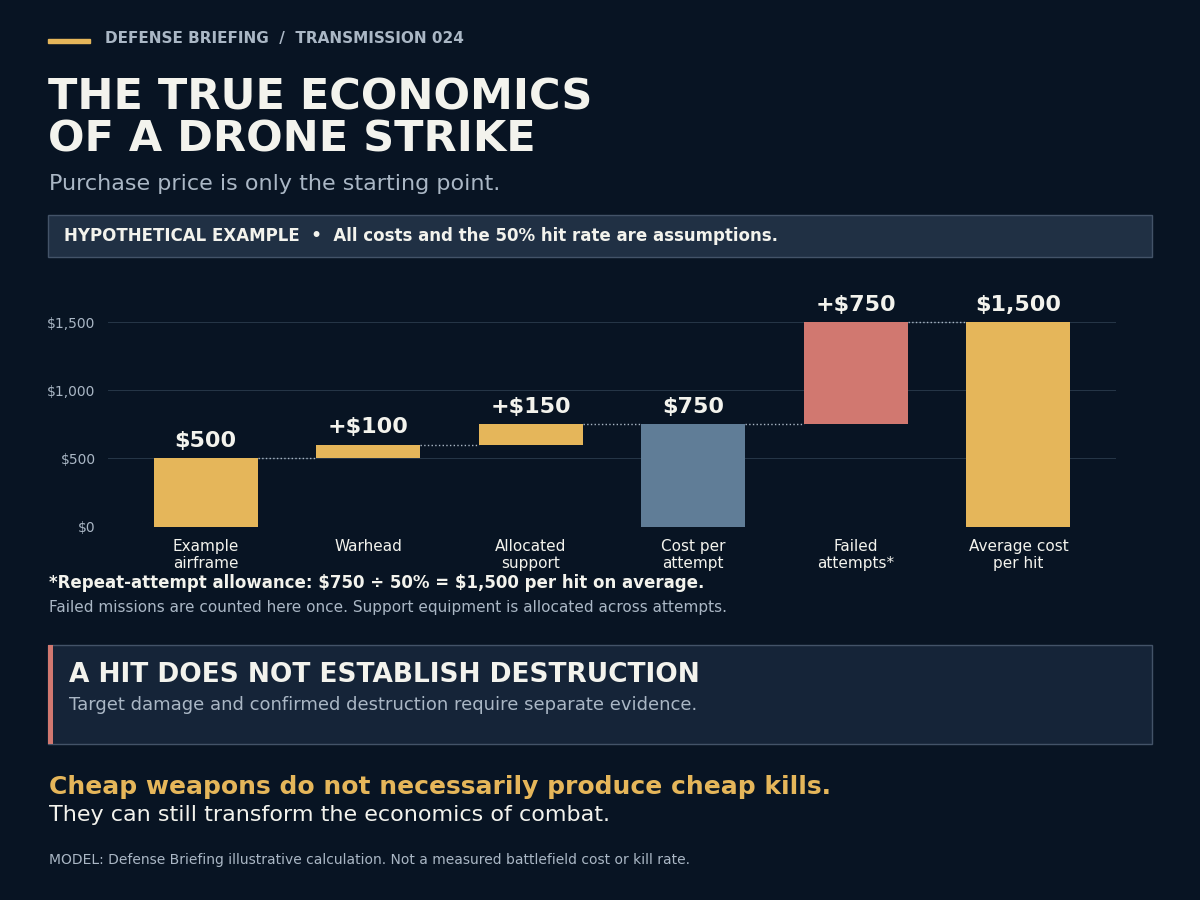
Hypothetical model. The 50 percent hit rate and all costs are illustrative assumptions, not measured battlefield figures. The single-team rate discussed above was 43 percent. Graphic: Defense Briefing.
Other evidence underscores the variation. A report for the Center for Strategic and International Studies (CSIS) by Kateryna Bondar gives a 10–20 percent baseline in its key findings.11 It also records interviewees describing 10–15 percent success for most small, low-cost FPV missions and 30–50 percent for highly skilled operators. These are operator reports, not controlled trials.
Fiber-optic links can overcome radio jamming, but their overall effectiveness also depends on cable reliability, handling and the target. An expert interview summarized by Daily360 put the chance of a working fiber-optic drone striking its target at about 50 percent.12 That is a single attributed estimate, not an established benchmark.
The Lancet offers another caution. In October 2026, Defence Blog reported Gubarev's account that a Sparta unit launched about 100 Lancets over three months beginning in mid-June and hit only three targets.10 He blamed Ukrainian defenses and Russian coordination failures. The unit's full records and battle-damage assessments have not been independently audited.
At that account's unit estimate, 100 launches imply $3.7 million–$6.7 million in nominal munition spending, or approximately $1.23 million–$2.23 million per reported hit. These are conditional calculations, not verified spending or costs per destroyed target.
A very different Lancet figure comes from January 2025. Reporting then credited LostArmour, an open-source tally, with a 77.7 percent success figure: 2,182 targets classified as damaged or destroyed out of 2,806 documented uses.13 That is a count of documented engagements, not a manufacturer claim or proof that every launch was counted.
The two records are not directly comparable. A public tally of documented engagements can omit unsuccessful launches, and a unit account can define success differently. Neither establishes a fixed hit probability. The same weapon can perform very differently as defenses, operator skill, target selection and coordination change. The cost of an effect changes with them.
CSIS offers a broader example.14 Its analysis used Ukrainian Air Force reporting on more than 19,000 missiles and drones, including over 14,700 one-way attack drones, launched from 28-SEP-2022 through 28-DEC-2024.
- Shahed-type drones: fewer than one in ten reached a target. At an assumed $35,000 unit price, Russia spent roughly $350,000 per target struck.
- Missiles: the most cost-effective missile in the analysis cost about $1 million per target struck.
Neither figure establishes destruction or the target's value. The data did not allow CSIS to calculate a full exchange ratio between attacker and defender. The analysis separately estimated more than $600,000 in lost value when a single interceptor from the National Advanced Surface-to-Air Missile System (NASAMS) is used against a one-way attack drone. That is not a universal figure for expensive interceptors.
Forwarded this Transmission? Subscribe and get the next one directly.
Subscribe FreeScale matters too. In 2024, Ukrainian state agencies procured approximately 1.5 million drones, and 96 percent of procurement spending went to Ukrainian manufacturers and suppliers.15 That 96 percent is a share of spending, not of units. Bondar's CSIS report separately states that Ukrainian companies manufactured more than 1.5 million FPV drones that year and that Ukraine produced approximately 2 million drones overall.11 The 2025 procurement plan called for about 4.5 million FPVs and more than $2.8 billion.15
Russia's plans run on a similar scale. On 08-MAY-2026, Gen. Oleksandr Syrskyi, Ukraine's commander-in-chief, cited Ukrainian intelligence assessing a Russian plan to produce 7.3 million FPVs in 2026.16 That is an adversary's estimate of planned output, not confirmed production.
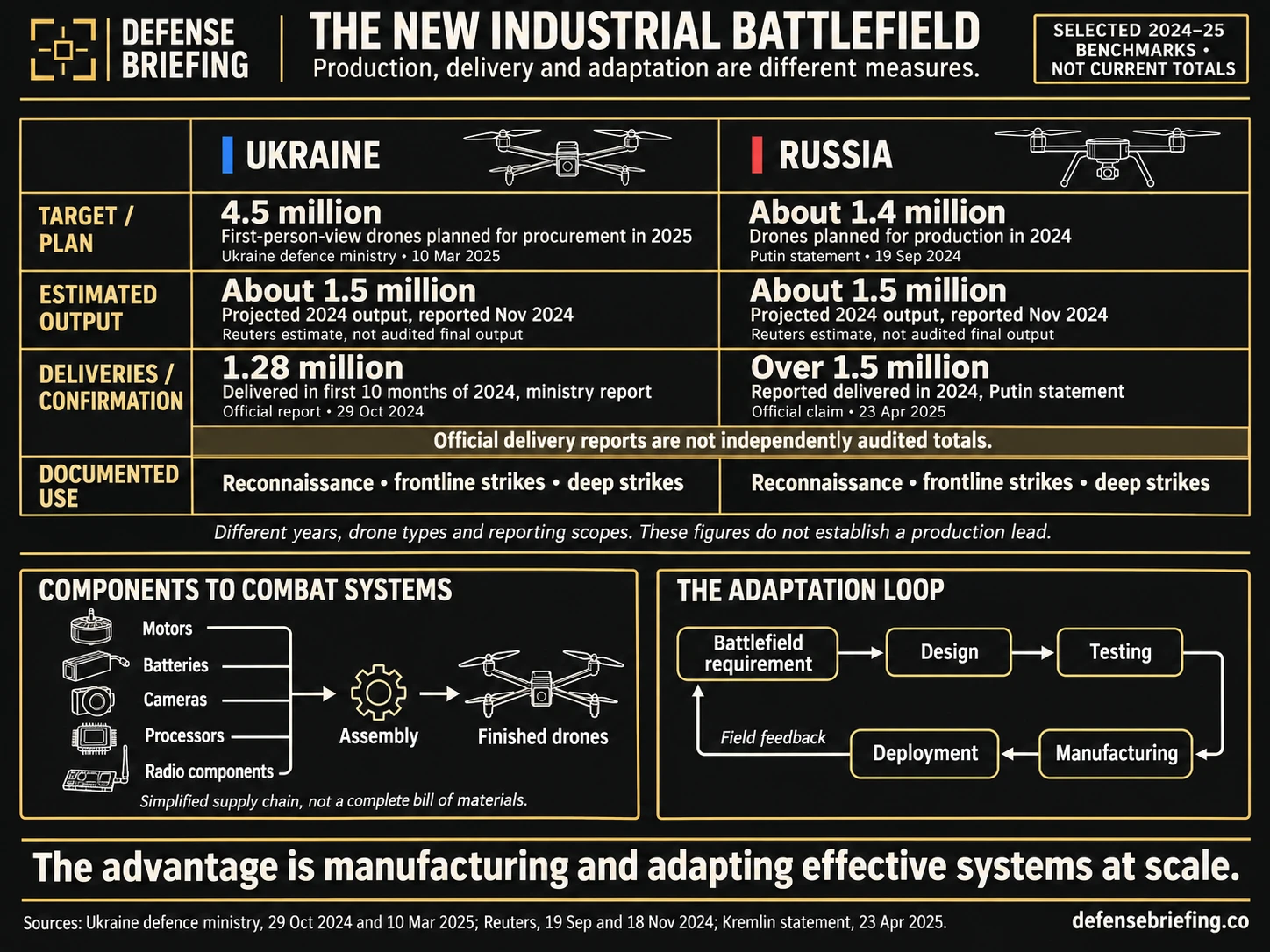
Selected 2024–25 benchmarks from official statements and Reuters estimates. Different years, drone types and reporting scopes; the figures do not establish a production lead. Graphic: Defense Briefing; sources: Ukraine Ministry of Defence (29-OCT-2024; 10-MAR-2025), Reuters (19-SEP-2024; 18-NOV-2024), Kremlin statement (23-APR-2025).
The limits of the cheap-killing story deserve to be stated plainly. Drones can finish targets already disabled by other weapons. A vehicle disabled by artillery or a mine and then burned out by an FPV counts as a drone kill. So does an abandoned vehicle. The typical drone kill is not a tank.
Ukraine claims its drones struck 819,737 targets in 2025, about 240,000 of them personnel targets, with officials saying each strike was confirmed on video.17 That is not necessarily a count of unique people, destroyed targets, sorties or drones launched, and it has not been independently audited.
Finally, the expensive side adapts by getting cheaper. On 03-MAR-2026, Syrskyi credited interceptor drones with more than 70 percent of Shahed-type drones destroyed over Kyiv and the surrounding area during February.18 That claim covers one area for one month. It is not a national interception share.
III. The Counter-Move
Return to the receiver in the soldier's pocket. Its limits are the story. The analog picture it shows is a snapshot of one moment in an arms race where every advantage expires, and the expiry dates keep getting shorter.
The cleanest example is fiber. Fiber-optic drones trail a thin cable that carries control and video, so radio jammers cannot touch the link. Both sides now field them at scale. Ukraine's Defense Procurement Agency reported that contracts it managed delivered 374,000 fiber-optic drones in 2025, and that deliveries by April 2026 had already passed 92 percent of that total.19 Those are delivery figures. They are not proof of equivalent battlefield performance or of a date at which Ukraine matched Russia.
Fiber brings its own penalties. The spool adds weight, and the cable can snag or break and can constrain handling. In principle, a physical cable can also reveal a route back toward the launch point, although tracing it across an active battlefield is neither simple nor guaranteed. The soldier's receiver cannot display a picture that travels only along that cable.
The same contest runs through other systems. The adaptations overlap rather than replacing one another in sequence. Jamming encourages changes in frequencies, communications links and autonomous guidance for the final approach. Cheap interceptors increase the pressure for faster attackers.
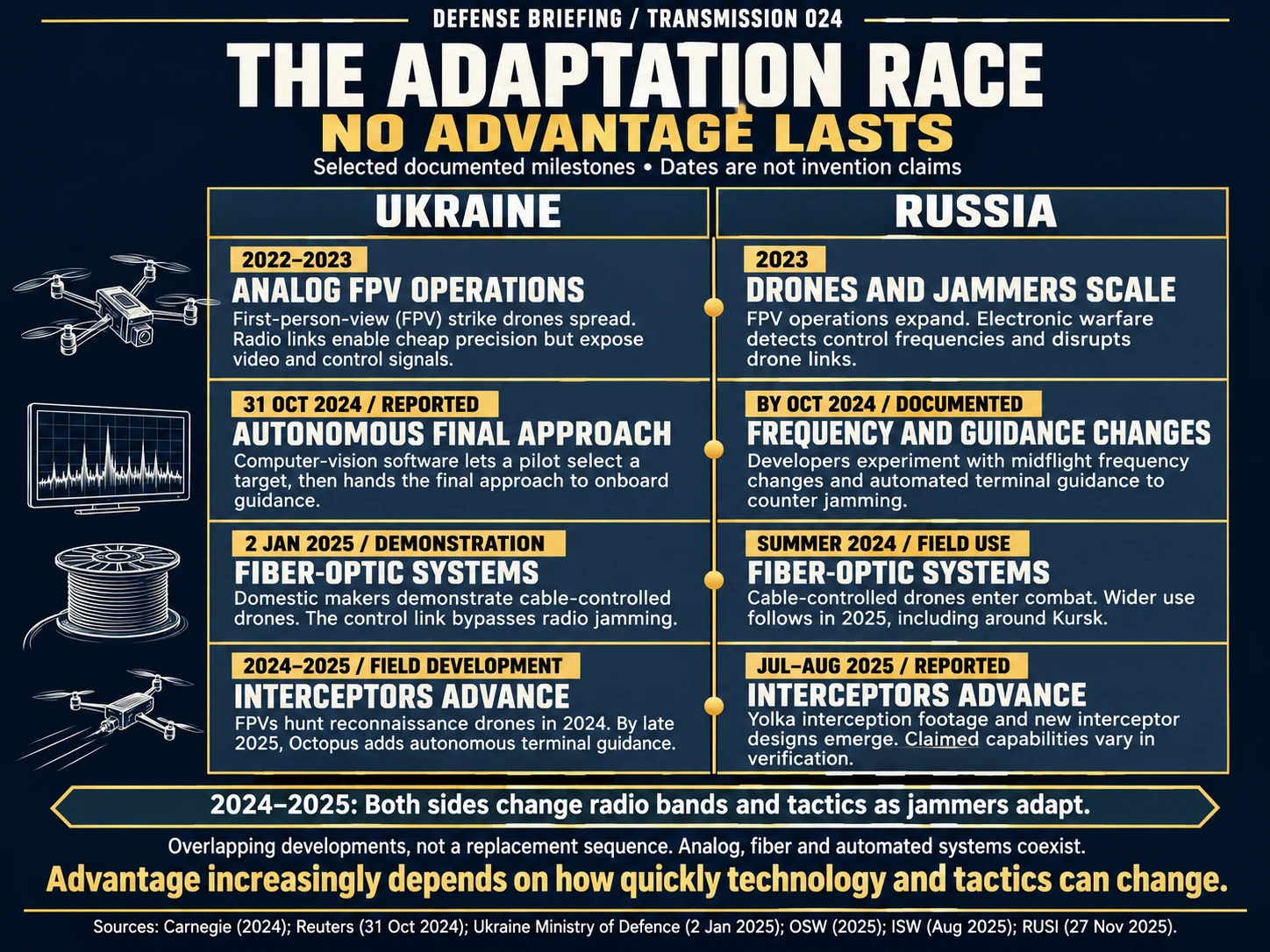
Selected milestones. Dates mark reported or documented use, not invention, and the developments overlap rather than replace one another. Graphic: Defense Briefing; sources: Carnegie (2024), Reuters (31-OCT-2024), Ukraine Ministry of Defence (02-JAN-2025), OSW (2025), ISW (Aug 2025), RUSI (27-NOV-2025).
The Ukraine Air War Monitor, Volume XXI, published by Germany's Konrad Adenauer Foundation and citing Ukrainian reporting, estimates Russia's use of jet-powered drones at:20
| Month (2026) | Estimated jet-drone launches |
|---|---|
| June | about 350 |
| July | about 1,500 |
| August | about 2,800 |
These are estimated deployments, not factory output. At these speeds, guidance and the time available to react become critical.
Adaptation is not always imposed by the enemy. Beginning 14-OCT-2026, restrictions cut Starlink and military-grade Starshield satellite connectivity above approximately 160 kilometers an hour. President Volodymyr Zelensky said Ukrainian interceptor drones were losing their link above that speed.21 Service was reported restored on 24-OCT-2026.22, 24
Accounts of who was responsible differ:
- Elon Musk acknowledged that SpaceX had imposed the restrictions and alleged that offensive use violated its terms. Ukraine disputed that justification.22
- Reuters separately reported sources saying the decision came from inside the White House.23 U.S. officials gave conflicting accounts.
SpaceX's role in carrying out the restriction is established by Musk's acknowledgment. The full chain of decisions and its justification remain contested.
Contested claims, attributed and sourced. That is the Orbital Intel standard.
Get Orbital Intel FreeThe drone threat has remade evacuation behind the line as well. The "golden hour" was always an aspiration, never a guarantee that every casualty would reach a surgeon within sixty minutes. Under persistent drone observation, even that aspiration is increasingly hard to meet. Watling's account of wounded soldiers stabilized in place and moved later at night reflects that reality.7
The extreme cases show the alternatives. Kostiantyn Vlasenko spent 491 days at an isolated position in the Kharkiv region, known at first as Vertun, before his rescue on 04-OCT-2026, according to Inside Unmanned Systems.25 Those days describe his time at the position, not continuous time wounded. Reporting describes the loss of his left foot to necrosis and his amputation of his right foot himself.26 A heavy hexacopter lifted him out.
The rescue figures measure different legs of the operation:
- Passenger flight: about fifteen minutes, in accounts based on Reuters reporting.27
- Whole aircraft mission: roughly 62 kilometers and about 75 minutes, according to other reporting.25
- Ground leg: about eight kilometers by ground robot after the flight.25
None of these justifies saying he flew the whole mission distance.
In another October account, the 475th Separate Assault Regiment said it used SkyFall's StarGate drone for two evacuations in one week. One reportedly involved a flight of nearly 32 kilometers outbound and a similar return under attempted navigation jamming.28
Ground robots carried out more than 9,000 frontline missions in March, according to Ukraine's defense ministry.29 A reported plan to procure 25,000 robots in the first half of 2026 is a procurement goal, not confirmation that all were delivered. Aerial evacuation has its own exposure. A robot on the ground can sometimes shelter where an aircraft cannot.
See the war behind the headlines. Get Orbital Intel free.
Get Orbital Intel FreeAmmunition, rotations and recovery changed the same way. A mortar commander in the 92nd Brigade told David Kirichenko of the Center for European Policy Analysis (CEPA) that with a twenty-kilometer kill zone, organizing logistics is practically impossible.30 Infantry walk thirty kilometers to the line, and mortar and drone crews walk ten to fifteen. Those distances describe one sector, not a uniform belt along the whole front.
Recovery has become a mission of its own. Frontliner reported on 19-SEP-2026 that soldiers in the 33rd Brigade said their Leopard tanks had not carried out a planned firing mission since 2025.31 The tanks sit in reserve for a breakthrough that has not come. The soldiers said the hardest repairs take two to three weeks, because mechanics must strip half the vehicle to reach the damaged parts. Some tanks are now used mainly to tow other wrecks. These are one unit's experiences, not evidence that all Ukrainian armor is idle.
The people running these systems have become targets themselves. Watling's study describes Russian forces systematically locating Ukrainian jamming positions, radar, command posts, drone pilots, artillery and hardened positions.7 Once these are located, Russia hits them with artillery, rockets, Molniya drones, fiber-optic drones and glide bombs. The aim is to push pilots farther from the line and thin out the surveillance above it.
What does it do to people to live under these conditions? The kill zone described to CEPA runs twenty kilometers deep in that sector,30 and the distance varies by sector, aircraft and conditions. In The War Zone's StarGate account, one evacuee, 25-year-old Yevhen, described losing half a foot and doubted he could have escaped without the aircraft.28 Courage, intelligence, initiative and leadership still matter. The threat squeezes them into shorter, harder moments.
Return one last time to the soldier and the receiver in his pocket. The box is useful now, in certain places and against certain signals. Its usefulness may fade against some systems while persisting against others. That is not a flaw in the design of the box. It is the condition of the war.
Successful tools invite countermeasures, even when those replies take time. The reply forces a new tool, and the new tool forces another reply. It is less a chess match than a long, grinding exchange in which each move changes the board for both sides, whether they intended the change or not.
The Angle
What decides the exchange is not the receiver, the drone or the jammer. It is the speed of the loop that produces them: the ability to see a problem, build a fix, put it in the field and start again on the next one before the other side has finished its own turn. Countries that treat this as a shopping list will keep buying the last war's answer. Countries that treat it as a system will keep changing the question.
War has not become fully transparent, cheap or automatic. Ukraine has shown, more clearly than anyone else, how much of it now turns on an industrial contest to see, to strike, to stay alive and to adapt. The lesson is not that better drones win.
"The lesson is that the side that learns faster keeps its chance to win at all."
Forward this to someone tracking how drones are changing the war in Ukraine.
Sources: This Transmission draws on primary research from RUSI and CSIS, statements from Ukraine's Ministry of Defence, Defense Procurement Agency and commander-in-chief, and reporting from Reuters, the Associated Press, Defense News and Ukrainian outlets. Unit accounts, manufacturer specifications and pricing analyses are attributed as such. The numbered list below is authoritative. No classified information was used and all material is publicly accessible.