
208,200 Attack Drones on Paper: Taiwan's Mass Bet Meets the Legislative Clock
Taiwan wants to buy 210,966 uncrewed systems under a NT$210 billion special act that has not yet passed. The binding constraint is not factory capacity. It is whether the legislature funds the program on a multi-year clock and whether Taiwan can qualify enough of its electronics base for military production without Chinese components.
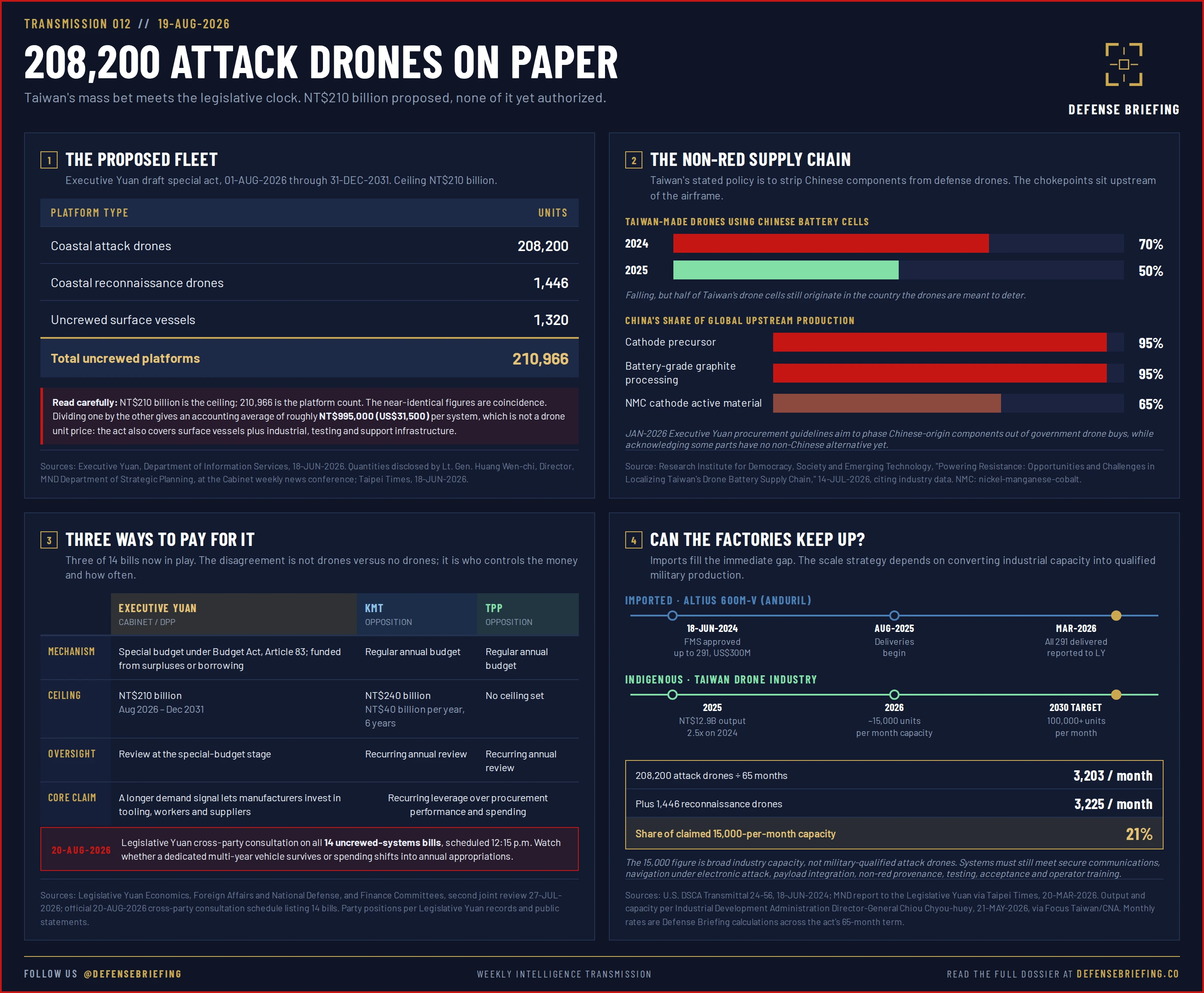
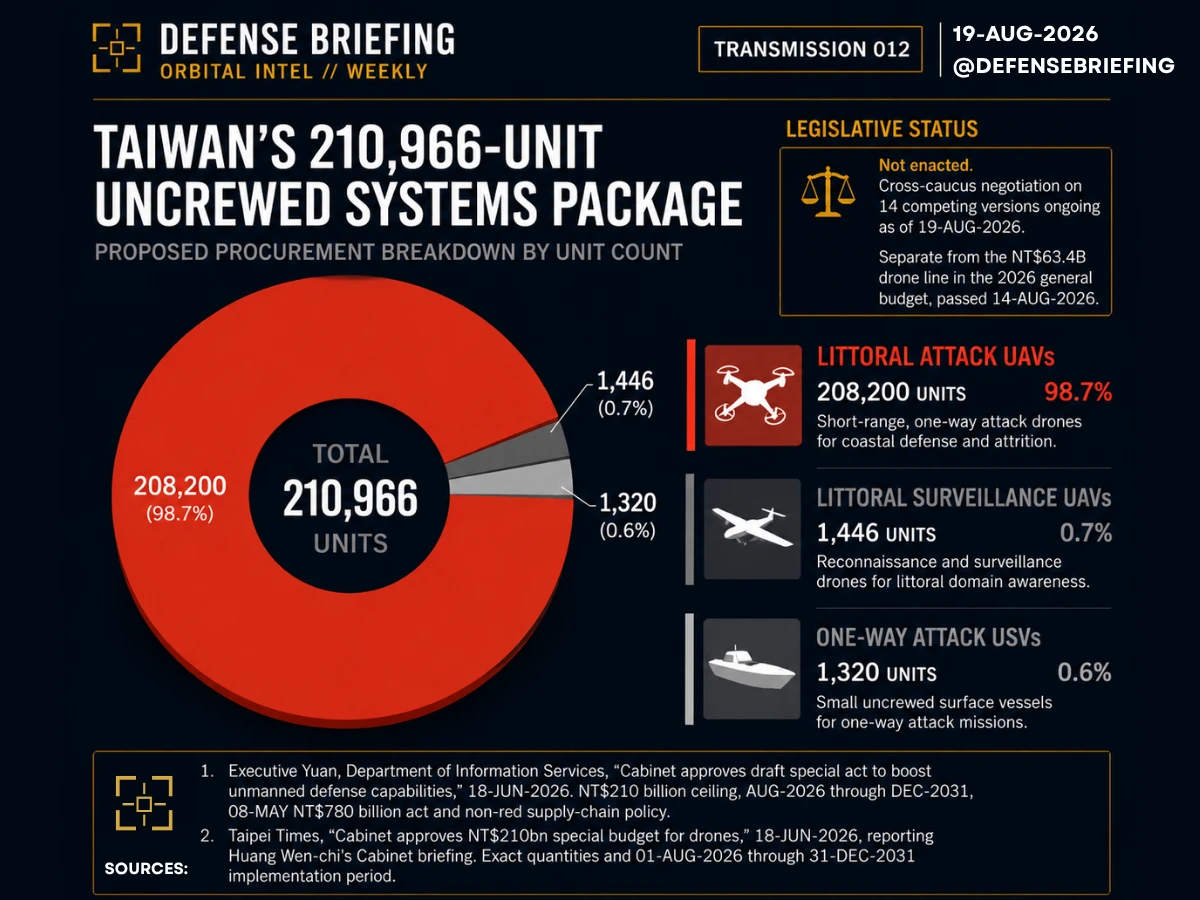
Taiwan wants to buy 210,966 uncrewed systems. The 208,200 in the headline represents the largest line item: coastal attack drones. The full package also includes 1,446 coastal reconnaissance drones and 1,320 uncrewed surface vehicles. None of it has yet been authorized under the legislation designed to pay for it.1, 2
The Executive Yuan approved its draft special act for procurement of indigenous unmanned defense systems on 18-JUN-2026. It authorizes up to NT$210 billion (US$6.59 billion at the 19-AUG-2026 mid-market rate of NT$1 = US$0.031374) across the 65-month period beginning 01-AUG-2026 through 31-DEC-2031. Lieutenant General Huang Wen-chi, director of the Ministry of National Defense's Department of Strategic Planning, disclosed the quantities at the Cabinet's weekly news conference.1, 2
TAIWAN'S DRONE ACT IN 30 SECONDS
- • The Cabinet's draft act would authorize NT$210 billion (US$6.59 billion) across the 65 months from 01-AUG-2026 through 31-DEC-2031 for 210,966 uncrewed systems.
- • The largest line item is 208,200 coastal attack drones, plus 1,446 reconnaissance drones and 1,320 uncrewed surface vehicles. MND has since moved the surface vehicles into the FY2027 regular defense budget, so 210,966 is the act-as-drafted figure rather than what the act would still buy.
- • It has not passed. Fourteen competing uncrewed-systems bills go to cross-party consultation on 20-AUG-2026.
- • Taiwan's stated drone-industry capacity is roughly 15,000 units per month, with a 2030 target above 100,000. The act's aerial requirement averages about 3,225 per month.
- • The harder problems are supply-chain provenance, military qualification and operator throughput, not raw manufacturing volume.
The act is not a standalone drone initiative. It is one leg of a larger attempt to reconstruct the defense package the Cabinet originally requested.
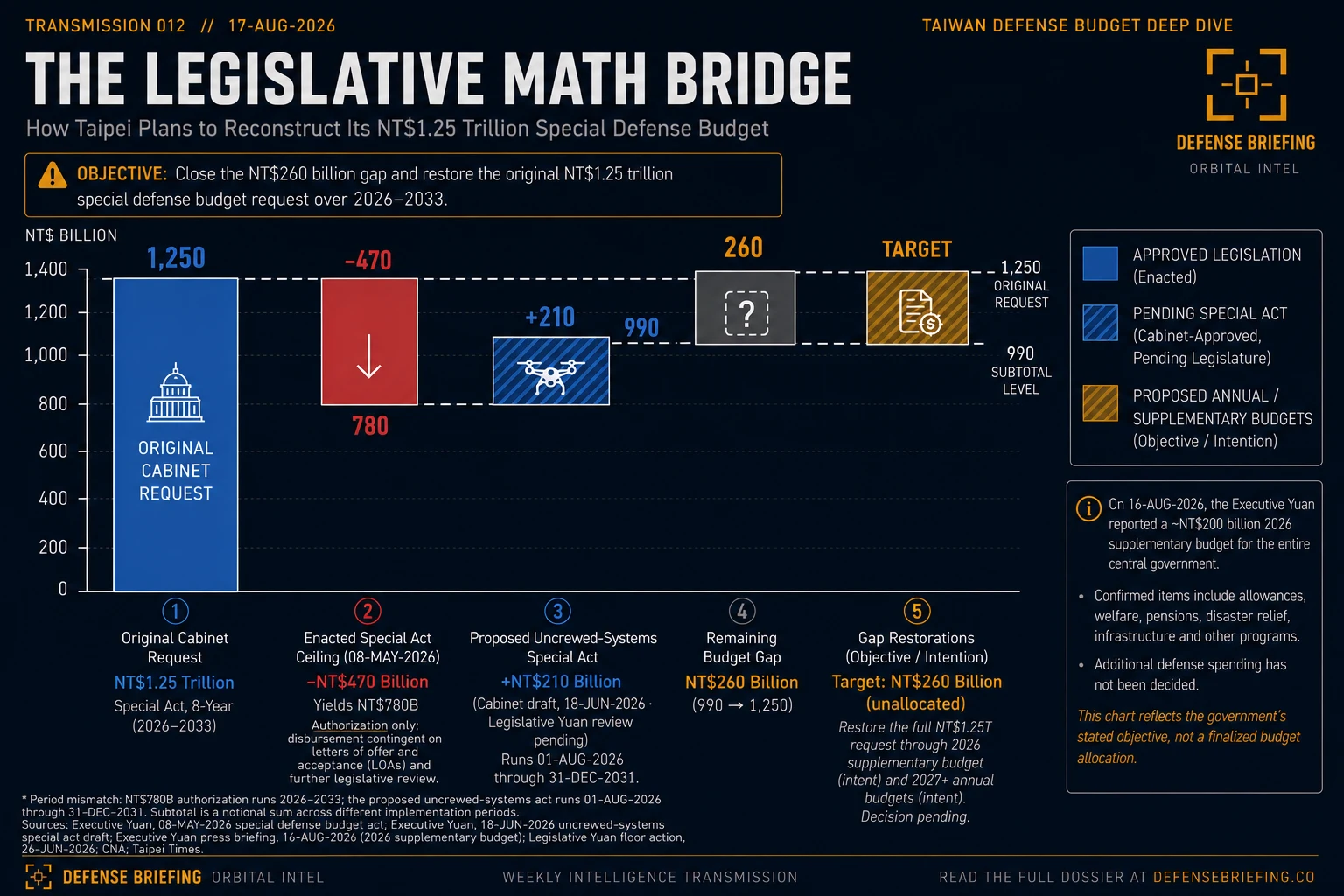
On 08-MAY-2026, the Legislative Yuan passed the Special Act on Safeguarding National Security and Strengthening Asymmetric Warfare Capabilities Procurement with a NT$780 billion ceiling, about US$24.7 billion. The Cabinet had initially requested NT$1.25 trillion (US$39 billion). The enacted version excluded commercial purchases, commissioned production and equipment procured or jointly developed through U.S.-Taiwan cooperation.1, 3
Two separate instruments are in play and they are easy to confuse. The regular defense budget passed on 15-AUG-2026 after a 266-day deadlock, with drone funding retained after the Kuomintang dropped a proposed cut. The uncrewed-systems special act is a different vehicle, and it has not passed. Coverage that reads "drone funding stripped" and coverage that reads "drone funding retained" are describing different bills in the same month.
The arithmetic explains the next move. NT$780 billion already authorized plus the proposed NT$210 billion drone act reaches NT$990 billion, leaving NT$260 billion between what the legislature approved and the Cabinet's original request.
On 16-AUG-2026, the Taipei Times, citing a single unnamed government source, reported that the Cabinet intends to restore that remainder through annual budgets over several years and supplementary budgets. The same source said the Executive Yuan was expected on 20-AUG to approve the 2027 central government budget and a record supplementary budget of roughly NT$200 billion for 2026, with defense spending included in the latter. Neither budget had been approved as of 19-AUG-2026.4
The special act therefore sits inside a larger fiscal architecture. The Cabinet is trying to rebuild the original defense program through several funding channels while giving the uncrewed-systems component its own multi-year procurement vehicle.
That is relevant because Taiwan is not merely buying drones.
It is trying to create a wartime production system before the war begins.
Mass as Strategy
A cross-strait invasion is first a logistics problem before it graduates into a fighting problem. The People's Liberation Army (PLA) would have to move troops, armor, fuel and ammunition across open water, suppress Taiwan's defenses, seize usable landing areas and then sustain forces ashore.
Taiwan's drone concept seeks to counter that chain. Reconnaissance platforms find ships and staging areas. Attack drones multiply the number of shooters. Uncrewed surface vehicles complicate the approach to the coastline and force escorts to devote sensors, weapons and attention to relatively cheap targets while larger Taiwanese weapons remain in the fight.
The proposed number sounds enormous at first glance. But Taiwan need only look at a nearby ongoing war which is already consuming drones on an industrial scale. Ukraine's Defense Ministry says its armed forces received 3 million first-person-view drones in 2025 alone, more than 14 times Taiwan's entire proposed 208,200 attack-drone purchase. The systems and missions are not equivalent, but the comparison establishes the scale of wartime attrition: what looks like a huge peacetime inventory can become a flow requirement once drones are being expended every day.5
That also turns manpower into part of the equation. Taiwan's military was already being questioned in the Legislative Yuan about whether qualified operators could keep pace when planned procurement was measured in thousands rather than hundreds of thousands. A force built around mass therefore needs a sufficient training, certification and command pipeline that scales alongside production, even when one operator controls multiple aircraft.6
And the defensive side of the race is moving too. Taiwan's Audit Office recently flagged that an existing National Chung-Shan Institute of Science and Technology (NCSIST) counter-drone system did not cover the 5.1 GHz band or newer fiber-optic and artificial-intelligence autonomous control threats. Ministry of National Defense spokesman Lieutenant General Sun Li-fang said the system originated from a 2021 requirement covering other common frequencies and that NCSIST plans to add 5.1 GHz coverage while the ministry pursues additional solutions for newer threats.7
Mass works only if the network surrounding it works in parallel.
Primary-source defense and space intelligence, delivered free every Wednesday.
Get Orbital Intel FreeThe Bridge Force Has Already Arrived
Taiwan is not starting from zero.
NCSIST has already developed the Chien Hsiang anti-radiation loitering munition, designed to detect and attack emitting radars. Ministry of National Defense professional military publications say the system entered mass production in 2021 under a six-year program for 104 units.8
Taiwan has also begun importing U.S. loitering munitions while its larger domestic strategy develops.
On 18-JUN-2024, the U.S. State Department approved a possible Foreign Military Sale of up to 291 ALTIUS 600M-V systems and related equipment for an estimated US$300 million. The Defense Security Cooperation Agency notification named Anduril as the principal contractor and made clear that a "system" included more than an airframe: the package also covered inert training aircraft, pneumatic launch systems, ground-control systems, support equipment, training and logistics.9
The Ministry of National Defense reported to lawmakers in MAR-2026 that all 291 systems had been delivered, with deliveries beginning in AUG-2025.10
An additional, significantly larger U.S. package could follow. The Defense Security Cooperation Agency notified Congress on 17-DEC-2025 of a possible US$1.1 billion sale involving ALTIUS-700M loitering-munition systems and ALTIUS-600 intelligence, surveillance and reconnaissance systems. The U.S. notification specifies no quantities and says contractors will be selected through competitive U.S. government procurement. Taiwan's own budget disclosures, not the U.S. notification, provide the planned figures of 1,554 ALTIUS-700M systems and 478 ALTIUS-600 intelligence, surveillance and reconnaissance systems.11
Imported systems fill an immediate gap. They are not the scale strategy.
The industrial relationship is already moving beyond finished weapons. Anduril opened a Taiwan office in 2025 and has pursued cooperation with NCSIST. In JUN-2026, Taiwan's government-sponsored Metal Industries Research & Development Centre signed a memorandum of understanding with Anduril covering artificial-intelligence autonomous systems, key drone components, local production and China-free supply chains. Taiwan's Industrial Development Administration said more than 10 Taiwanese companies had already secured trial or mass-production orders from Anduril for airframe structures, payload equipment and power systems.12
That is the deeper transition: from buying an American weapon to becoming part of the production network behind it.
Imported “Bridge” Systems vs. Indigenous Scale Strategy
Immediate U.S. Foreign Military Sales (FMS) deliveries measured against long-term domestic production programs.
| System / Line Item | Origin / Developer | Quantities / Status | Unit Cost Metric / Scope | Role in Strategy |
|---|---|---|---|---|
| Chien Hsiang | Taiwan (NCSIST) | 104 units Mass production since 2021 |
Indigenous radar-killing loitering munition | Proven domestic baseline |
| ALTIUS 600M-V | United States (Anduril) | 291 systems Delivered Aug 2025 – Mar 2026 |
~$1.03M / system avg.† Includes ground gear & spares |
Immediate capability bridge |
| ALTIUS 700M / 600 ISR | United States (Anduril) | 1,554 (700M) & 478 (600 ISR) Planned |
~$1.1B total FMS ceiling | Advanced sensor / strike capability |
| Coastal Attack Drones | Domestic industry Non-Red supply chain |
208,200 units Proposed Special Act |
~$31,500 budget avg. Per system equivalent |
Mass attrition & deterrence scale |
† Derived figure: total announced package value divided by systems delivered. Includes ground support equipment and spares; not a published per-unit price. Gold-bordered rows denote domestically produced systems; navy-bordered rows denote imported FMS deliveries. Table: Defense Briefing.
The Factory Is Part of the Weapon
Taiwan must build its drone force without depending on the country the drones are intended to deter.
The government's phrase is "non-red supply chain." Premier Cho Jung-tai used it when announcing the special act, saying Taiwan needs to reduce reliance on Chinese components while strengthening domestic production of critical systems.1
The standard is easier to write into policy than to enforce inside a circuit board.
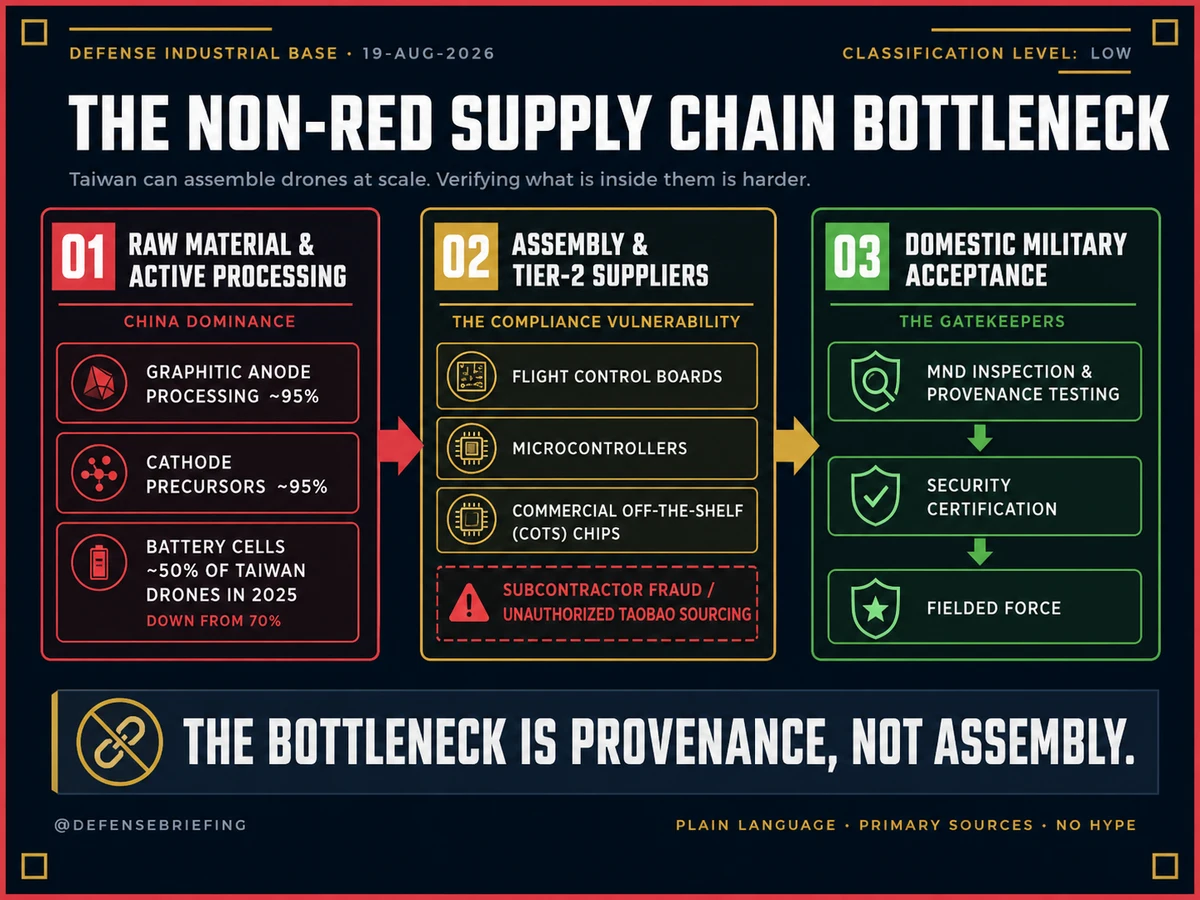
A JUL-2026 report from the Research Institute for Democracy, Society and Emerging Technology found that the share of Taiwan-made drones using Chinese battery cells fell from about 70 percent in 2024 to 50 percent in 2025. Citing industry data, the report says China still controls roughly 65 percent of global nickel-manganese-cobalt cathode active material production, about 95 percent of cathode precursor production and about 95 percent of battery-grade graphite processing.13
The same report points to JAN-2026 procurement guidelines issued under the Executive Yuan that aim to progressively remove Chinese-origin components from government drone procurement. Those guidelines also acknowledge that some components cannot be immediately replaced because suppliers have not yet found non-Chinese alternatives.13
Then came a live test of enforcement.
On 18-AUG-2026, the Ciaotou District Prosecutors' Office said investigators had uncovered a case in which a contractor allegedly assembled Army drones using UAV chips packaged in China, Chinese-made flight-control boards and other components, then concealed product markings and submitted false certificates of origin. The 8th Army Corps discovered suspected prohibited components during acceptance, withheld payment and referred the matter for investigation.14
The Taipei Times separately reported that the training-drone contract was worth NT$2.95 million and, citing an unnamed source familiar with the case, said components had been sourced through Taobao. Those two details do not appear in the prosecutors' release and should be treated as reported allegations rather than prosecutorial findings.15
At NT$2.95 million, provenance is a contract-inspection problem. At NT$210 billion, it becomes part of mobilization.
Manufacturing Capacity Is Not Combat Capacity
Taiwan's drone industry is growing faster than the 208,200 figure implies.
Industrial Development Administration Director-General Chiou Chyou-huey said at a 21-MAY-2026 media briefing that Taiwan's drone-industry output reached NT$12.9 billion (US$408 million) in 2025, a 2.5-fold increase from 2024. Drone exports reached US$93 million in 2025 and US$147 million in just the first four months of 2026.16
More important for the military math, Chiou said Taiwan's current drone-production capacity is about 15,000 units per month, with the government targeting more than 100,000 per month by 2030.16
The proposed special act runs for 65 months. Spread evenly across that period, 208,200 coastal attack drones require an average production rate of about 3,203 per month. Add the 1,446 reconnaissance drones and the aerial requirement rises to roughly 3,225 per month.
The attack-drone requirement is therefore only about 21 percent of Taiwan's stated current monthly industrial capacity.
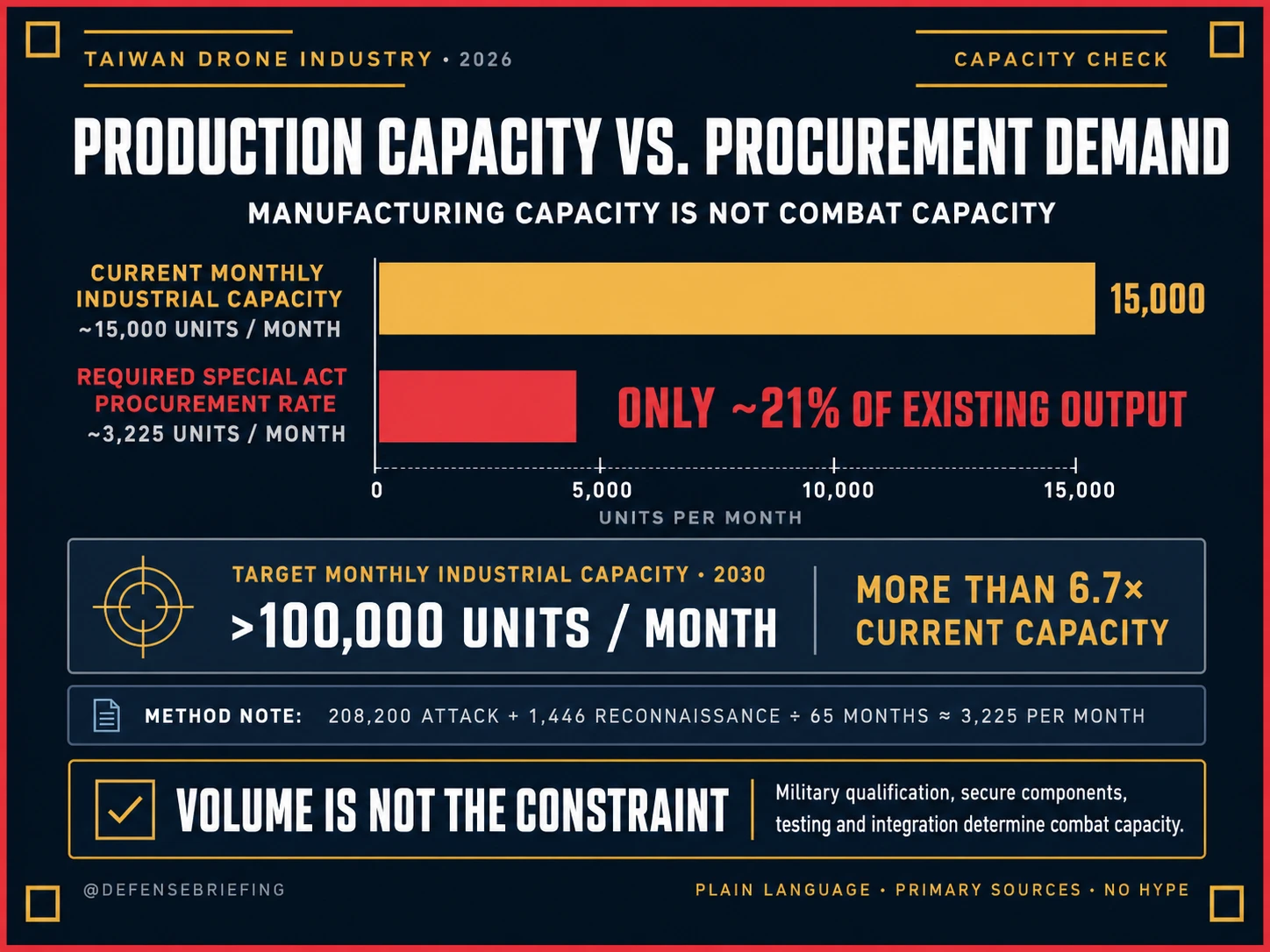
That does not mean Taiwan can fill the order tomorrow. The 15,000 figure measures broad industry capacity, not 15,000 military-qualified attack drones. The systems still must meet requirements for secure communications, navigation under electronic attack, payload integration, non-red component provenance, testing, military acceptance and operator training.
But it changes the bottleneck.
The problem is not whether Taiwan can physically manufacture 208,200 flying machines. It is whether Taiwan can convert enough of its manufacturing base into qualified military production and sustain it for years.
The money tells the same story.
Divide the NT$210 billion ceiling by 210,966 systems and the accounting average is roughly NT$995,000, or about US$31,500, per system.
That is not a drone unit price. The legislation covers different aerial and surface systems as well as the industrial, testing and support infrastructure required to field them.
The comparison with ALTIUS shows why that distinction matters. The 2024 U.S. notification carried a US$300 million ceiling for up to 291 ALTIUS 600M-V systems, an average of about US$1.03 million per authorized system-equivalent. But that package also includes launchers, ground control, training, spares and logistics, and its published value is an estimated ceiling rather than a final per-aircraft price.9
The two averages measure different things. Their order of magnitude still exposes the strategy.
Taiwan is not trying to buy 208,200 cheaper versions of ALTIUS.
It is trying to build a different category of force.
Track the contracts, budgets and capability gaps before they become headlines.
Subscribe FreeThe Fight Inside Taipei
Fourteen versions of uncrewed-systems legislation are now in play.
The Legislative Yuan's Economics, Foreign Affairs and National Defense and Finance committees held their second joint review on 27-JUL-2026. The legislature's official record lists all 14 proposals. Its published schedule now sets cross-party consultation for 12:15 p.m. on 20-AUG-2026.17
The disagreement is not simply drones versus no drones.
The Cabinet wants a dedicated multi-year special act. The Kuomintang (KMT) has proposed NT$240 billion over six years through annual budgets. The Taiwan People's Party (TPP) has proposed keeping procurement within normal annual appropriations without an overall statutory spending ceiling. Both opposition approaches preserve legislative review more frequently than the Cabinet's preferred special-budget mechanism.18
| Feature / Mechanism | Executive Yuan (Cabinet) | Kuomintang (KMT) | Taiwan People's Party (TPP) |
|---|---|---|---|
| Funding structure | Dedicated multi-year special act, outside the annual budget | Return to the annual budget, funded six years running | Return to the annual budget, no special act |
| Headline budget | NT$210 billion ceiling (approx. US$6.7 billion) | NT$240 billion (NT$40 billion per year × 6) | No ceiling in the bill — set “by fiscal conditions and actual need” |
| Timeframe | 65 months: 1 Aug 2026 – 31 Dec 2031 | 6 years of recurring annual allocations | Open-ended; 4-year blueprints reviewed every 2 years |
| Lead agency | Ministry of National Defense — a military procurement law | Ministry of Economic Affairs — an industrial development law | Ministry of Economic Affairs, plus a standing national drone industry strategy committee |
| Oversight level | Front-loaded allocation; limited statutory review language | Written report to the Legislature on any single procurement above NT$100 million within 30 days; annual performance reporting | Strict annual line-item approval; committee meets at least twice yearly with agendas and resolutions published |
| Industrial impact | Stable, long-horizon demand signal suppliers can build capacity against | Controls spending pace via annual caps; ties funding to proof of domestic production progress | Maximum legislative leverage over procurement performance; weakest forward demand signal for capital expenditure |
Status as of 19 August 2026: all articles were held in committee on 27 July after eight hours of debate and referred to cross-party negotiation, scheduled for 20 August. A separate NT$44.2 billion unmanned-vehicle industry package cleared on 14 August. Table: Defense Briefing, compiled from Legislative Yuan bill texts and Taiwanese reporting on the fourteen competing versions.
Defense Minister Wellington Koo has already shown what happens while that argument remains unresolved. On 03-AUG, he said uncrewed ground vehicles had already been moved into the FY2027 regular defense budget because the special act was stalled. Koo said that if the special act ultimately fails, the ministry would have no choice but to seek more of the funding through annual appropriations.19
The scope is already leaking from one funding vehicle into another.
The same fight has now appeared in the industrial budget. On 14-AUG, lawmakers approved the government's six-year NT$44.2 billion, or US$1.38 billion, Unmanned Vehicle Industry Development Program. The Ministry of Economic Affairs says about NT$8.3 billion is budgeted for 2026.20
The KMT and TPP attached a joint resolution asking the Cabinet to distribute the program evenly over six years and keep annual allocations from exceeding the average. NT$44.2 billion divided by six is approximately NT$7.37 billion per year, below the Ministry's stated NT$8.3 billion 2026 allocation. The resolution does not establish from the public record whether the 2026 amount must now be reduced or whether the smoothing requirement would be applied prospectively. But the underlying policy choice is already visible: the opposition is using annual limits to retain control over the pace of industrial spending.20, 21
That is the same argument now surrounding the NT$210 billion military act.
One approach gives the military and manufacturers a longer demand signal against which they can invest in tooling, workers and suppliers. The other gives lawmakers recurring leverage over procurement performance and spending.
There is also a political layer that requires a harder evidentiary line.
KMT Chairwoman Cheng Li-wun said in JUN-2026 that she did not expect a drone-related bill to pass before Chinese President Xi Jinping's planned visit to the United States in September. Linking expectations for Taiwanese defense legislation to the timing of a U.S.-China summit is politically significant. It is not proof that Beijing directed the position.22
A 17-AUG Taipei Times report made a more serious allegation. Citing one unnamed Beijing source, it said the Chinese Communist Party's United Front Work Department and Taiwan Affairs Office were pressuring Beijing-friendly Taiwanese politicians to block the Executive Yuan's act. The same source said PLA staff units had wargamed Taiwan's drone buildup and recommended efforts to slow it. The allegation is single-source and unverified. Legitimate disagreement over special budgets, annual appropriations and legislative oversight cannot be relabeled as Chinese direction without evidence.23
What is established is simpler. China has an obvious military incentive to slow Taiwan's drone buildup, and Taiwan's legislature is having a real democratic argument over who controls the money.
Both can be true.
Three Races, One Clock
The pieces converge on 20-AUG-2026.
Confirmed: The Legislative Yuan has scheduled cross-party negotiations over all 14 uncrewed-systems bills. Defense Briefing tracks the outcome on the Command Center policy and legislative board. Watch whether the talks preserve a dedicated multi-year procurement vehicle or push more spending into annual appropriations.17
Expected: The Executive Yuan is expected to approve the 2027 central government budget. Koo has already said UGV procurement has migrated into that budget because the special act remains stalled. The question is whether other capabilities follow.4, 19
Reported: The Cabinet is also expected, according to the unnamed government source cited on 16-AUG, to approve a supplementary 2026 budget of roughly NT$200 billion that includes defense spending. Watch how much of the remaining NT$260 billion from the original defense plan begins reappearing through that channel.4
The outcome is not binary. Taiwan can continue buying drones through annual budgets, supplementary appropriations, U.S. Foreign Military Sales and existing indigenous programs even if the Cabinet's special act does not survive intact.
What changes is the speed, certainty and industrial signal.
The Angle
Taiwan is trying to convert an electronics and manufacturing base into military-scale production while stripping Chinese components from supply chains that still reach deep into China. It is doing so while the PLA studies how to counter drone swarms and while Taiwan's own military adapts its defenses to new frequencies, fiber-optic control and autonomous systems.
The first 291 ALTIUS 600M-V systems show that imported capability can fill part of the gap. Chien Hsiang shows Taiwan already has an indigenous base to build from. A stated industrial capacity of 15,000 drones per month suggests raw manufacturing is not the impossible part.
The difficult step is turning factory throughput into weapons that are secure, integrated, crewed, accepted by the military and replaceable under fire.
"A drone wall on paper deters nothing."
China does not have to defeat every drone. It only needs enough gaps for an assault force to keep moving.
The number that matters is not 208,200. It is how rapidly Taiwan can convert funding into deployed, combat-ready scale.
The only metric China cares about is how fast Taiwan can field operational mass.
The special act's number is 210,966. The number funded through that act is currently zero. That may have changed by the time you read this.
Forward this to anyone curious about Taiwan's plans to deter or defeat a cross-strait invasion by Beijing.
Sources: Primary documents include Executive Yuan releases and the draft uncrewed-systems special act, Legislative Yuan committee records and scheduling, Taiwan Ministry of National Defense statements and military publications, the Ciaotou District Prosecutors' Office, the Ministry of Economic Affairs, the U.S. Defense Security Cooperation Agency and the Ministry of Defence of Ukraine. Secondary reporting from CNA/Focus Taiwan and the Taipei Times is identified where it is the sole source, including single-source claims that remain unverified. The numbered list below is authoritative. No classified information was used and all material is publicly accessible.