What Is HBTSS? The Pentagon's Hypersonic Missile Tracking System
- • The Missile Defense Agency started HBTSS in 2018 to close the tracking gap against maneuvering hypersonic and advanced ballistic missiles.
- • Two prototype satellites, one built by L3Harris and one by Northrop Grumman, launched to low Earth orbit on 14-FEB-2024 alongside four SDA Tranche 0 Tracking satellites.
- • HBTSS uses a more focused, sensitive sensor to turn broader missile-warning cues into fire-control-quality tracks.
- • It is designed to work inside the larger Overhead Persistent Infrared enterprise, including SDA's Proliferated Warfighter Space Architecture, not replace every other missile-warning satellite.
- • On 13-JUL-2026, SDA awarded L3Harris about $955 million for 18 HBTSS-like missile-defense satellites supporting Golden Dome.
Hypersonic weapons are a tracking problem before they are an interception problem. A traditional ballistic missile follows a predictable arc after launch. But a hypersonic glide vehicle can fly lower, maneuver laterally and even alter its course.
Ground radars also have a line-of-sight problem: Earth's curvature limits how early they can detect a low-flying threat. That leaves prescious little time to identify the object, decide whether it is dangerous and get an interceptor into the right piece of sky.1
HBTSS was built to solve that problem from orbit. The Missile Defense Agency (MDA) describes the requirement as providing fire-control-quality data. That distinction is central to understanding the program. Missile warning answers the first question: “Something launched. Where is it headed?” Fire control must answer a far harder one: “Where will this maneuvering target be when an interceptor reaches it, and how confident are we in that prediction?”2
Why Hypersonic Missiles Are Harder to Track
Speed is only part of the problem. Hypersonic weapons travel at Mach 5 or faster, but ballistic missiles can also reach hypersonic speeds. What makes a hypersonic glide vehicle especially difficult is the combination of speed, lower-altitude flight and maneuverability. It can spend much of its flight inside the atmosphere, below the clean line of sight enjoyed by a high-altitude ballistic trajectory, then turn in ways that break a defender's earlier prediction of where it is going.1
Infrared sensing also gets harder after the bright boost phase ends. The rocket plume that first gives away a launch is an easy object compared with a dimmer glide vehicle moving across the warm, cluttered background of Earth. The Government Accountability Office, or GAO, has identified high-clutter target detection as one of the areas where the Space Development Agency still carries meaningful technical risk in its proliferated missile-warning and tracking architecture.3
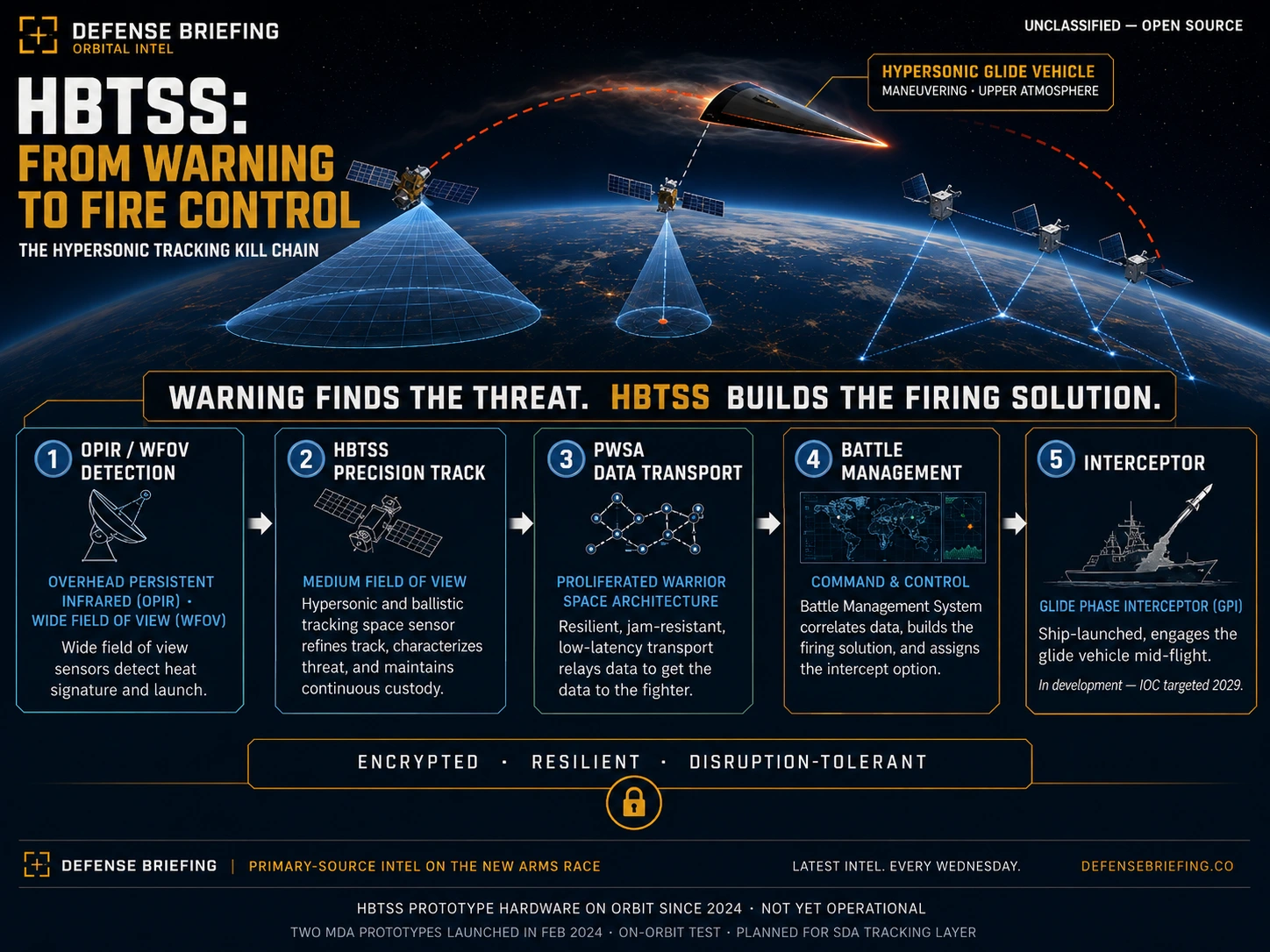
That is why the Pentagon does not rely on one sensor doing everything. The architecture is deliberately layered. One sensor can search a broad area. Another can narrow its attention and produce the tighter track. Communications satellites and ground systems move that track. A battle-management system turns it into an engagement. An interceptor then has to execute the shot.
How HBTSS Works
The public architecture can be understood as a five-step chain. The exact algorithms, thresholds and engagement logic are not public, but the division of labor is.
MDA calls the desired result "birth-to-death" tracking: maintain custody from launch through intercept rather than repeatedly losing and reacquiring the target. In its 2021 Phase IIb announcement, MDA said the prototypes were intended to demonstrate the sensitivity and fire-control quality needed for both the hypersonic kill chain and dim upper-stage ballistic missiles.2
The Difference Between Missile Warning and Fire Control
This distinction is where most short explainers become misleading. A satellite can be extremely useful for missile warning without being precise enough to guide a weapon. Warning systems are optimized to detect launches, characterize events and provide strategic notice. Fire control requires a tighter and faster track because the interceptor is solving a geometry problem against a target that may still be changing course.
SDA's original Tracking Layer concept paired wide-field-of-view sensors with HBTSS medium-field-of-view sensors. The wide-field sensors provide persistent coverage over a larger area. The HBTSS-type sensor looks at less sky at one time but with the sensitivity and track quality required for missile defense. SDA described the pairing in 2020 as broad persistent global coverage combined with HBTSS precision global access.4
The February 2024 launch was designed to test exactly this relationship. The two HBTSS prototypes went to orbit with four SDA Tranche 0 Tracking satellites so engineers could observe the same targets from the same orbital regime and compare how the wide-field and more focused sensors worked together.5
Want this kind of defense and space intelligence every Wednesday?
Get Orbital Intel FreeHow HBTSS Fits Into OPIR
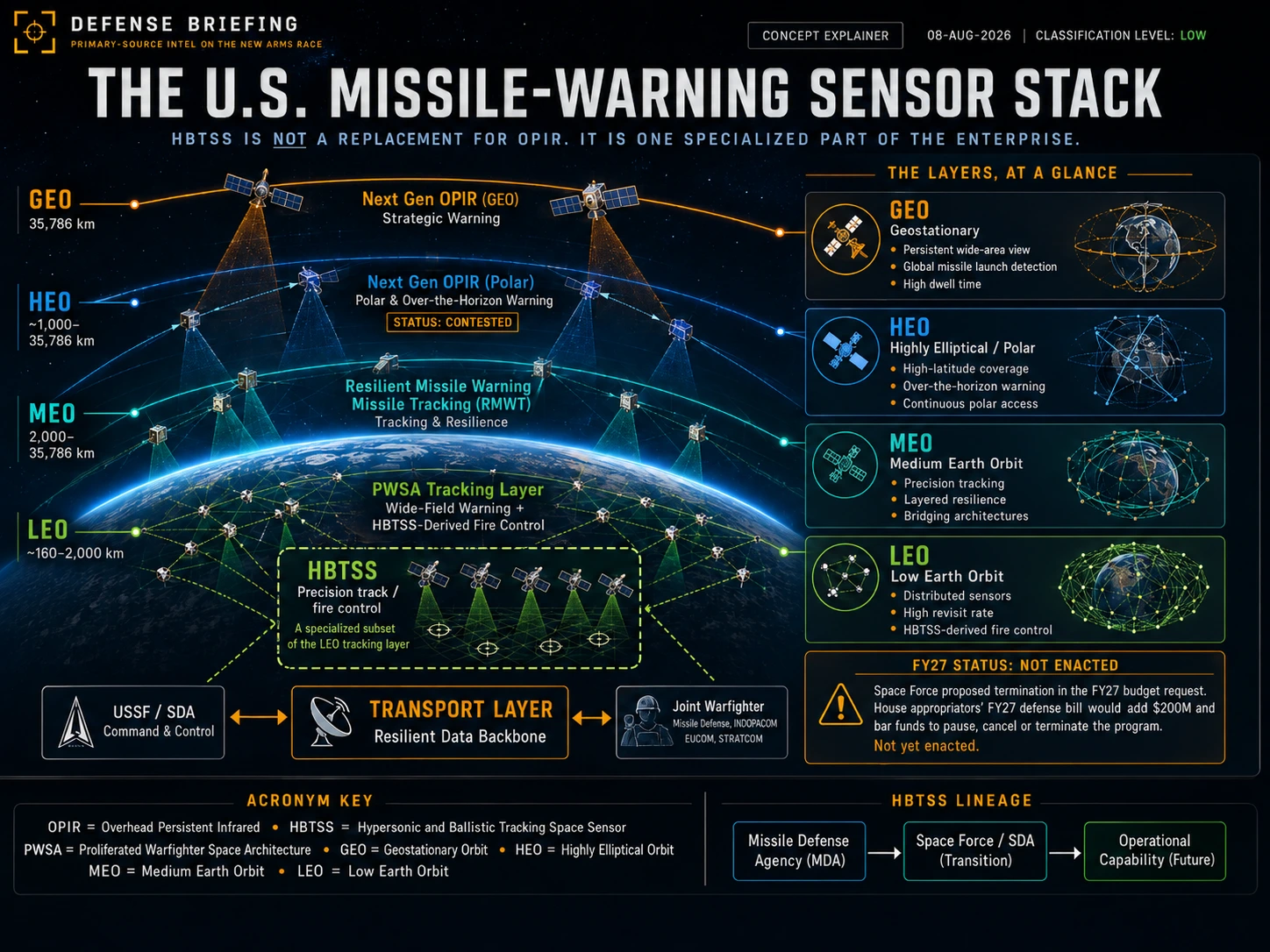
Overhead Persistent Infrared, or OPIR, is the larger missile-warning and tracking enterprise. HBTSS is one sensor type inside that enterprise, not a replacement for it. MDA explicitly designed HBTSS to operate as part of a unified OPIR solution and to receive help from other sensors. Northrop Grumman describes its prototype as providing near-global reach when cued by other OPIR systems, then handing a higher-precision track to battle management and fire-control systems.26
The broader OPIR architecture includes legacy and next-generation satellites in several orbital regimes. Historically, the United States has relied heavily on large geosynchronous and highly elliptical orbit satellites for strategic missile warning. The newer architecture adds proliferated low Earth orbit and medium Earth orbit constellations to increase coverage, revisit rate and resilience. HBTSS is the fire-control end of that evolution: it tries to turn the space-based warning network into a sensor network that can support an actual intercept.
How HBTSS Works With PWSA
The Proliferated Warfighter Space Architecture, or PWSA, is where the HBTSS concept becomes a network instead of a pair of demonstrations. SDA's Tracking Layer carries infrared sensors. Its Transport Layer provides the low-latency optical and radio-frequency mesh that moves data between satellites, ground stations and warfighters. Tracking satellites can process mission data onboard, communicate across the constellation through optical links and pass data into the larger missile-warning, missile-tracking and missile-defense enterprise.7
The architecture has evolved by tranche. Tranche 0 proved the basic wide-field tracking concept. Tranche 1 scales persistent missile warning and tracking. Tranche 2 adds a limited number of fire-control-quality missile-defense sensors. Tranche 3 expands that split between broad missile warning and more precise missile-defense sensing. The July 2026 Accelerated Missile Defense Tranche 3 award goes further by buying 18 HBTSS-like missile-defense satellites as a dedicated variant.8910
Where Next Gen OPIR and NGP Fit
Next Generation OPIR is the Space Force's modernization of the older strategic missile-warning architecture. Its original design combines geosynchronous satellites with polar coverage in highly elliptical orbit, supported by a new ground system. The Next Gen OPIR Polar element, commonly shortened to NGP, is a Northrop Grumman-led program for two satellites intended to watch the northern polar region, a difficult but strategically important missile approach.11
HBTSS and NGP solve different pieces of the problem. NGP is fundamentally a strategic missile-warning asset with persistent polar coverage. HBTSS is a lower-orbit fire-control sensor focused on maintaining a track precise enough for missile defense. They can contribute to the same OPIR enterprise without being interchangeable one-for-one.
The architecture is now in flux. The Space Force's fiscal 2027 budget proposes ending NGP because proliferated low Earth orbit and medium Earth orbit layers are projected to provide the necessary polar coverage. Congress has pushed back. The House Appropriations Committee's fiscal 2027 defense bill includes $200 million for Next Gen OPIR Polar and language barring the Department from using funds to pause, cancel or terminate either the GEO or Polar programs.12
As of 07-AUG-2026, that fight is unresolved. The Pentagon has proposed shifting more of the missile-warning burden toward proliferated LEO and MEO. House appropriators are trying to preserve NGP. The outcome matters to HBTSS because the sensor does not operate in isolation. The more the United States leans on proliferated constellations for warning, tracking and polar coverage, the more important the performance and integration of the LEO fire-control layer become.
Who Built HBTSS: Every Direct Award
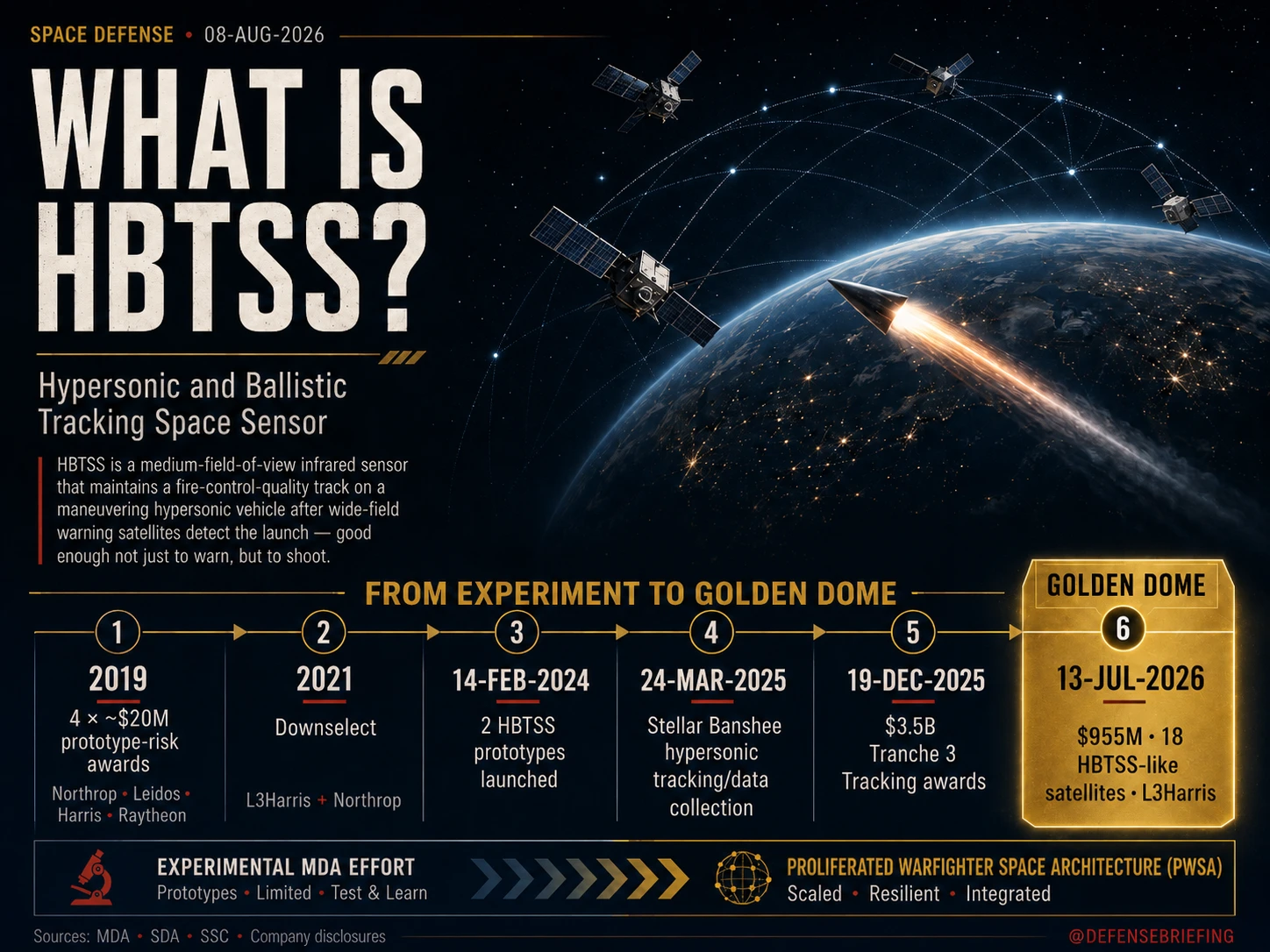
Four companies received the first HBTSS prototype awards in 2019. MDA received 12 proposals and selected Northrop Grumman, Leidos, Harris Corporation, now L3Harris, and Raytheon, now part of RTX, for approximately $20 million each to reduce payload and signal-processing risk.13
| Date | Company | Public value | What the award covered |
|---|---|---|---|
| 29-OCT-2019 | Northrop Grumman | $20.0M | Prototype payload design and signal-chain processing risk reduction. |
| 29-OCT-2019 | Leidos | $19.995M | Prototype payload design and signal-chain processing risk reduction. |
| 29-OCT-2019 | Harris Corp. / L3Harris | $19.995M | Prototype payload design and signal-chain processing risk reduction. |
| 29-OCT-2019 | Raytheon / RTX | $19.959M | Prototype payload design and signal-chain processing risk reduction. |
| JAN-2021 | L3Harris | MDA release did not state value | Phase IIb on-orbit prototype demonstration. One of only two planned Phase IIb awards. |
| 22-JAN-2021 | Northrop Grumman | $153M cited by Northrop | Phase IIb on-orbit prototype demonstration. One of only two planned Phase IIb awards. |
The 2021 downselect is important. Leidos and Raytheon participated in the earlier risk-reduction competition, but MDA selected only L3Harris and Northrop Grumman to build the two flight prototypes. Those are the two HBTSS satellites that launched in 2024.26
HBTSS-Derived Awards: Do Not Confuse Them With the Original Program
Once HBTSS moved from demonstration toward an operational architecture, the contracting labels changed. Many later SDA Tracking Layer awards are not literally HBTSS contracts, even when they use fire-control sensors that build on HBTSS technology. That distinction matters.
| Program | Companies | Public value | HBTSS relationship |
|---|---|---|---|
| Tranche 1 Tracking, 18-JUL-2022 | L3Harris, Northrop Grumman | ~$700M and ~$617M | 28 wide-field missile-warning and tracking satellites. They provide the broader tracking layer that pairs with the HBTSS fire-control concept. |
| Tranche 2 Tracking, 16-JAN-2024 | L3Harris, Lockheed Martin, Sierra Space | $919M, $890M, $740M | Each vendor provides 16 wide-field satellites plus 2 missile-defense infrared satellites capable of fire-control-quality tracks. SDA says the missile-defense sensors build on HBTSS investments. |
| Tranche 3 Tracking, 19-DEC-2025 | Lockheed Martin, Rocket Lab, Northrop Grumman, L3Harris | ~$3.5B total | 72 satellites split between missile-warning/tracking and missile-warning/tracking/defense variants. Half the constellation's payloads support advanced missile-defense missions. |
| Accelerated Missile Defense Tranche 3, 13-JUL-2026 | L3Harris | ~$955M | 18 HBTSS-like missile-defense satellites. This is the clearest direct operational descendant of the HBTSS prototype. |
| Accelerated Missile Defense Tranche 3, 13-JUL-2026 | Sierra Space | $798M | 18 companion missile-warning/missile-tracking satellites. Important to the same architecture, but SDA does not call these HBTSS-like. |
This is why simply asking "Who has an HBTSS contract?" no longer captures the industrial picture. The original HBTSS program had four risk-reduction competitors and two flight-prototype builders. The operational fire-control architecture now spreads across SDA tranches with L3Harris, Northrop Grumman, Lockheed Martin, Sierra Space and Rocket Lab all holding material missile-warning, tracking or defense work.891014
From Two Prototypes to an Operational Constellation
MDA launched HBTSS as a prototype program, not a finished global constellation. The two satellites reached low Earth orbit on 14-FEB-2024 aboard USSF-124 with four SDA Tracking Layer satellites. The government planned roughly two years of on-orbit testing to characterize performance and integration with the Missile Defense System and other mission areas.5
The next step was not to clone the two satellites indefinitely. SDA's spiral-development model absorbs useful technology into newer tranches. Tranche 2 introduced a small number of fire-control-quality sensors. Tranche 3 expands missile-defense sensing. Accelerated Missile Defense Tranche 3 then adds an entire 18-satellite HBTSS-like variant, expected to be available for launch by the end of 2028.810
That progression is the real HBTSS story. The program name may become less important as the capability moves into PWSA and the broader Space Force missile-warning, missile-tracking and missile-defense portfolio. The technology is moving from a pair of MDA experiments toward a proliferated operational layer.
How HBTSS Fits Into Golden Dome
The Golden Dome connection is explicit, not inferred. Executive Order 14186, issued on 27-JAN-2025 under the original name "The Iron Dome for America," directed the Department of Defense to produce a next-generation homeland missile-defense architecture that included accelerating deployment of the HBTSS layer. The same order separately called for proliferated space-based interceptors, a PWSA custody layer, terminal defenses and non-kinetic capabilities.15
HBTSS therefore sits on the sensor side of Golden Dome, not the interceptor side. A space-based interceptor, Glide Phase Interceptor, Standard Missile or future weapon still needs a sufficiently accurate track before it can attempt an engagement. Golden Dome can add more shooters, but if the sensor network cannot maintain custody of a maneuvering target and move that track through the battle network fast enough, the shooter does not have a useful solution.
SDA's 13-JUL-2026 award makes the policy connection concrete. The agency says its 36 Accelerated Missile Defense Tranche 3 satellites support Golden Dome. L3Harris will provide 18 HBTSS-like missile-defense satellites and Sierra Space will provide 18 missile-warning/missile-tracking satellites. The spacecraft are designed to interoperate with Tranches 1, 2 and 3 through a common ground system.10
Congress, Funding and the Shift Out of the Prototype Era
HBTSS funding is easiest to understand as a transition. Early budgets paid for a discrete MDA prototype. Newer budgets increasingly pay for the operational capability through broader Space Force and Golden Dome lines.
| Fiscal year / action | Public funding signal | What it means |
|---|---|---|
| FY2023 enacted | $89.2M for HBTSS | Congress funded continued development of the dedicated MDA tracking-sensor program.21 |
| FY2025 request | $76M HBTSS request cited by CRS | On-orbit demonstration and integration remained the program's focus.1 |
| FY2026 request | $57.2M HBTSS request | The standalone MDA line continued while the operational architecture shifted toward the Space Force.19 |
| FY2027 Golden Dome request | $17.528B mandatory request for Golden Dome capabilities; no public HBTSS breakout in the summary | The Department's budget overview explicitly lists acceleration of the HBTSS layer among the capabilities supported by the broader Golden Dome request.20 |
| 13-JUL-2026 SDA award | ~$955M to L3Harris for 18 HBTSS-like satellites | The capability is moving from a two-satellite demonstration into a proliferated missile-defense constellation. |
Congress has generally pushed for stronger space-based hypersonic tracking, but the oversight questions have not disappeared. CRS has repeatedly flagged whether command-and-control systems can process the data fast enough, whether the technology is mature enough for acceleration and whether MDA, SDA and Space Systems Command have clearly divided responsibility.1
GAO made the governance problem explicit in 2022, finding that MDA had not adequately coordinated HBTSS with SDA and the Space Force. The Department later implemented GAO's recommendation through a memorandum that put SDA in charge of developing and delivering low Earth orbit missile-warning, missile-tracking and missile-defense capabilities while MDA retained fire-control requirements, prototype demonstrations and ground systems that accept data from the space sensors.16
Primary sources. No hype. Built for readers who want the architecture, not the acronym soup.
Subscribe FreeWhat Has HBTSS Actually Demonstrated?
The public record supports several claims. The two prototypes successfully launched. MDA and SDA completed initial checkout. The satellites entered a planned on-orbit demonstration period. MDA also used the 24-MAR-2025 Stellar Banshee hypersonic flight test as a data-collection opportunity for HBTSS.517
Stellar Banshee is often summarized too aggressively. What MDA publicly said is that the USS Pinckney used Sea Based Terminal Increment 3 in the Aegis Weapon System to detect, track and perform a simulated engagement of an advanced maneuvering hypersonic target. MDA's public history separately notes that HBTSS collected data during the test.1718
MDA's public Stellar Banshee release does not say that HBTSS itself generated the Aegis engagement solution or guided a live interceptor into the target. L3Harris has publicly said its prototype demonstrated fire-control-quality tracking against a live hypersonic target, but the government release is less specific. Treat "HBTSS guided an intercept" as an overstatement unless MDA publishes that result directly.
That distinction matters because HBTSS is meant to support a real weapon engagement, not merely collect interesting infrared data. The program's value will ultimately be measured by end-to-end performance: acquire the target, maintain custody, generate an accurate track, move it through the network and give the shooter enough time and precision to act.
Risks and Unresolved Problems
1. The target is dim and the background is noisy
A hypersonic glide vehicle is harder to see after the bright launch plume fades. Tracking against Earth background clutter places heavy demands on infrared detectors, onboard processing and algorithms. GAO says SDA's missile-warning architecture still carries risk in areas including target detection in high-clutter environments.3
2. A good sensor is useless if the track arrives too late
HBTSS is one node in a larger kill chain. Optical links, radio-frequency downlinks, ground processing, battle management and the weapon all add latency. The technical success of the sensor does not automatically prove the entire chain can close within the available engagement window.
3. Wide-field to fire-control handoff has to work at scale
The architecture assumes broad sensors can cue more focused sensors without losing the target. Doing that with two demonstration spacecraft is different from doing it continuously across dozens of satellites, orbital planes and vendors. Interoperability is therefore not an administrative detail. It is part of the weapon system.
4. Program ownership has already shifted
MDA created the HBTSS prototype, but SDA and the Space Force are now responsible for proliferating low Earth orbit missile-warning, tracking and defense capabilities. That division is cleaner than it was when GAO criticized the program in 2022, but the transition still creates integration risk between requirements, satellites, ground systems and operational control.16
5. The surrounding OPIR architecture is still politically contested
The proposed cancellation of Next Gen OPIR Polar and Congress's attempt to preserve it show that the United States has not finished deciding how much mission responsibility should sit in a few large strategic-warning satellites versus proliferated LEO and MEO constellations. HBTSS performs a different mission from NGP, but the overall sensor architecture determines what cues are available, where coverage comes from and how much redundancy exists.
6. Golden Dome is accelerating before every question is closed
The January 2025 executive order explicitly calls for faster HBTSS deployment. The July 2026 award moves that direction into hardware. Acceleration can reduce the time to field capability, but it also compresses the period available to resolve integration, test and production problems before more satellites are committed.
The Bottom Line
HBTSS is the missing middle between seeing a missile and shooting at it. The United States already has satellites that can warn of launches. The harder task is keeping a sufficiently precise track on a maneuvering hypersonic threat after the bright boost phase, then moving that track into a weapon system fast enough to support an intercept.
The two HBTSS prototypes were built to prove that fire-control-quality sensing from low Earth orbit is possible. The important change since their 2024 launch is that the Pentagon is no longer treating the idea as a stand-alone science project. SDA is inserting fire-control sensors into successive PWSA tranches, L3Harris now holds a roughly $955 million award for 18 HBTSS-like satellites and Golden Dome policy explicitly calls for accelerating the layer.
The unresolved question is no longer whether HBTSS belongs in the architecture. It is whether the Pentagon can scale the sensor, network and command-and-control chain fast enough to turn persistent tracking into reliable weapons engagement against the threats HBTSS was created to follow.
What This Means for National Security
HBTSS matters because modern missile defense is increasingly constrained by the sensor-to-shooter chain rather than the interceptor alone. A faster or longer-range weapon provides limited value if the United States cannot maintain custody of a maneuvering threat and generate an accurate engagement-quality track. The move from two prototypes to proliferated fire-control sensors inside PWSA therefore expands the defensive battlespace, but it also makes space communications, sensor interoperability and orbital resilience part of the missile-defense weapon system.
What This Means for Capital
The spending is moving from a small MDA prototype line toward larger Space Force constellation awards. L3Harris has the clearest direct HBTSS lineage and the July 2026 $955 million HBTSS-like award, while Northrop Grumman, Lockheed Martin, Sierra Space and Rocket Lab hold major roles across the broader Tracking Layer. The architecture remains deliberately multi-vendor, which spreads opportunity but also exposes contractors to repeated tranche competitions, integration requirements and changing Pentagon decisions about which orbital layers receive future funding.